Carrot Market Co-CEO
15 Billion KRW in Shares and Bonuses to Employees
Owner Loses Out Compared to Stock Options
Employees Satisfied with Lower Tax Burden
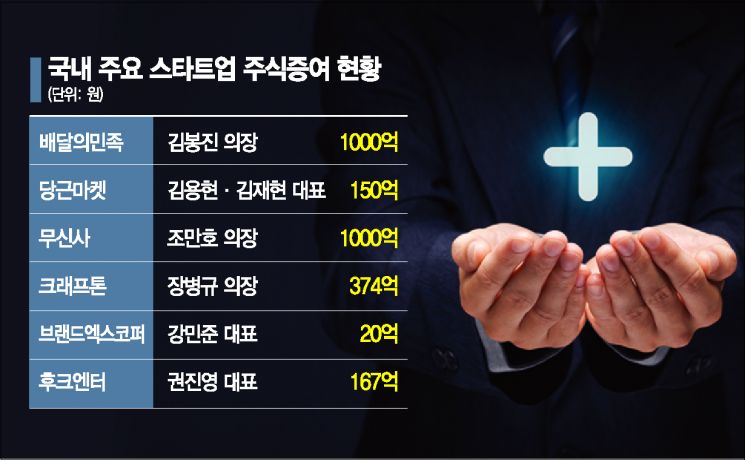
[Asia Economy Reporter Donghyun Choi] Startup founders (executives and owners) are increasingly gifting shares worth hundreds of billions to even thousands of billions of won to their employees free of charge. This method, favored recently by “generous owners,” not only signifies sharing the fruits of corporate growth but also aims to prevent talent outflow.
Kim Yong-hyun and Kim Jae-hyun, co-CEOs who founded the secondhand trading platform Danggeun Market, made headlines on the 9th by announcing they would provide shares and bonuses worth around 15 billion won to all employees. Regardless of rank or position, employees will receive shares worth an average of 50 million won proportional to their length of service.
While stock options have primarily been used as a way for startups to share performance with employees, stock gifting has recently become more common. Stock options grant employees the right to purchase company shares at a predetermined price. From the employee’s perspective, this allows buying shares at a price lower than the market value, making it widely used in the startup industry. For owners, it offers the advantage of using it as a performance bonus or salary negotiation tool without spending personal money.
Stock gifting, on the other hand, involves owners giving their personal shares, which is a financial loss for them but more advantageous for employees compared to stock options. Stock options often come with strict conditions such as employment duration or status to exercise the purchase rights. Additionally, employees must pay earned income tax on the difference between the market price and exercise price at the time of exercising (or other income tax upon retirement). Although stock gifting requires paying gift tax, considering the tax rate by taxable income brackets, the burden is relatively lighter. Especially, many stock gifts occur before an Initial Public Offering (IPO), which also helps reduce gift tax.
Owners choose stock gifting despite the financial loss to retain or secure talented personnel. Competition for IT industry talent is intensifying. In this context, such reward methods foster a sense of belonging among existing employees and enhance the company’s image externally.
Before the Danggeun Market case, in March, Jo Man-ho, chairman and founder of the fashion platform Musinsa, announced he would gift shares worth 100 billion won to employees free of charge. He included employees of Musinsa and its subsidiaries who joined by March 31 this year, including those from recently acquired StyleShare and 29CM, showing meticulous care to avoid excluding any employees from the gift. In the same month, Jang Byung-gyu, chairman of Krafton, also gifted shares worth 37.4 billion won to employees. Last year, Kim Bong-jin, chairman of Baedal Minjok (10 billion won), Kang Min-jun of Brand X Corporation (2 billion won), and Kwon Jin-young, CEO of Hook Entertainment (16.7 billion won), among others, announced they would gift shares they held to employees or employee stock ownership associations for similar reasons.
Employee satisfaction with stock gifting was higher compared to stock options. An employee of an online travel platform (OTA) who has held unlisted stock options for five years said, “I thought it would be very profitable once the company went public, but it was halted due to COVID-19, so I have long forgotten about holding stock options,” adding, “If I resign, I have to return all the stock options I received.” An employee at Baedal Minjok who received shares worth tens of millions of won said, “Stock options require a large sum of money when exercising rights, but stock gifting feels like receiving a cash-like bonus, so employees respond positively,” and added, “Stock options become worthless if the market price falls below the exercise price, but stock gifting is relatively free from such burdens.” Furthermore, from the perspective of existing shareholders, exercising stock options means dilution of shares, which negatively affects stock prices, but stock gifting does not have such an impact.
© The Asia Business Daily(www.asiae.co.kr). All rights reserved.
![Clutching a Stolen Dior Bag, Saying "I Hate Being Poor but Real"... The Grotesque Con of a "Human Knockoff" [Slate]](https://cwcontent.asiae.co.kr/asiaresize/183/2026021902243444107_1771435474.jpg)











