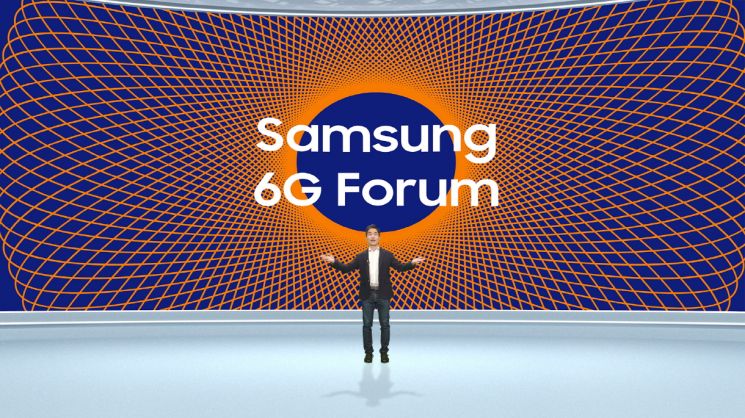
[Asia Economy Reporter Lim Hye-seon] Companies are vying to secure leadership in 6th generation (6G) mobile communication technology. On the 13th, Samsung Electronics held the first 'Samsung 6G Forum' to discuss future technologies with global experts in the 6G field, as well as academia and industry representatives.
Seung Hyun-joon, President of Samsung Research, said, "Although the commercialization of 5G networks is still ongoing, research and development (R&D) for 6G has already begun," adding, "6G will be a core technology that can integrate services across various fields, featuring ultra-broadband, ultra-low latency, ultra-intelligence, and ultra-spatial characteristics." He continued, "6G technology will provide people with an experience of 'hyper-connectivity' where everything is connected."
From 1G 'Brick Phones' to 4G High-Definition Video
Mobile communication began in 1980 with the 1st generation (1G). Mobile communication is wireless communication that allows communication regardless of location, even while in transit. It includes mobile phones and wireless data. The 1G mobile phone in 1988 was in the form of a vehicle-mounted 'car phone.' Car phones could make calls only within the vicinity of the vehicle but were useless outside that range.
As call quality issues persisted, digital mobile communication 2G was introduced to address them. 2G enabled data transmission such as text messages. According to SK Telecom, the speed was about 14.4 kbps, and call quality improved. Digital mobile phone services became popular thanks to 2G. Korea Mobile Telecom (SK Telecom) was the first in the world to commercialize CDMA-based 2G technology in January 1996. Not only messaging but also internet access became possible. In the same year, digital mobile phone service started under the name 'Digital 011.' The 3G mobile phone released in 2002 enabled video calls and e-commerce in earnest. The technology that opened the door to the mobile multimedia era was IMT-2000. IMT-2000 is a 3rd generation mobile communication (3G) technology, offering a data transmission speed of 2.4 Mbps. With the commercialization of IMT-2000, mobile internet shifted from text-based to graphic user interface (GUI)-based.
SKT was the first in the world to commercialize synchronous IMT-2000 in January 2000. It also launched internet multimedia services based on 3G. It introduced 'Nate' and released a mobile version of 'Cyworld' in 2004. The 3.5th generation mobile communication (3.5G) brought a change from voice-only phones to video phones, thanks to 'High-Speed Downlink Packet Access (HSDPA)' technology. Data transmission speed reached 14.4 Mbps, faster than previous generations. SKT started the world's first commercial HSDPA service based on mobile phones in May 2006.
With the advent of 4th generation mobile communication, LTE, in 2011, it became possible to watch videos on smartphones. LTE was theoretically more than five times faster than previous generation technologies, showing speeds up to 75 Mbps. After LTE commercialization, the most noticeably changed field was mobile entertainment. Entertainment content, which had evolved from internet to music streaming, advanced to high-definition video streaming in the LTE era.
From 5G Metaverse to Hyper-Connected 6G
Subsequently, South Korea succeeded in commercializing smartphone-based 5G mobile communication first in the world on April 3, 2019. In the 5G era, the quality and service of video calls improved. According to the International Telecommunication Union (ITU), 5G offers ultra-high speeds with a maximum transmission speed of 20 Gbps, 20 times faster than LTE. Transmission latency was reduced to 1 millisecond (1 ms), one-tenth of that of 4G. While previous generation video calls focused on 'high definition,' 5G emphasized high definition along with multi-access and multimedia sharing. 5G also enabled metaverse and cloud gaming.
6G, expected to be commercialized around 2030, is anticipated to be up to 50 times faster than current 5G with data transmission speeds of up to 1 Tbps (1 terabit per second), making it an infrastructure technology enabling autonomous vehicles, virtual reality (VR), and more. A movie file (2GB) can be downloaded in 0.016 seconds. Experts also foresee advancements in the remote work era. 6G technology will enable high-quality communication in remote areas, enhancing work efficiency for telecommuting and remote work.
© The Asia Business Daily(www.asiae.co.kr). All rights reserved.

















