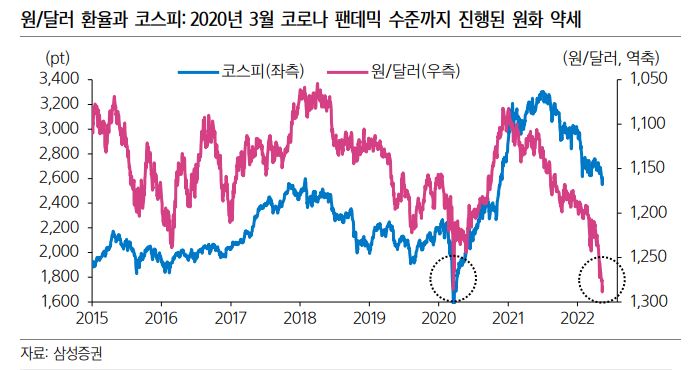
[Asia Economy Reporter Ji Yeon-jin] Foreign investors have continued a seven-week streak of net selling in the KOSPI market. Amid the Federal Reserve's (Fed) big step of raising the benchmark interest rate by 50 basis points, concerns about stagflation?where inflation and economic recession occur simultaneously?have emerged, leading to a continued 'Sell Korea' trend. However, since the strong dollar that fueled foreign selling has reached its peak, there is also speculation about a possible reversal in the future.
According to the Korea Exchange on the 15th, foreign investors net sold stocks worth approximately 1.019 trillion KRW in the KOSPI market from the 9th to the 13th. On the other hand, foreign investors net purchased stocks worth about 137.7 billion KRW in the KOSDAQ market during the same period, resulting in a net foreign selling amount of 881.3 billion KRW in the domestic stock market.
During the same period, foreign investors sold the most Samsung Electronics shares, net selling about 419.8 billion KRW, followed by LG Household & Health Care (-151.5 billion KRW), Samsung Electronics Preferred (-117.9 billion KRW), Samsung SDI (-100.7 billion KRW), and Kakao (-60.9 billion KRW).
Conversely, they net purchased Kia (129.5 billion KRW) the most, followed by SK Telecom (84.1 billion KRW), S-Oil (81.7 billion KRW), Woori Financial Group (47.8 billion KRW), and Kangwon Land (46.6 billion KRW).
Foreign investors have been net sellers in the KOSPI market for seven consecutive weeks from the last week of March through last week. During this period, the total net selling amount by foreign investors in KOSPI reached 7.1012 trillion KRW.
Shin Seung-jin, a researcher at Samsung Securities, said, "The continued selling by foreign investors is largely due to the U.S. interest rate hikes and the prolonged lockdown in China, which have led to a reduction in emerging market portfolios." He added, "Since the Korean won has weakened to about 1,285 KRW, which was the peak during the COVID-19 pandemic, from the perspective of foreign investors, the Korean stock market may now be perceived as undervalued."
© The Asia Business Daily(www.asiae.co.kr). All rights reserved.
!["I'd Rather Live as a Glamorous Fake Than as a Poor Real Me"...A Grotesque Success Story Shaking the Korean Psyche [Slate]](https://cwcontent.asiae.co.kr/asiaresize/183/2026021902243444107_1771435474.jpg)
















