Report to the Plenary Session Voting Within 72 Hours → 48 Hours
If No Vote, Deemed Approved According to Regulations
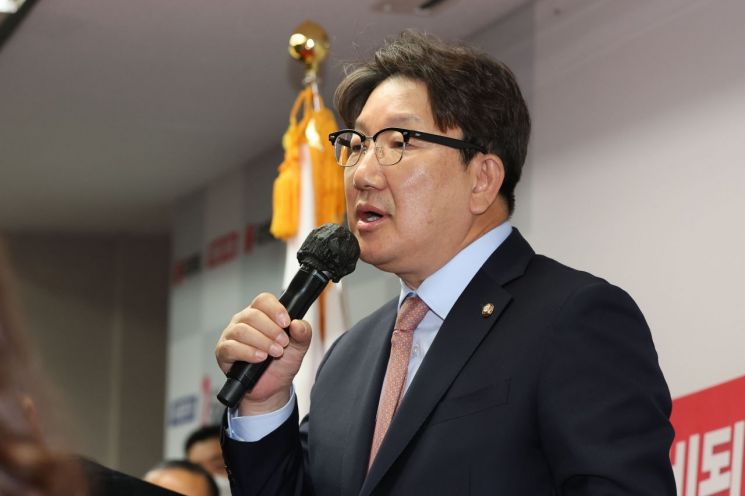
[Asia Economy Reporter Park Jun-yi] Kwon Seong-dong, floor leader of the People Power Party, stated that "there are many criticisms that Lee Jae-myung, the Democratic Party's general election campaign committee chairman, is running for the Incheon Gyeyang-eul district to take advantage of the parliamentary immunity from arrest," and announced plans to propose an amendment to the National Assembly Act to restrict this privilege.
On the 15th, Kwon said on Facebook, "Chairman Lee must respond to these public criticisms. If he truly feels wronged, he should actively support our proposed amendment."
He pointed out, "There is significant public distrust regarding the parliamentary immunity from arrest. Whenever a motion for consent to arrest a member of the National Assembly has been requested in the past, criticism of a 'bulletproof parliament' has followed."
According to Article 26 of the current National Assembly Act, a motion for consent to arrest a member of the National Assembly must be reported at the first plenary session and voted on within 72 hours after 24 hours have passed. However, if the vote is not held within 72 hours, the motion is to be submitted and voted on at the next plenary session. Kwon claims that this allows delaying the arrest by not scheduling the plenary session.
He stated, "We will relax the requirement to 'vote within 48 hours after 24 hours' from the time the motion is reported to the plenary session and consider the motion 'approved if not voted on' to fundamentally block the 'bulletproof parliament' tactics." He also added, "We will change from anonymous voting to roll-call voting."
© The Asia Business Daily(www.asiae.co.kr). All rights reserved.

















