Survey of 930 Member Companies by Chamber of Commerce
69% of Companies Say "Difficult to Understand Laws, Hard to Respond"
Significant Differences in Dedicated Staff by Company Size
87% of Large Companies vs. 36% of Medium-Sized Companies
Need for New Exemption Rules and Imposition of Worker Safety Obligations
[Asia Economy Reporter Jeong Dong-hoon] More than 100 days have passed since the Serious Accident Punishment Act came into effect, but only about 3 out of 10 companies are able to understand and respond to the related law.
According to a survey conducted by the Korea Chamber of Commerce and Industry (KCCI) on 930 companies with five or more employees that participated in the Serious Accident Punishment Act briefing sessions, 30.7% of companies responded that they understand the contents of the Serious Accident Punishment Act and are able to respond accordingly. On the other hand, 68.7% of companies do not understand the law, indicating difficulties in responding to the Serious Accident Punishment Act.
Regarding this, a KCCI official said, "Most companies attending the Serious Accident Punishment Act briefing sessions have listened to explanations multiple times and reviewed various materials to understand the law, but they still feel at a loss because they do not know what and to what extent they must comply with the law."
Only 21% of Companies Have Taken Response Measures... 64% 'Reviewing Measures'
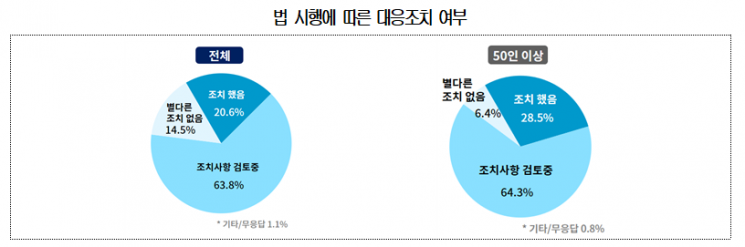
When asked about whether they have taken measures to respond to the Serious Accident Punishment Act, 63.8% of responding companies answered that they are still 'reviewing measures.' Companies that have taken 'no particular measures' accounted for 14.5%. In contrast, only 20.6% of companies responded that they have taken measures. Even among companies with 50 or more employees, to which the Serious Accident Punishment Act applies, only 28.5% responded that they have taken measures.
Among the companies that responded they have taken measures, the most common specific action was 'strengthening safety culture' at 81.0%. This was followed by 'management's declaration of safety management' (55.5%), 'expansion of protective equipment' (53.5%), and 'consulting by specialized institutions' (43.3%).
Meanwhile, 80.2% of companies answered that the enforcement of the Serious Accident Punishment Act is a management burden, while only 18.6% said it is not a burden.
Regarding this, a representative of a small business who attended the briefing said, "Including our factory, there has been no serious accident resulting in employee death at nearby workplaces, so we have not yet taken response measures. Since the new government is expected to release guidelines or manuals clarifying the safety and health obligations of management, we plan to establish a safety and health system based on those."
Large Gap in Safety Capabilities by Company Size... Dedicated Personnel and Departments
A survey on the status of safety and health management systems by company size revealed a significant gap between large and small businesses. Among all responding companies, 31.6% have dedicated personnel for safety and health tasks. By size, 86.7% of large companies (300 or more employees) have dedicated personnel, whereas medium-sized companies (50?299 employees) and small companies (5?49 employees) have only 35.8% and 14.4%, respectively.
Regarding the establishment of dedicated departments, 88.6% of large companies have organized such departments, while 54.6% of medium-sized companies and only 26.0% of small companies have done so.
In terms of safety and health budgets, 61.0% of large companies allocated '100 million KRW or more.' In contrast, medium-sized companies concentrated in the '10 million KRW or less' (27.7%) and '10 million to 30 million KRW' (21.8%) ranges, while small companies mostly allocated '10 million KRW or less' (47.8%).
A KCCI official expressed concern, saying, "From 2024, the law will apply to small companies with 5 to 49 employees, which number about 783,000 companies?18 times the size of companies with 50 or more employees (about 43,000) to which the law currently applies. Without special measures for medium and small companies with weaker safety and health management capabilities, the side effects of the law will be much more serious than expected."
Regarding provisions of the Serious Accident Punishment Act that urgently need supplementation, companies most frequently cited 'establishment of exemption provisions for serious accidents without intentional or gross negligence' (71.3%). This was followed by 'imposition of legal compliance obligations on workers' (44.5%), 'specification of safety and health obligations' (37.1%), and 'clarification of the scope of primary contractor responsibility' (34.9%).
Additionally, for government policy tasks, companies identified 'distribution of industry-specific safety manuals' (64.5%), 'clear compliance guidelines' (50.1%), and 'training of safety personnel' (50.0%) as core policies. Other priorities included 'consulting support' (39.0%) and 'financial and tax support for safety investments' (38.8%).
Yoo Il-ho, head of the Employment and Labor Policy Team at KCCI, emphasized, "The biggest problem is that the law is unclear, so companies do not know what and to what extent they must do. Although some uncertainty will be reduced during investigations and trials, it will take considerable time. Therefore, it is urgent to amend the law to present clear obligations for practical serious accident prevention and to exempt management responsible persons who fulfill these obligations."
© The Asia Business Daily(www.asiae.co.kr). All rights reserved.

















