Diesel Subsidy Payment Method Likely to Change
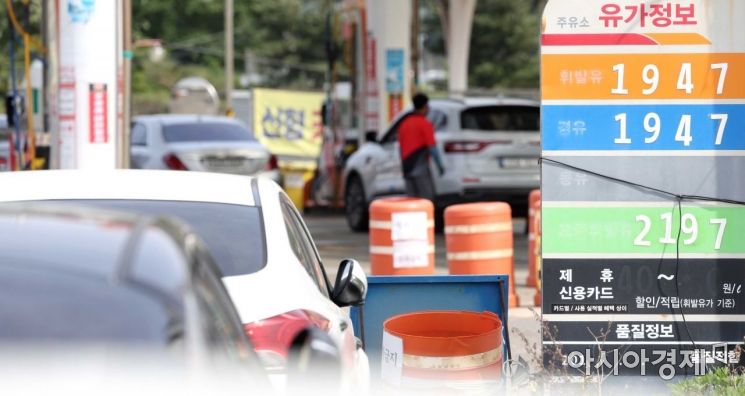 On the 11th, when the national average diesel price surpassed the gasoline price, fuel price information was displayed at a gas station in Seoul. Photo by Mun Ho-nam munonam@
[Asia Economy Reporter Moon Chaeseok] Although the government expanded the fuel tax reduction rate from 20% to 30%, both diesel and gasoline prices have turned upward due to rising international oil prices. In particular, diesel is soaring toward 2,000 KRW per liter, setting a new record high. As diesel prices have surpassed gasoline prices, the government is reportedly considering expanding fuel subsidies for freight truck and taxi operators who use diesel.
According to the Korea National Oil Corporation's oil price information service Opinet, as of 2 a.m. on the 15th, the average nationwide diesel price at gas stations reached a new high of 1,964.79 KRW per liter. The previous record was 1,947.75 KRW on July 16, 2008. At the same time, the average nationwide gasoline price was 1,955.38 KRW per liter. Diesel prices have been exceeding gasoline prices since June 2008, after surpassing gasoline at 1,947.6 KRW per liter on the 11th, compared to gasoline at 1,946.1 KRW per liter.
In this situation, the government is reportedly considering announcing measures to ease the burden of diesel costs for transportation operators such as freight trucks as part of its response to the livelihood economy, possibly later this week. It is expected to propose reforms to the temporary diesel fuel price fluctuation subsidy system, which is scheduled to operate until July. Currently, transportation operators such as freight trucks, buses, taxis, and coastal cargo ships receive fuel tax-linked subsidies that cover part or all of the fuel tax increase resulting from the 2001 energy tax reform.
As the government reduced the fuel tax, subsidies were also cut. If the fuel tax is reduced by 30%, subsidies decrease by 159 KRW per liter. Currently, the diesel fuel price-linked subsidy system covers 50% of the excess amount over the base price when diesel prices rise to 1,850 KRW per liter. For example, if the diesel price is 1,950 KRW, the government provides 50 KRW per liter. Freight truck operators demand subsidies be provided at the level before the fuel tax reduction or when it was reduced by 20%. To address this, proposals such as lowering the subsidy payment base price of 1,850 KRW per liter or increasing the support rate from 50% are being discussed.
Given the global diesel shortage situation in Europe and elsewhere, and supply difficulties of petroleum products due to Russia's invasion of Ukraine, the prevailing outlook is that diesel prices will inevitably continue to rise for the time being. For this reason, domestic diesel prices are expected to continue their upward trend until next week. The Korea National Oil Corporation analyzed, "International oil prices showed a downward trend this week due to uncertainties over the European Union's agreement on the ban of Russian oil and the Organization of the Petroleum Exporting Countries (OPEC)'s downward revision of the global oil demand forecast for this year."
© The Asia Business Daily(www.asiae.co.kr). All rights reserved.
![Clutching a Stolen Dior Bag, Saying "I Hate Being Poor but Real"... The Grotesque Con of a "Human Knockoff" [Slate]](https://cwcontent.asiae.co.kr/asiaresize/183/2026021902243444107_1771435474.jpg)











