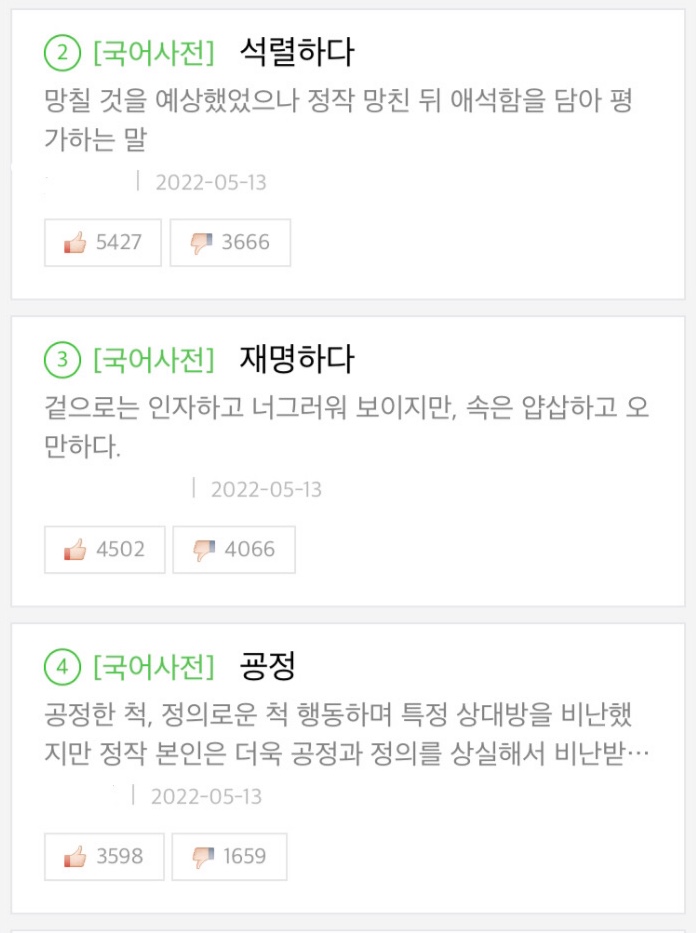
 On the 14th, expressions named after President Yoon Seok-yeol and Lee Jae-myung, the Standing Adviser of the Democratic Party of Korea, ranked among the popular entries in the Naver Dictionary.
 [Photo by Naver Open Dictionary capture]
[Asia Economy Reporter Hwang Sumi] Expressions named after President Yoon Seok-yeol and Lee Jae-myung, the Standing Adviser of the Democratic Party of Korea, have appeared in the popular rankings on Naver Dictionary.
According to the popular rankings on Naver Open Dictionary on the 14th, the words "Seokryeolhada" and "Jaemyeonghada," which several netizens requested to be registered the previous day, ranked 2nd and 3rd respectively as of 4:30 PM that day.
Naver Open Dictionary is a service where users can directly register new words, slang, technical terms, dialects, and meanings that are not in the dictionary. Words and definitions requested for registration may be exposed in the dictionary service.
A netizen who registered "Seokryeolhada" explained the meaning of the word as "a term used to evaluate with regret after expecting something to be ruined but it actually gets ruined." The meaning of "Jaemyeonghada" is described as "appearing kind and generous on the outside but actually sly and arrogant inside."
This seems to have been posted by supporters of the ruling and opposition parties with the intention of criticizing the opposing party's figures. In addition, the Open Dictionary includes words such as "Gongjeong (acting fair and righteous while criticizing a specific opponent, but actually losing fairness and righteousness oneself and being criticized for it)," "M-beonbang (a nickname given to the Democratic camp party where sexual violence frequently occurs, derived from N-beonbang)," and "Gyeyangachi (an abbreviation of 'pushing a child in Gyeyang')."
However, the possibility of these words being exposed in the dictionary seems low. According to Naver Open Dictionary policy, new word registrations must be written in an objective descriptive manner based on facts, using expressions that other users can understand.
Also, if a word or meaning defames or slanders a specific individual or group, or corresponds to personal opinions or claims, it will not be exposed in the Open Dictionary service.
© The Asia Business Daily(www.asiae.co.kr). All rights reserved.
![Clutching a Stolen Dior Bag, Saying "I Hate Being Poor but Real"... The Grotesque Con of a "Human Knockoff" [Slate]](https://cwcontent.asiae.co.kr/asiaresize/183/2026021902243444107_1771435474.jpg)
















