[Asia Economy Reporter Chunhee Lee] Recently, there has been an increase in cases where people complain of shoulder pain despite not having any specific injury. According to statistics from the Health Insurance Review and Assessment Service, the number of patients with shoulder disorders has steadily surged from 1.6 million in 2010 to over 2.5 million in 2021.
In particular, if you experience shoulder pain without any obvious cause, you should consider the possibility of 'Osipgyeon' (Frozen Shoulder). The name 'Osipgyeon' comes from its common onset in people in their 50s, and its precise medical terms are 'adhesive capsulitis' or 'frozen shoulder.' Often, the exact cause is unknown, and symptoms may worsen after minor trauma. In 2020, patients in their 50s accounted for 31.7% of all cases, indicating that it mainly affects middle-aged individuals aged 50 and above; however, the number of Osipgyeon patients among younger people has also been steadily increasing recently.
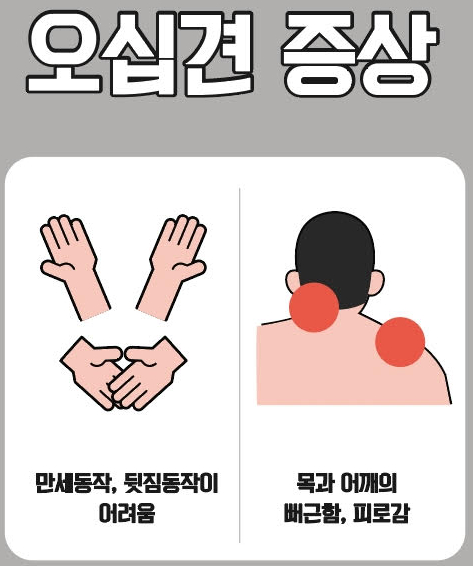
Choi Kyungwon, an orthopedic specialist at Mokdong Himchan Hospital, explained, “If you cannot raise both arms in a 'manse' (hands raised in celebration) gesture or find it difficult to place your hands behind your back, Osipgyeon should be suspected,” adding, “Discomfort when extending the arm outward or lifting it upward is characteristic of Osipgyeon.” Most cases of Osipgyeon occur due to inflammation in the joint capsule, which is the 'bursa' of the shoulder joint, caused by other factors, leading to contracture of the joint capsule. When the joint capsule becomes congested or inflamed, it contracts and causes pain. It usually starts with stiffness or fatigue in the neck and shoulder, and as it worsens, severe pain is felt when raising or lowering the arm.
Moreover, unlike other joints where muscles strengthen the joint through exercise, the shoulder joint is delicate and can be damaged or torn if muscles become too bulky. In fact, overexertion or incorrect exercise methods aimed at strengthening shoulder muscles can cause problems. Common exercises seen in parks, such as shoulder-rotating equipment or clapping hands back and forth, do not make the shoulder more flexible but rather forcefully twist it, potentially damaging the shoulder tendons. Household chores like washing dishes or cleaning, if repeated multiple times, can negatively affect the shoulder, and especially reaching for objects from high places or stretching the arm far can be harmful to the shoulder.
Osipgyeon without a specific cause often heals naturally but requires a considerable period of at least six months and sometimes as long as two to three years. In the first stage of Osipgyeon, the inflammatory phase, moving the shoulder increases pain; in the second stage, the freezing progression phase, pain can become severe enough to disrupt sleep. The third stage, the frozen phase, characterized by increased shoulder stiffness and rigidity, progresses over approximately 15 months, and in the final fourth stage, the thawing phase, pain subsides but joint movement remains limited.
If treatment begins in the early first and second stages, most joint movement functions can be restored, but treatment becomes difficult and less effective in the third stage when fibrosis of the joint capsule has progressed. Therefore, it is recommended to receive treatment at an early stage rather than enduring prolonged pain without treatment.
Treatment for Osipgyeon starts with non-surgical methods and gradually intensifies. During the initial inflammatory and freezing progression phases, conservative physical therapies such as medication to reduce inflammation, anti-inflammatory injections, warm compresses, and electrical stimulation are used. In severe cases, injections into the joint are administered to expand the joint capsule, or joint mobilization under anesthesia is performed to manually move the shoulder and release adhesions, restoring the range of motion. If recovery is difficult with these conservative treatments, arthroscopic surgery can be performed to separate the adhered joint membrane, widen the narrowed joint capsule, and achieve full restoration of joint movement.
© The Asia Business Daily(www.asiae.co.kr). All rights reserved.

















