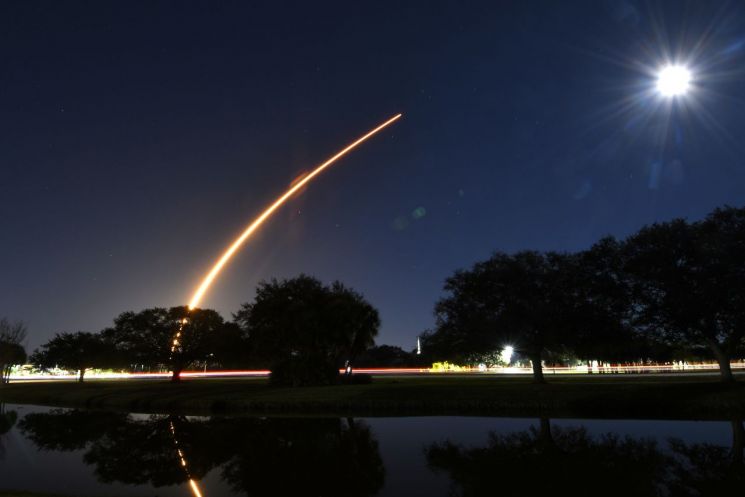
 In January, SpaceX's Falcon 9 rocket carrying Starlink satellites was launched from Kennedy Space Center in Florida, USA. [Image source=Yonhap News]
[Asia Economy Reporter Lee Chun-hee] SpaceX, the American space exploration company led by Elon Musk, CEO of Tesla, continues its space exploration by achieving its 19th successful space launch this year on the 13th (local time) and proceeding with the 20th launch in less than a day.
On the same day at 3:07 PM (Pacific Time, 7:07 AM KST on the 14th), SpaceX launched a Falcon 9 rocket carrying 53 Starlink satellites for internet service from Vandenberg Air Force Base in California, USA. The first stage booster of this rocket was recycled for the fifth time. As with previous launches, a drone ship waiting in the Pacific Ocean recovered it for reuse in the next launch.
Following this, SpaceX plans to launch another Falcon 9 rocket carrying Starlink satellites from Kennedy Space Center in Florida, USA, at 4:33 PM Eastern Time on the 14th (5:33 AM KST on the 15th), just 22 hours later. The first stage booster used in this rocket is a new product joining the rocket fleet for the second time this year. This is the first time a new first stage booster has been used for a Starlink launch.
Including the launch on the 14th, SpaceX’s Falcon 9 rocket launches for deploying Starlink satellites will have been conducted 46 times. Approximately 2,600 Starlink satellites have been launched into low Earth orbit, with about 2,200 of them currently operational. However, this is still only about half of SpaceX’s goal for the first-generation satellite network. SpaceX plans to increase this number up to 42,000 satellites.
If SpaceX’s current launch trend continues, it is expected to easily achieve the target of 52 launches set for this year and possibly exceed it. This would surpass last year’s 31 launches by a wide margin, averaging more than one launch per week.
© The Asia Business Daily(www.asiae.co.kr). All rights reserved.

















