[Asia Economy Reporter Song Hwajeong] Household loans showed an increase last month for the first time this year, but the weakened demand is expected to not ease easily.
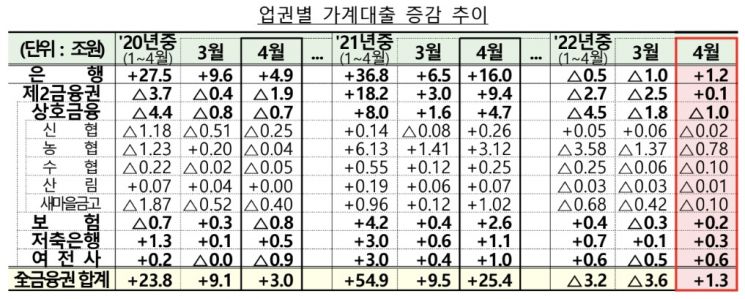
According to the Financial Services Commission's 'Household Loan Trends in April 2022' on the 14th, household loans across all financial sectors increased by 1.3 trillion KRW last month. This marks a return to an upward trend after five months.
While mortgage loans slightly increased, the overall household loan balance rose as the decrease in other loans significantly narrowed compared to the previous month. Last month, mortgage loans across all financial sectors increased by 2.8 trillion KRW, slightly less than the 3 trillion KRW increase in the previous month. Other loans decreased by 1.6 trillion KRW, a sharp reduction in the decline compared to 6.5 trillion KRW in the previous month.
By sector, household loans increased compared to the previous month in most sectors, but in the mutual finance sector, the decline continued due to a decrease in non-mortgage loans. Last month, bank sector household loans increased by 1.2 trillion KRW. Mortgage loans increased by 2.1 trillion KRW, centered on group loans (1.1 trillion KRW) and jeonse loans (1.1 trillion KRW). Other loans decreased by 900 billion KRW, mainly credit loans (500 billion KRW), narrowing the decline compared to 3.1 trillion KRW in the previous month.
Household loans in the secondary financial sector increased by 100 billion KRW. Insurance (200 billion KRW), savings banks (300 billion KRW), and credit card companies (600 billion KRW) saw increases in household loans compared to the previous month, but the mutual finance sector decreased by 1 trillion KRW.
Although household loans have returned to an increasing trend, demand appears to remain subdued. Kim Doha, a researcher at Hanwha Investment & Securities, said, "Household loan demand is still interpreted as being in a slowed state," adding, "Excluding loans presumed to have shifted from the secondary financial sector due to the expansion of mid-credit loan supply in the banking sector, household loans have been decreasing since the beginning of the year." Kim added, "The key to demand recovery seems to depend on whether the real estate market transaction volume recovers, but at the current interest rate level, it will not be easy."
© The Asia Business Daily(www.asiae.co.kr). All rights reserved.

















