Russia to Implement 'Special Economic Measures' Against Unfriendly Countries from the 3rd
South Korea Excluded from 31 Companies Subject to Export Bans and Sanctions
Price Increase Inevitable Due to Gas Supply Competition in Europe
Ministry of Trade, Industry and Energy: "Mobilizing Overseas Networks to Stabilize Supply Chains"
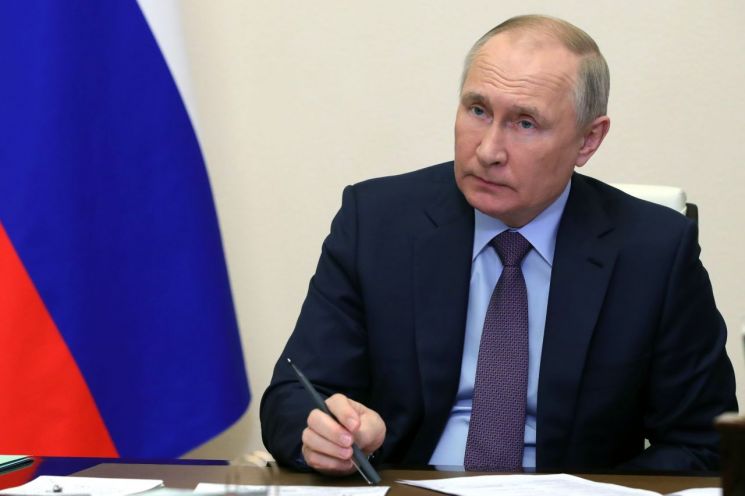 Putin Presiding Over Video Conference to Review Oil and Gas Situation
(Moscow AP/Sputnik=Yonhap News) Russian President Vladimir Putin is presiding over a video conference reviewing the situation in the oil and gas sector at the Novo-Ogaryovo residence on the outskirts of Moscow on the 14th of last month (local time), amid the ongoing war of invasion in Ukraine. 2022.4.15
sungok@yna.co.kr
(End)
<Copyright(c) Yonhap News Agency, Unauthorized reproduction and redistribution prohibited>
[Asia Economy Sejong=Reporter Lee Jun-hyung] Amid Russia’s implementation of ‘special economic measures’ targeting unfriendly countries including South Korea, it has been confirmed that domestic companies are excluded from the sanctions list. However, the government expressed concerns over the rise in natural gas prices due to export sanctions on Russia.
On the 12th, the Ministry of Trade, Industry and Energy announced that it had obtained and analyzed the detailed contents and sanctions list of the special economic measures announced by Russia. Earlier, starting from the 3rd of this month, Russia applied retaliatory special economic measures against unfriendly countries including South Korea. The core of these measures is to prohibit transactions with unfriendly countries and ban the export of Russian products and raw materials.
The key point of the sanctions lies in the control of Russian natural gas exports. This is why Russia included 31 gas-related companies from the US, UK, Germany, and others in the sanctions list. Domestic companies such as Korea Gas Corporation were excluded from the sanctions. It was also confirmed that there are no transactions between the 31 sanctioned companies and Korea Gas Corporation. Accordingly, the Ministry of Trade, Industry and Energy expects the direct impact of these measures on South Korea to be limited.
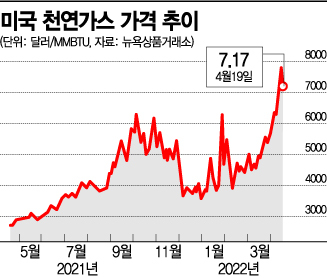
However, the ministry is concerned about the rise in natural gas prices. Although South Korea’s dependence on Russian natural gas was only about 6% as of last year, international prices are bound to rise if competition for gas procurement intensifies, especially in Europe.
Rare gases used in semiconductors, which have a high dependence on Russia, are also an issue. South Korea relies heavily on Russia for a significant portion of rare gases such as neon, krypton, and xenon, which are essential for semiconductor photolithography and etching processes. In fact, 31.3% of xenon and 17% of krypton imported by South Korea last year were Russian. A Ministry of Trade, Industry and Energy official stated, “We are responding by stockpiling rare gases and securing alternative supply sources,” adding, “The tariff rate quota, which lowers the basic tariff from 5.5% to 0%, is also being applied until the end of this year.”
Scrap iron prices are another concern. Scrap iron has a domestic self-sufficiency rate of 84.6%, and alternative imports from countries such as the US and Japan are possible, so supply disruptions are unlikely. However, considering that scrap iron prices have risen sharply due to the global supply chain disruption caused by the Ukraine crisis, further price increases are inevitable.
Concerns about rising raw material prices were also raised at the ‘Industrial Resource Security Task Force (TF)’ held by the Ministry of Trade, Industry and Energy on the same day. A TF official said, “So far, we are preparing without disruption against supply chain instability caused by Russia,” but added, “(However) there are difficulties such as rising raw material prices and increased management uncertainty.”
The ministry plans to mobilize overseas networks to stabilize the supply chain. Ju Young-jun, Director of Industrial Policy at the Ministry of Trade, Industry and Energy, said, “The government will mobilize all available networks including overseas diplomatic missions, KOTRA, the Korea International Trade Association, and local agents,” and added, “We will promptly share relevant information with companies and make every effort to resolve uncertainties.”
© The Asia Business Daily(www.asiae.co.kr). All rights reserved.
![Clutching a Stolen Dior Bag, Saying "I Hate Being Poor but Real"... The Grotesque Con of a "Human Knockoff" [Slate]](https://cwcontent.asiae.co.kr/asiaresize/183/2026021902243444107_1771435474.jpg)

















