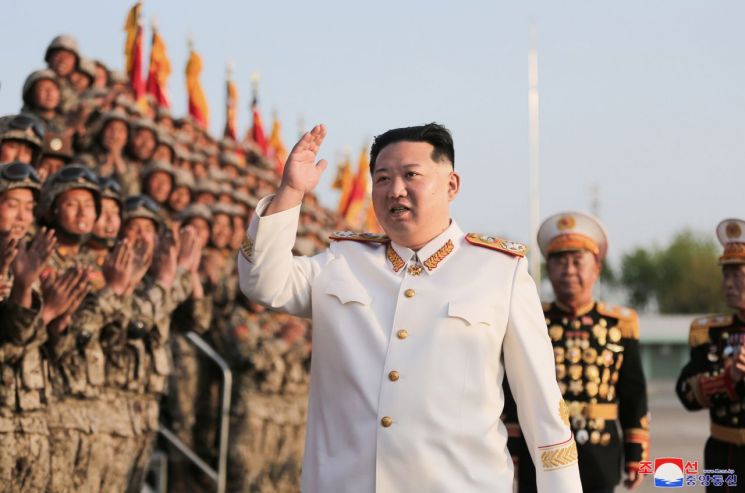
[Asia Economy Yang Nak-gyu, Military Specialist Reporter] North Korea carried out its first provocation since the new government took office by launching short-range ballistic missiles into the East Sea on the 12th.
The Joint Chiefs of Staff announced that at around 6:29 p.m. that day, they detected three short-range ballistic missiles launched from the Sunan area in Pyongyang toward the East Sea. This missile launch came five days after the submarine-launched ballistic missile (SLBM) launch on the 7th, marking the 16th show of force this year and the first provocation since President Yoon’s inauguration on the 10th.
The short-range ballistic missiles were detected flying approximately 360 km, reaching an altitude of about 90 km, and traveling at a speed of around Mach 5. Detailed information is currently being analyzed precisely by South Korean and U.S. intelligence authorities.
.
Won In-chul, Chairman of the Joint Chiefs of Staff, shared the situation closely through a coordination call with General Robert Abrams, Commander of the United Nations Command, immediately after North Korea’s ballistic missile launch, confirming the firm South Korea-U.S. combined defense posture.
The Joint Chiefs of Staff stated, "The recent successive ballistic missile launches by North Korea are serious provocations that threaten peace and stability not only on the Korean Peninsula but also in the international community, and we strongly urge an immediate halt."
The missile launch occurred on the same day North Korea officially acknowledged the occurrence of COVID-19 cases for the first time. During a Workers' Party Political Bureau meeting chaired by Kim Jong-un, North Korea officially admitted the first confirmed COVID-19 cases since the outbreak began at the end of 2019 and declared the transition to a 'maximum emergency epidemic prevention system.'
While focusing on national epidemic prevention, it is interpreted that North Korea intends to continue its ‘policy of strengthening the Ministry of Defense’ according to its own plans externally. As expectations arose that provocations such as nuclear tests would be restrained due to the need to concentrate all national capabilities on epidemic prevention amid the COVID-19 spread, North Korea drew a clear line.
The military authorities under the newly inaugurated Defense Minister Lee Jong-seop have upgraded their description of North Korea’s ballistic missile test launches from ‘threat’ to ‘provocation.’ The term ‘projectile,’ previously used when North Korean ballistic missiles were first detected, has been discarded.
© The Asia Business Daily(www.asiae.co.kr). All rights reserved.

















