Professor Kim Yoon-seok's Research Team at Sungkyunkwan University Publishes Paper in 'Science' on the 13th
[Asia Economy Reporter Kim Bong-su] A Korean research team has developed a next-generation high-performance semiconductor material using ion beams for the first time in the world.
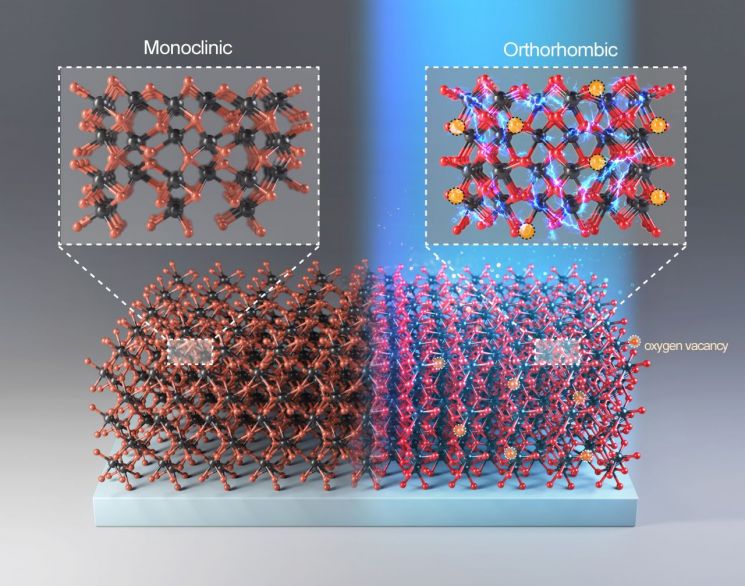
The Ministry of Science and ICT announced on the 13th that Professor Kim Yoon-seok's research team at Sungkyunkwan University has implemented a method to dramatically enhance the ferroelectricity of hafnium oxide (HfO2), a next-generation semiconductor material attracting attention, using 'ion beams' for the first time in the world. The research results were published on the same day in the international journal Science.
Ferroelectricity refers to the property by which a part of an object acquires a positive (+) or negative (-) pole due to an external magnetic field and retains that property. When ferroelectricity is strong, the difference between '0' and '1', the basic structure for storing data in memory, becomes larger, allowing stored data to be read more accurately. The idea of using materials with such ferroelectric properties to increase the integration density of semiconductor devices through excellent ferroelectricity even in nanometer-thin film states was proposed over 40 years ago. However, even in hafnium oxide, a newly introduced material, additional post-processing is required to increase ferroelectricity, and various process conditions greatly affect ferroelectricity, posing significant limitations in practical application, so it had not been realized.
The research team proposed a method to easily control and dramatically enhance the ferroelectricity of hafnium oxide using only one variable, the 'ion beam', without post-processing or complex process optimization. It has been known that the degree of ferroelectric expression is closely related to oxygen vacancies (vacant sites where oxygen atoms are missing in the crystal structure of oxide materials), and the team devised a method to enhance ferroelectricity by quantitatively controlling oxygen vacancies using ion beams.
As a result of applying ion beams, the research team revealed the principle that the increase in ferroelectricity originates from changes in the crystal structure linked to the density of oxygen defects, and they were able to increase ferroelectricity by more than 200% compared to when ion beams were not applied.
Professor Kim Yoon-seok said, "This research is expected to accelerate the practical application of high-efficiency semiconductor devices utilizing ferroelectricity," and added, "Based on the current methodological research results, continuous follow-up studies such as exploring optimal conditions are necessary to apply this to the actual semiconductor industry."
© The Asia Business Daily(www.asiae.co.kr). All rights reserved.
![User Who Sold Erroneously Deposited Bitcoins to Repay Debt and Fund Entertainment... What Did the Supreme Court Decide in 2021? [Legal Issue Check]](https://cwcontent.asiae.co.kr/asiaresize/183/2026020910431234020_1770601391.png)
















