Yoon Administration Actively Promotes Carbon Neutrality as a National Task
Emissions Must Be Reduced by 40% by 2030
Corporate Financial Burden Expected to Continue Increasing
[Asia Economy Reporter Oh Hyung-gil] It has been revealed that the greenhouse gases directly and indirectly emitted by POSCO Holdings and Hyundai Steel amount to 100 million tons annually.
As the Yoon Seok-yeol administration announced an active carbon neutrality promotion plan, the burden of reduction is expected to increase further for high greenhouse gas emitting industries such as steel, as well as oil refining and chemical companies. While they are rushing to adopt technologies to directly reduce greenhouse gas emissions, the cost burden for purchasing insufficient emission allowances is also expected to gradually increase.
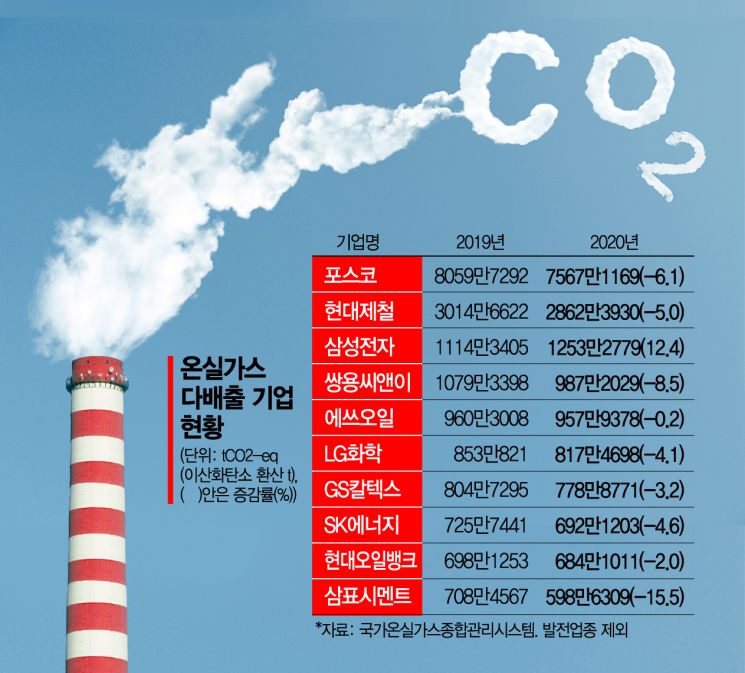
According to the National Greenhouse Gas Comprehensive Management System on the 11th, among the target management companies, POSCO emitted the most greenhouse gases in 2020. It emitted 75.67 million tons of carbon dioxide equivalent (tCO2-eq) in one year.
Hyundai Steel followed with 28.62 million tons, showing that the two steel companies emitted nearly 100 million tons of greenhouse gases.
This accounts for 17% of the total emissions of 587.51 million tons, more than twice the carbon absorption capacity of all forests in South Korea, which was 43.23 million tons (as of 2019). However, POSCO and Hyundai Steel achieved reductions of 6.1% and 5.0%, respectively, compared to the previous year's emissions.
Samsung Electronics emitted 12.4% more than the previous year, totaling 12.53 million tons. Ssangyong C&E (formerly Ssangyong Cement) recorded 9.87 million tons, and among the top greenhouse gas emitters were mostly oil refining, chemical, and cement companies including ▲S-OIL 9.57 million tons ▲LG Chem 8.17 million tons ▲GS Caltex 7.78 million tons ▲SK Energy 6.92 million tons ▲Hyundai Oilbank 6.84 million tons ▲Sampyo Cement 5.98 million tons.
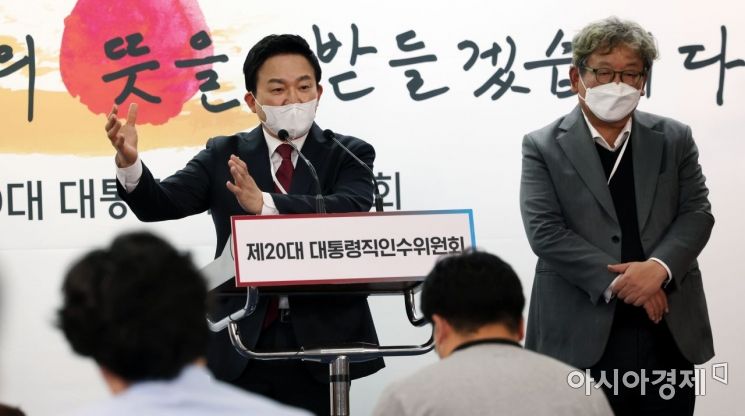 Won Hee-ryong, Chairman of the Presidential Transition Committee Planning Committee (left), and Kim Sang-hyeop, Standing Planning Committee Member, are briefing on "Policy Directions for Achievable Carbon Neutrality" at the 20th Presidential Transition Committee in Tongui-dong, Jongno-gu, Seoul, on the 12th. Photo by Transition Committee Press Corps
The Yoon administration plans to actively promote carbon neutrality policies to respond to the global decarbonization transition as a national agenda.
According to the Nationally Determined Contribution (NDC), greenhouse gas emissions must be reduced by 40% by 2030 compared to the 2018 emissions (727.6 million tons). This means emissions should be limited to about 436.6 million tons.
Companies are also presenting management strategies to achieve carbon neutrality by 2050. POSCO Holdings established a Group ESG Council, and POSCO operates a Carbon Neutrality Committee and a Carbon Neutral Green Steel Technology Advisory Group.
Hyundai Steel has also launched a Carbon Neutrality Promotion Team this year, establishing a carbon-neutral steel production system and carbon neutrality strategies. Additionally, each business site is engaging in reduction activities such as optimal operation of heating furnaces, improving hot blast stove efficiency, and waste heat recovery. Externally, they are participating in overseas emission allowance acquisition projects by distributing cookstoves and water purifiers to least developed countries.
In particular, as major countries such as the European Union (EU) and the United States show movements to strengthen carbon trade barriers, the Ministry of Environment is considering increasing the current 10% paid allocation in the emission trading system. Companies with high greenhouse gas emissions inevitably face increasing financial burdens for emission reductions.
According to the Financial Supervisory Service, the emission liabilities of the top 30 listed companies allocated emission allowances by the government in 2020 reached 709.2 billion won. Emission liabilities refer to funds for companies to fulfill carbon emission allowance submission obligations, and if greenhouse gas emissions exceed the free allocation amount, the scale of emission liabilities also increases.
POSCO Holdings covered 78.6 billion won in emission liabilities in 2020 and reflected 84.3 billion won last year. Hyundai Steel also recognized emission liabilities of 157.1 billion won in 2020 and 135.5 billion won in 2021.
© The Asia Business Daily(www.asiae.co.kr). All rights reserved.


















