[2022 Bio Korea]
Hong Gijong, Head of the Emerging Infectious Disease mRNA Vaccine Project Team
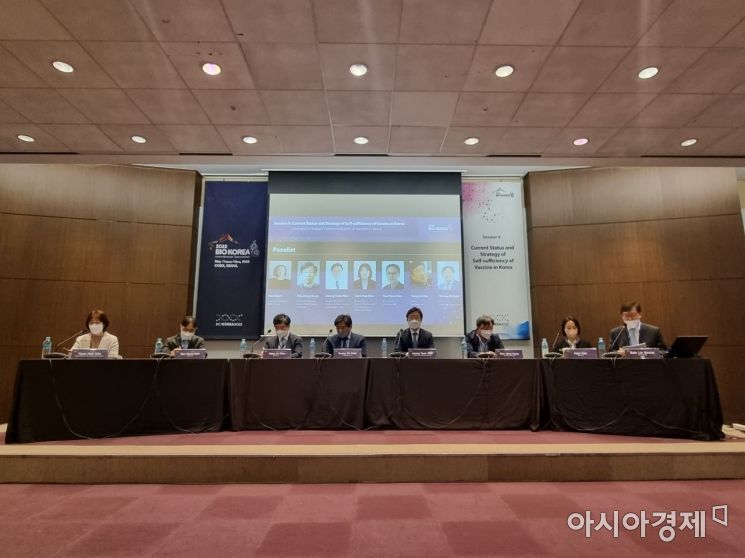 Participants of the '2022 Bio Korea' 'K-Vaccine Self-Sufficiency Status and Strategy' conference are engaged in a discussion. From the left: Yeonhee Kim, Researcher at the Ministry of Food and Drug Safety Evaluation Institute; Taehyun Kim, Team Leader at LG Chem Product Development Research Center; Yangje Cho, Chief Technology Officer at iGene; Youngok Baek, CEO of UbioLogics; Jeongtaek Woo, Director of the Global Vaccine Technology Leading Project Group; Gijong Hong, Director of the Emerging Infectious Disease mRNA Vaccine Project Group; Hani Kim, CEO of the Global Health Technology Fund; Baeklin Sung, Director of the Vaccine Commercialization Technology Development Project Group.
[Asia Economy Reporter Lee Chun-hee] The New Variant Infectious Disease mRNA Vaccine Project Group, established with the goal of domestic production of messenger ribonucleic acid (mRNA) vaccines to respond to new infectious disease pandemics after COVID-19, has expressed its determination to secure vaccine development capabilities that can obtain emergency use authorization within two years when a new infectious disease emerges.
On the morning of the 12th, at the '2022 Bio Korea' conference held at COEX in Gangnam-gu, Seoul, during the 'K-Vaccine Self-Sufficiency Status and Strategy' session, Hong Ki-jong, head of the project group, stated about the group's goal, "How quickly it can be realized," and added, "We will challenge whether it is possible to complete Phase 2 clinical trials and receive emergency use authorization."
Typically, vaccine development is considered to take about 10 years when considering everything from candidate material discovery to Phase 3 clinical trials. However, companies like Pfizer and Moderna succeeded in developing COVID-19 vaccines in less than two years through mRNA vaccines.
The reason this rapid pace was possible is due to the characteristics of mRNA. Director Hong emphasized, "mRNA vaccines go through a simpler process than expected," and "Because only the antigen code needs to be changed for production, it can be made very quickly." He also explained, "In a pandemic, Phase 3 clinical trials may not be necessary," and "Since emergency use authorization will be granted after Phase 2, the goal is to produce Phase 2 clinical trial results within two years when a new infectious disease emerges."
Director Hong also expressed his determination to directly tackle the various patent issues entangled with mRNA vaccines. Currently, core mRNA technologies such as IVT synthesis technology, lipid nanoparticles (LNP), capping technology, and pseudouridine are mostly monopolized by existing mRNA vaccine developers like Moderna through patents. Regarding this, Director Hong said, "Unless we create a new material from the moon, almost everything is tied up in patents, making it a difficult situation," and emphasized, "We must combine patented technologies, improved technologies, or independently acquired technologies if we are lucky."
The project group plans to disclose seven companies receiving non-clinical support after the 17th. Targets include influenza multivalent vaccines, COVID-19 variants, and Zika virus. Among them, two companies will be supported up to Phase 2 clinical trials.
Additionally, domestically, companies such as ST Pharm (STP2014), iGene (EG-COVID), and Quratis (QTP104) are currently pursuing the development of mRNA COVID-19 vaccines.
However, Director Hong took a reserved stance on whether mRNA vaccines will become the mainstream vaccines in the future. He said, "mRNA has the characteristics of speed and flexibility, but there are several inconveniences such as safety and storage conditions," and emphasized, "While vaccines universally contribute to humanity, improvements in the entire range of vaccines, including recombinant vaccines, inactivated vaccines, and live vaccines, which may be more effective, should continue."

During the discussion following the announcement, there were also remarks that continuous support should be provided not only for COVID-19 but also for national essential vaccination vaccines and other platform vaccines besides mRNA vaccines.
Kim Tae-hyun, team leader of product development research at LG Chem, said, "I think active support from the government or related ministries is necessary (for vaccine development)," and added, "Rather than supporting many manufacturers, a foundation should be established to intensively support one or two companies capable of development through to the late stages of Phase 3 clinical trials," urging bold government investment. LG Chem is currently preparing to develop a hexavalent combined vaccine that includes diphtheria, tetanus, and pertussis as part of the national essential vaccination project.
Baek Young-ok, CEO of UbioLogics, developing the synthetic antigen COVID-19 vaccine 'Ucovac,' said, "Many people currently think mRNA vaccines are the ultimate ideal, but we should not focus too much on mRNA; various technologies are needed," and added, "Support for traditional vaccine development methods is also necessary going forward."
© The Asia Business Daily(www.asiae.co.kr). All rights reserved.


















