75 Russian National Treasure Artworks Imported Late Last Year for Exhibition
Direct Flights to Russia Discontinued Due to Ukraine Crisis
Stored in Warehouse and Being Repatriated via Third Countries
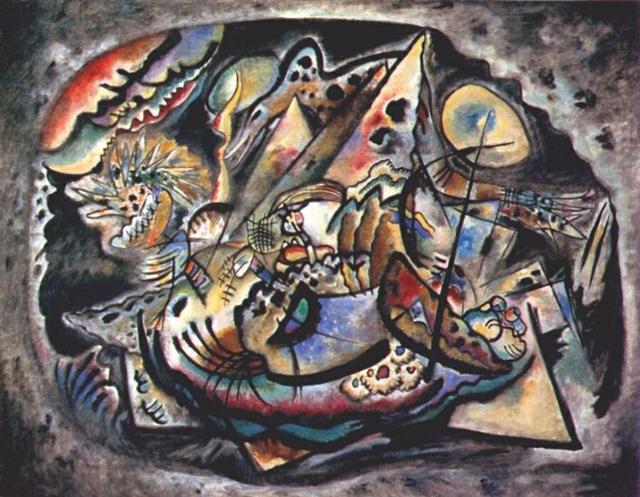 Vasily Kandinsky's 'Improvisation No.217. Gray Oval.' It shows the pinnacle of Kandinsky's abstract experiments. Photo by Yekaterinburg Museum of Art
[Asia Economy Reporters Kim Heeyoon and Kim Dongpyo] It has been confirmed that Russian national treasure-level artworks, which had been stranded in South Korea, are now being repatriated to their home country after various twists and turns. These artworks, totaling 75 pieces, were brought into South Korea for the exhibition "Kandinsky, Malevich & Russian Avant-Garde: Art of Revolution," held at the Sejong Center for the Performing Arts in Seoul from December 31 last year to the 17th of last month.
The collection consists of representative works by masters of abstract art considered Russian national treasures, including Kandinsky and Kazimir Malevich.
The issue arose because the Russian invasion of Ukraine occurred during the South Korean exhibition. As sanctions against Russia expanded, led by the United States and the European Union (EU), the Russian national treasure-level artworks on display in South Korea became entangled in the fallout. The Russian side, concerned about the sanctions, requested the early return of the exhibited works. However, the exhibition organizers continued the display as scheduled in South Korea due to contractual obligations.
During the exhibition, international sanctions against Russia were further tightened. Direct flights to Russia were discontinued. The Russian side expressed reluctance to return the artworks via flights transiting through Europe.
On the 2nd of last month (local time), Finnish customs announced that they had seized artworks worth $46 million (approximately 56.03 billion KRW) at Valima, a border town adjacent to Russia. If the Russian national treasure-level artworks to be returned from South Korea were seized during transit through Europe, the situation would inevitably become complicated.
Ultimately, after the exhibition ended, the Russian artworks were stored in a domestic warehouse for about three weeks. The longer the storage period, the greater the burden of management costs. Moreover, if the return continued to be delayed, the issue could escalate into a diplomatic and political problem intertwined with changes in the international situation.
The solution found after much deliberation was to route the return through a third country. A representative of the exhibition organizers explained on the 12th, "These works departed South Korea on the 10th and are currently being returned to Russia via a third country," adding, "Since artworks are included in the EU sanctions list, it is difficult to disclose the exact transit route."
The Russian government also announced the return of these works through the media. According to the Russian state media Sputnik on the 9th (local time), Olga Lyubimova, Russia’s Minister of Culture, stated, "Everything related to the return of Russian artworks in South Korea is proceeding as planned."
It is known that South Korea’s return of Russian artworks is unrelated to the sanctions target list. The EU classifies artworks as luxury goods and includes them in the sanctions list. While the South Korean government participates in sanctions against Russia alongside the United States and the EU, the targeted items mainly focus on resources such as rare earth elements and gas.
Meanwhile, the Ministry of Land, Infrastructure and Transport expressed a cautious stance regarding the repatriation of Russian artworks. A ministry official said, "It seems there is no part where the government, especially the Ministry of Land, Infrastructure and Transport, can provide support or convenience in the transportation process or route setting," adding, "In the past, when similar issues arose between other countries and Russia, artworks were returned via third countries."
The ministry official further stated, "It is understood that in that process, there were cases where artworks were seized due to EU sanctions. If such issues arise in this case, it should be regarded as a diplomatic matter."
© The Asia Business Daily(www.asiae.co.kr). All rights reserved.

















