New Minister of Science and ICT Jong-ho Lee Inaugurated on the Morning of the 11th
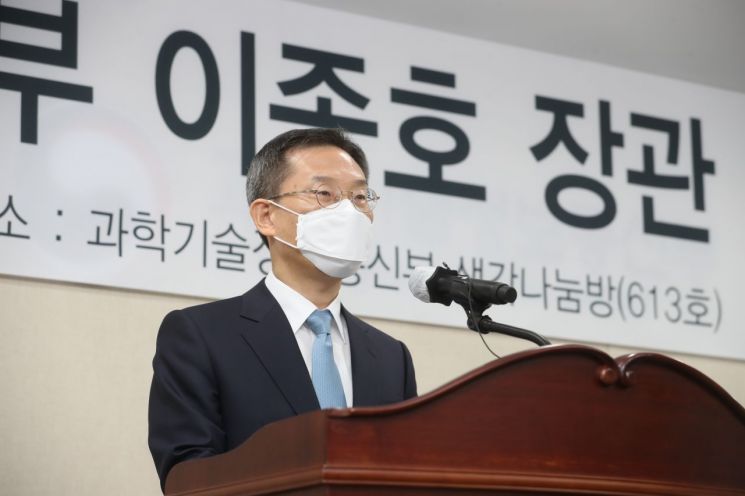
[Asia Economy Reporters: Kim Bong-su, Lim Hye-seon, Kang Na-hum] "At the crossroads of a technological revolution that will determine the fate of the nation, we must become leaders rather than followers to rise as a global leading country."
◇Presentation of Goal to Become One of the Top 5 Science and Technology Powers
On the 11th, Lee Jong-ho, the inaugural Minister of Science and ICT of the Yoon Seok-yeol administration, stated at his inauguration ceremony that the goal is to become one of the top 5 science and technology powers and to build a digital economic hegemony. Minister Lee announced plans to expand private sector participation throughout the science, technology, and digital policy processes and to redesign the national innovation system. He promised early acquisition of core technologies with super-gap advantages such as semiconductors, artificial intelligence (AI), space, and bio, as well as strengthening basic research and supporting the digital platform government. In particular, he pledged to maintain world-class network competitiveness including 5G and to strengthen cybersecurity systems to realize a digitally shared prosperous society. Minister Lee said, "The Ministry of Science and ICT will serve as the center of inter-ministerial collaboration and as a coordinator," urging, "Let us foster an open and creative organizational culture and spread it across government ministries."
◇The Biggest Challenge: Resolving Controversies over Neglect of Science and ICT
Minister Lee’s biggest challenge is to resolve the current government's controversies over neglecting science and ICT. Along with the task of supporting ‘scientific quarantine’ through research and development (R&D) in basic medicine and bio fields, he must also consider the future of Korea’s semiconductor industry. There are also numerous space-related tasks, including the planned successful second launch of the Nuri rocket scheduled for mid-next month. Experts view this as a critical moment to decide whether Korea’s space development will catch up with major powers like the U.S. or remain at an ‘outsourcing’ level. Other representative challenges for Minister Lee include addressing the shortage of science and engineering talent, securing stable nuclear technology, difficulties in the 1.5 trillion won-class heavy ion accelerator project, and improving R&D systems (such as abolishing PBS and preliminary feasibility studies).
◇Portal Regulation and Big Tech Abuse Also Challenges
In the ICT sector, a priority task is to reasonably coordinate the level of regulation on domestic portals. Previously, the transition team raised concerns about bias in portal news and hinted at abolishing news editing rights. Domestic portals have raised issues of fairness compared to overseas operators like Google that provide Korean news services. Decisions must also be made regarding global application (app) market operators such as Google and Apple. Although the National Assembly passed the ‘Google Abuse Prevention Act,’ Google has circumvented it, causing content prices to surge, making prompt responses such as fact-finding investigations by the Ministry of Science and ICT necessary.
Another major issue is the 5G mid-tier pricing plan, which effectively acts as a reduction in communication fees. Since early introduction of 6G following 5G has been set as a national agenda, the challenge is to encourage network investment by the three major telecom companies while lowering fees.
© The Asia Business Daily(www.asiae.co.kr). All rights reserved.
![User Who Sold Erroneously Deposited Bitcoins to Repay Debt and Fund Entertainment... What Did the Supreme Court Decide in 2021? [Legal Issue Check]](https://cwcontent.asiae.co.kr/asiaresize/183/2026020910431234020_1770601391.png)















