Ruling Party and Government Agree to Pay '6 Million KRW + α' Regardless of Loss
Spending Restructuring and Excess Tax Revenue Expected Without National Bond Issuance…Opposition Says "53 Trillion KRW Excess Tax Revenue Is a Serious Problem"
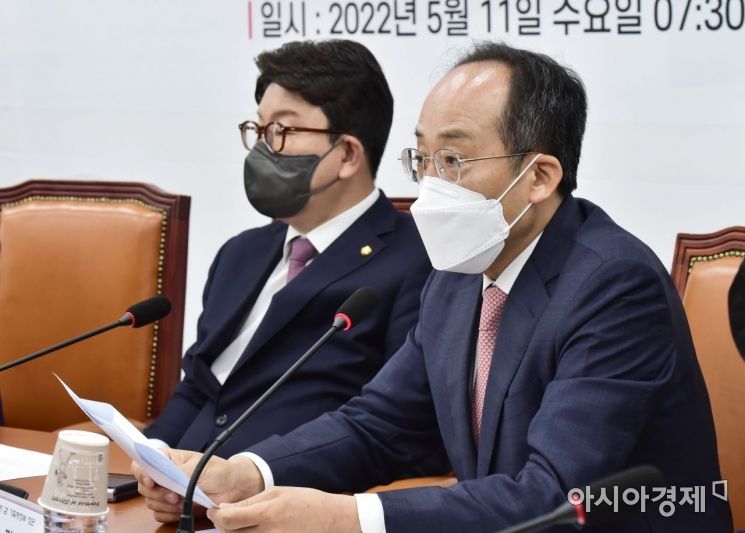 Deputy Prime Minister for Economy Choo Kyung-ho is delivering opening remarks at the 2nd supplementary budget meeting related to compensation for losses of small business owners held at the National Assembly on the 11th. Photo by Yoon Dong-joo doso7@
[Asia Economy Sejong=Reporters Kwon Haeyoung and Son Seonhee] The first supplementary budget (supplementary budget) drafted immediately after the launch of the Yoon Seok-yeol administration focuses on compensating small business owners who suffered damage due to government quarantine measures, as President Yoon promised a supplementary budget of 50 trillion won during his candidacy. Considering the size of the first supplementary budget conducted in February this year (about 17 trillion won), the second supplementary budget is expected to be at least '33 trillion won+α (plus alpha)'. The ruling party and government stated that they would utilize expenditure restructuring within the main budget without issuing government bonds to secure funds for the second supplementary budget. Meanwhile, the opposition party has sparked controversy by presenting a specific figure of '53 trillion won in excess tax revenue.'
◆At least 6 million won paid to 3.7 million small business owners, etc.=According to the ruling party and government consultations on the 11th, the second supplementary budget to be implemented by the new government will first provide a minimum of 6 million won in quarantine support funds, renamed as loss compensation funds, to 3.7 million small business owners and self-employed individuals. The target includes all self-employed and small business owners regardless of loss, as well as small and medium-sized enterprises with sales under 3 billion won. The People Power Party particularly requested the government to expand and preferentially support sectors previously excluded from loss compensation, such as travel, performance exhibitions, and air transportation. As People Power Party floor leader Kwon Seong-dong stated, "At least 6 million won, with plus alpha by industry," additional support for these previously neglected sectors is expected to increase.
Special-type workers (teuksoohyeong geunroja) and freelancers, who were in the blind spots of COVID-19 damage, are also included in the support targets. Consultations between the ruling party and government have been completed to ensure support for corporate taxi, charter bus, and route bus drivers, cultural artists, insurance planners, and substitute drivers. However, after-school program workers in elementary schools are excluded. The ruling party and government announced that they would prepare support measures using education finance grants reflected in this supplementary budget.
Approximately 2.25 million low-income and vulnerable households struggling with soaring prices will also receive emergency living support funds, temporarily providing 750,000 to 1 million won based on a four-person household.
◆How to secure funds? Opposition: "53 trillion excess tax revenue? We will question the intent"=As the scale and number of recipients of loss compensation increase significantly, the supplementary budget size is expected to increase substantially compared to the first supplementary budget. The ruling party and government firmly denied additional deficit bond issuance. Therefore, the remaining options are expenditure restructuring and revenue adjustments. The government is expected to combine these two methods to secure funds.
Regarding this, Park Hong-geun, floor leader of the Democratic Party of Korea, warned in a morning emergency committee meeting at the National Assembly, "The astronomical excess tax revenue of 53 trillion won is a serious problem that shakes the foundation of national finances," and said, "We will thoroughly investigate the intent of the budget and tax authorities regarding this supplementary budget." This mention of the specific figure '53 trillion won' came despite the government not yet announcing the total size or funding plan of the supplementary budget.
In fact, there have been internal and external speculations that a large-scale revenue adjustment will occur in this second supplementary budget. However, this is the first time a specific figure has been mentioned. National tax revenue until February this year was about 70 trillion won, an increase of 12.2 trillion won compared to the same period last year. Considering corporate tax revenue coming in March and the increase in value-added tax due to future inflation, it is expected that a large-scale excess tax revenue in the tens of trillions of won will occur again this year following last year. The government plans to utilize this excess tax revenue as funding for the second supplementary budget through revenue adjustments. This means significantly increasing the total national revenue estimate for this year.
However, this large-scale revenue adjustment is somewhat premature, as the government itself acknowledges record-breaking 'tax revenue errors' for two consecutive years, last year and this year, and the first quarter fiscal operation trends have not yet been finalized. Additionally, unlike last year, when tax revenue was abundant due to asset bubbles including real estate, this year’s economic growth rate (GDP) is trending downward to the mid-2% range, which adds to concerns.
© The Asia Business Daily(www.asiae.co.kr). All rights reserved.
![User Who Sold Erroneously Deposited Bitcoins to Repay Debt and Fund Entertainment... What Did the Supreme Court Decide in 2021? [Legal Issue Check]](https://cwcontent.asiae.co.kr/asiaresize/183/2026020910431234020_1770601391.png)















