Will the 'Underboob' Trend Spread in Korea Following Overseas Popularity?
Jennie and HyunA Appear in Underboob Fashion
Exposing the Lower Bust Line Sparks Debate: "Excessive Exposure" vs "Fashion Freedom"
Short Jeogori Also Sparked Controversy in the Joseon Dynasty...
Why Is 'Women's Fashion' a Subject of Heated Debate?
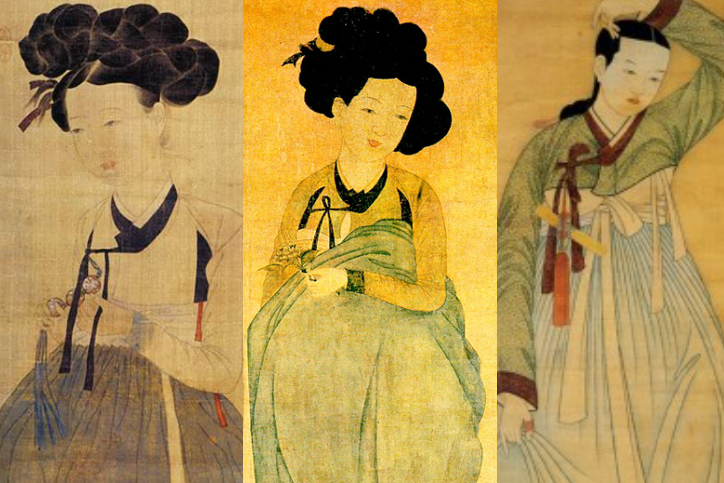 The chest is exposed due to the short jeogori. Shin Yun-bok and unknown author <Portrait of a Beauty> / Photo by Naver Encyclopedia Capture.
[Asia Economy Reporter Yoon Seul-gi] The 'underboob' fashion, which exposes the lower part of the breasts, is showing signs of becoming a trend, sparking controversy. The excessive body exposure by famous celebrities with significant media influence has become an issue, but similar debates also existed in the late Joseon Dynasty. At that time, among Joseon women, the 'hahusangbak' style?wearing voluminous skirts and tightly fitted jeogori (jackets)?was popular, but the short jeogori exposing the chest drew criticism from the yangban (aristocrats). Experts diagnose that the phenomenon of women's fashion becoming a subject of controversy stems from a patriarchal perspective that does not view women as decision-making agents.
◆ 'Underboob' gaining popularity among Korean celebrities following overseas trends... "Excessive exposure" vs. "Fashion criticism is interference"
Korean women's tops are getting shorter. After the crop top fashion that slightly exposed the waistline or abdomen was popular for a while, the 'underboob' style, which exposes the lower breast line, has now become the center of the trend.
The underboob fashion started in 2017 when overseas stars showcased it. Previously used mainly for music videos and magazines, recently more people have been wearing it as everyday clothing. In Korea, K-POP stars like BLACKPINK's Jennie and singer HyunA have drawn attention with underboob fashion, indicating signs of its popularity spreading in Korea as well.
The problem lies in the fact that clothing styles that fully expose the lower line of women's breasts are quite provocative. In Korea, where there is a strong tendency to follow the fashion of famous celebrities, there have been criticisms that excessive exposure is inappropriate. This is because impressionable teenagers who admire celebrities might imitate such revealing fashion.
On the other hand, underboob fashion has been criticized as a symbol of female subjectivity and freedom, and fashion criticism can be seen as excessive interference. Some also argue that underboob fashion is part of the 'Free the Nipple' movement, which advocates for women's right to freely go topless. A fashion magazine in 2017 interpreted underboob fashion as an extension of 'Free the Nipple.'
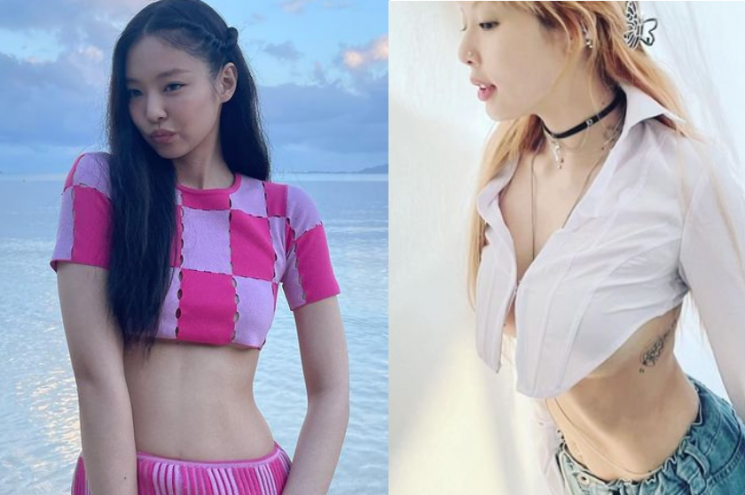 Recently, the 'Underboob' fashion, which reveals the lower line of the chest, is showing signs of becoming a trend.
 Photo by BLACKPINK Jennie Instagram capture (left), Photo by singer HyunA Instagram capture (right)
◆ Similar 'short jeogori' resembling underboob appeared in the Joseon Dynasty... Criticized as 'yobok'
Debates surrounding women's fashion also existed during the Joseon Dynasty. The hanbok, with its separated top and bottom, had a clothing structure that clearly revealed the body shape. Originally, the jeogori length reached about the hips, but from the late 17th to 18th century, the length of women's jeogori noticeably shortened, and by the 18th century, the width also narrowed. Around 1920, the length of women's jeogori was about 19cm, smaller than the span of an adult man's hand.
This trend was related to the social upheaval during the late Joseon period in the 17th and 18th centuries, including the development of commerce and arts. The 'hahusangbak' style emerged as people pursued new aesthetic values in clothing. The trend was led by gisaeng (female entertainers) who started it to attract the attention of yangban men, and it spread to the royal palace and upper classes. The 'hahusangbak' style was chosen by Joseon women because the style itself was attractive. Some view it as a means of expressing individuality in a male-centered society that demanded chastity.
The short jeogori exposing the chest was criticized among the yangban class. Joseon scholar Lee Deok-mu (1741?1893) called the short jeogori 'yobok' (妖服), meaning 'bewitching clothing.' In his work 'Cheongjanggwan Jeonseo,' he wrote, "Generally, what is called fashion in clothing originates from the coquettish gestures of gisaeng, and worldly men are fascinated by those gestures, failing to realize their vulgarity, encouraging their wives and concubines to imitate them, thus spreading and becoming common."
Some accepted the change in clothing as a fashion trend. Scholar Yi Ik said in 'Seongho Saseol,' "In these degenerate times, women's clothing has narrow sleeves and short hems, resembling garments worn by evil spirits," but also added, "In the customs moving toward great harmony (Daedong), it is inevitable."
◆ Why is women's fashion a 'controversial topic'?
Both in the past and present, women's clothing has been a subject of public debate and controversy. Experts analyze that the prominent disputes over women's clothing stem from complex causes, including the perspective that still views women as subjects to be lectured.
Women's studies scholar Heo Min-sook said, "Even if clothes are inconvenient and restrict movement, choosing what to wear is a personal freedom," adding, "The reason why debates over women's clothing repeatedly occur is because women are regarded as objects of advice and admonition. It is a patriarchal view that fails to recognize women as autonomous decision-makers." She further analyzed, "In our society, when women expose their bodies, it is often excessively interpreted as having sexual intent. This is due to the cultural context that has long evaluated women's bodies."
Regarding concerns that excessive body exposure negatively influences teenagers, she said, "What truly threatens teenagers is sexual objectification through webtoons and games," and questioned, "Why do people get so agitated only about fashion debates while not actively participating in improving the issue of viewing young children as sexual objects and making them victims of sexual crimes?"
© The Asia Business Daily(www.asiae.co.kr). All rights reserved.



















