Geely Automobile Holdings Acquires 34% Stake in Renault Korea
Both Companies Aim to Launch New Cars in Korea Based on CMA Platform
Maximizing Synergy of Competitiveness with Joint Venture Models
[Asia Economy Reporter Choi Dae-yeol] Geely Group, China's largest private automobile company, has established a foothold for entering the Korean market by becoming a major shareholder of Renault Korea Motors. As Renault and Geely jointly develop eco-friendly vehicles, they appear to be strengthening their cooperation through Renault Korea.
According to Renault Korea on the 10th, Geely Automobile Holdings, a subsidiary of Geely Group, has agreed to acquire 34.02% of Renault Korea's shares. Even after Geely Group becomes a major shareholder of Renault Korea, Renault Group, the current largest shareholder, will maintain its majority stake and largest shareholder status.
Although specific details of the share transaction have not been disclosed, Renault Group previously held over 80% of Renault Korea's shares. According to the company, new shares will be issued and sold to Geely. The shares held by Samsung Card, an existing shareholder and partner, will remain unchanged. As of the end of last year, Samsung Card was the second-largest shareholder with a 19.90% stake in Renault Korea. If this deal is finalized, Geely will become the second-largest shareholder of Renault Korea.

Renault and Geely have cooperated in various ways to develop eco-friendly vehicles such as electric and hybrid cars. A representative example is the plan to develop new eco-friendly vehicles based on the CMA platform of Volvo, which Geely acquired in the past, and produce them at Renault Korea's Busan plant. The CMA platform was developed at Volvo's Swedish research and development (R&D) center and has been applied to recently launched Volvo electric vehicles like the C40 Recharge in Korea. It can be used not only for eco-friendly vehicles such as electric and hybrid cars but also for internal combustion engine vehicles.
Renault and Geely are developing new vehicles using this platform with the goal of launching them in Korea in 2024. The work is divided such that Renault Group designs the vehicles using Geely's new platform, while Renault Korea's researchers develop advanced features tailored to domestic demand.
Stefan Deblaise, CEO of Renault Korea, said, "This decision to participate in the shareholding signifies a commitment to actively cooperate in developing joint models with Renault Korea based on the high potential of the Korean market to maximize synergy effects," adding, "We will also make self-driven efforts to successfully prepare joint models between Renault and Geely."
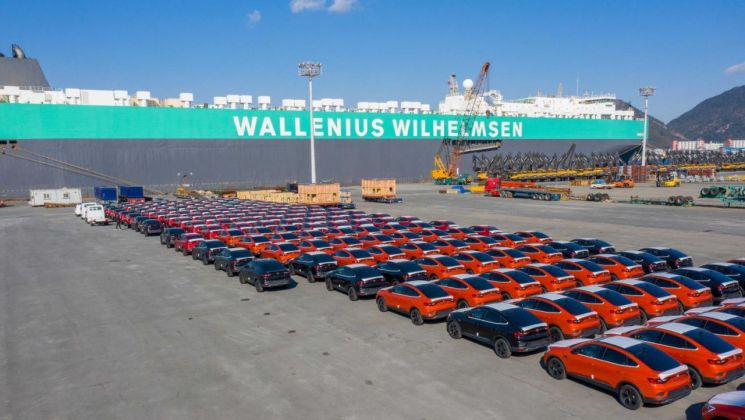 The compact SUV XM3, led in development by Renault Korea, is waiting at the dock for export shipment.
 [Image source=Yonhap News]
Geely, which started as a refrigerator and motorcycle manufacturer, entered the automobile business in earnest in the 2000s and rapidly expanded its business. It was supported by strong domestic demand. While many automobile manufacturers in China are state-owned or joint ventures with global automakers, Geely is a private company. Geely is praised for revitalizing the declining brand image of Volvo, which it acquired in 2010, by guaranteeing independent management activities such as research and development and marketing.
Geely owns the British high-performance car brand Lotus and the German compact car brand Smart as subsidiaries, and it is also the second-largest shareholder of Daimler, the parent company of Mercedes-Benz, a German luxury brand and a starting point of the modern automobile industry.

This is the second time a Chinese company has become a major shareholder of a Korean automobile company, following Shanghai Automotive's acquisition of SsangYong Motor in 2004. Shanghai Automotive sold SsangYong Motor and left Korea after about four years. Recently, Geely has accelerated its Korean market strategy by agreeing to build an electric truck production plant in Korea together with the Korean auto parts company Myungshin.
With this acquisition of Renault Korea shares, Geely has expressed its intention to directly compete in the passenger car market following commercial vehicles. The structure involves producing and selling vehicles in which Geely is directly or indirectly involved at production hubs in Busan (Renault Korea) and Gunsan (former GM Korea), both recognized as major automobile manufacturing regions in Korea.
Industry insiders expect significant synergy if Geely's electric vehicle manufacturing competitiveness and Renault Korea's software strengths are organically combined. Another advantage is Geely's partnership with CATL, China's largest battery manufacturer. Since Korea has no trade barriers with major overseas markets such as the U.S., Europe, and Southeast Asia, there is also speculation that Geely may use its domestic factories as export hubs.
© The Asia Business Daily(www.asiae.co.kr). All rights reserved.



















