New Government Stock Outlook
Highest Growth Rate in Years 1-2 of Term
Unfavorable Macroeconomic Pessimism Also Present
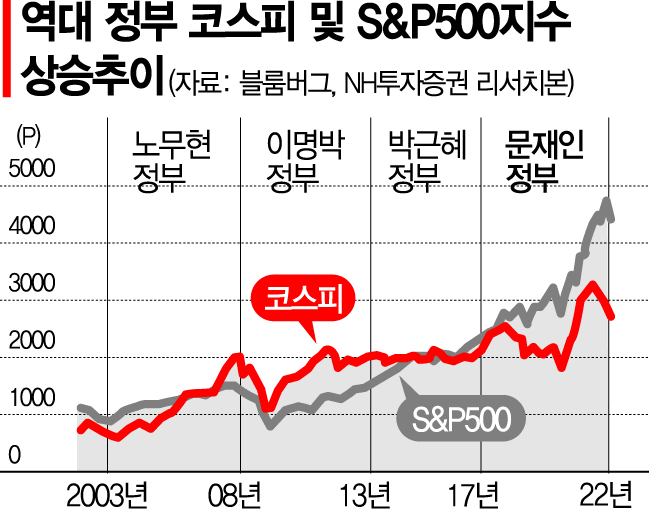
[Asia Economy Reporter Kwon Jae-hee] On the inauguration day of Yoon Suk-yeol, the 20th president, on the 10th, our stock market started lower due to the plunge in the U.S. stock market, drawing attention to the stock market trend under the new administration. In an unfavorable situation with rising inflationary pressures caused by the U.S. Federal Reserve's (Fed) big step (0.5% point interest rate hike) and the prolonged Russia-Ukraine conflict, let's examine whether our stock market can regain momentum with expectations for the new government by looking at the stock market performance of past administrations.
◆ KOSPI's 'Honeymoon Rally' in the 1st and 2nd years of administration = Among the eight presidential elections held since 1981, except for the 1997-1998 Asian financial crisis and the 2007-2008 global financial crisis, all administrations experienced a 'honeymoon rally' one year after the presidential election.
In the KOSPI market, the market showed sluggishness due to election uncertainty three months before the election, but the average rate of increase was highest in the 1st and 2nd years after the election. According to an analysis by Cape Investment & Securities of the KOSPI fluctuations during the 13th to 18th presidential terms, the average increase rate was 23.18% in the 1st year and 26.18% in the 2nd year of the term.
By administration, the KOSPI rose 91% one year after President Roh Tae-woo's election, and honeymoon rallies were observed in the Kim Young-sam (30.8%), Kim Dae-jung (25.4%), and Roh Moo-hyun (14.4%) administrations.
Following the 17th and 18th presidential elections (Lee Myung-bak and Park Geun-hye), which coincided with the global financial crisis, the KOSPI fell by 36.6% and 0.9%, respectively, while it rose 1.1% in the 1st year of the 19th President Moon Jae-in's term.
However, in the case of the KOSDAQ market, the stock price was more often sluggish after the presidential election. Including the 1997 election, the KOSDAQ index rose one year after the election only twice in five elections: under Park Geun-hye (0.2%) and Moon Jae-in (32.2%).
◆ The best stock market performance among past administrations was under Roh Moo-hyun... 184% increase = Then, what about the stock market performance over five years beyond the honeymoon rally?
According to the Korea Exchange on the 10th, comparing the KOSPI closing prices on the inauguration day and the last day of the term from the 13th to the 19th presidents under the direct presidential election system, the 16th President Roh Moo-hyun (2003-2008) showed the highest stock market performance with a 184.75% increase during his term. Due to the low interest rate environment, abundant liquidity flowed into the stock market, and the KOSPI grew more than threefold from 592.25 to 1686.45 over five years. In 2007, the KOSPI also surpassed the 2000 mark for the first time in history.
Next were former Presidents Kim Dae-jung (19.35%), Lee Myung-bak (18.12%), and Moon Jae-in (17.23%) in order of high growth. During Moon's term, the enthusiastic participation of individual investors known as Donghak Ants led the KOSPI to touch the 3000 mark for the first time ever.
Additionally, the KOSPI rose 5.94% under the Roh Tae-woo administration and 4.37% under the Park Geun-hye administration.
The only period when the KOSPI index declined during a presidential term since the direct election system was under Kim Young-sam (1993-1998). During his term, the KOSPI fell 17.5% amid the 1997 Asian financial crisis.
◆ Expectations for the new government vs. unfavorable macro environment... What is the stock market outlook under the Yoon administration? = In the securities industry, since presidential elections have traditionally acted as a bullish factor for the stock market, there is optimism that expectations for the new government will positively affect the stock market this time as well, alongside concerns that the unfavorable macroeconomic environment will make it difficult.
Researcher Heo Jae-hwan of Eugene Investment & Securities interpreted, "Like the U.S. stock market, where presidential elections have traditionally been positive factors, the Korean stock market generally sees the election as a bullish factor."
On the other hand, the Hanwha Investment & Securities Research Center diagnosed, "Due to macroeconomic issues such as the Fed's accelerated tightening, the domestic stock market will remain sluggish for the time being." Researcher Byun Jun-ho of Heungkuk Securities also analyzed, "The past stock market rises after presidential inaugurations were more influenced by global economic recovery or favorable stock market environments rather than expectations for new policies."
© The Asia Business Daily(www.asiae.co.kr). All rights reserved.

















