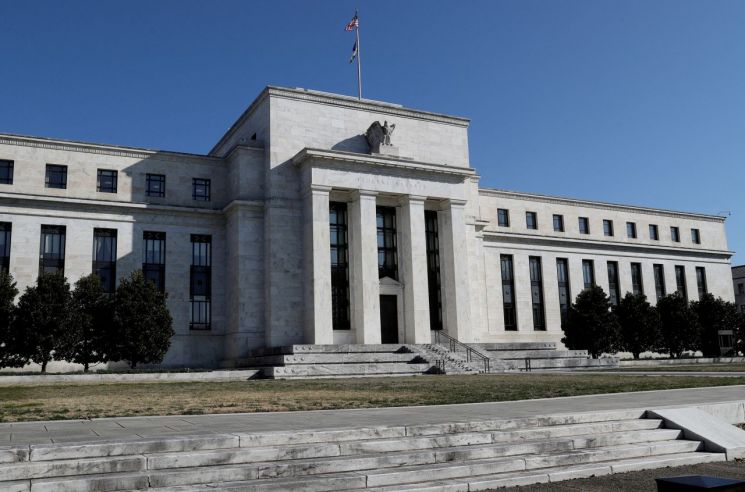
[Asia Economy Reporter Jeong Hyunjin] The U.S. Federal Reserve (Fed) has warned that market liquidity deterioration could lead to a vicious cycle. Following the "big step" (a 0.5 percentage point increase in the benchmark interest rate at once) and the subsequent stock market crash, the Fed expressed concerns that additional rate hikes, high inflation, and the impact of the Ukraine war could damage the U.S. financial market.
According to Bloomberg and others on the 9th (local time), the Fed stated in its financial stability report that "market liquidity has declined in recently issued U.S. Treasury bonds and stock index futures trading since the end of last year," adding, "Although the recent liquidity deterioration is not as extreme as in past cases, the risk of a sudden and significant worsening is higher than during normal times."
Since the beginning of this year, most markets including bonds, commodities, and securities have shown significant volatility due to U.S. tightening monetary policy, Russia's airstrikes in Ukraine, and concerns over China's economic slowdown. The Fed noted, "Since Russia's airstrikes in Ukraine, liquidity in the crude oil futures market has been somewhat pressured. Other commodity markets have also experienced noticeable difficulties." The Fed assessed that "increasing uncertainty and volatility could lead to a vicious cycle of liquidity deterioration, which in turn may cause greater price volatility."
Concerns were also raised that additional measures such as high inflation and rate hikes, accompanied by a decline in economic activity, could negatively affect the financial system. The Fed believes consumer finance could be hit by unemployment, high interest rates, and falling housing prices, while corporate finance may face rising delinquency rates and bankruptcies. It further stated, "Rapid rate hikes could increase volatility, pressure market liquidity, and cause significant price adjustments in asset markets, potentially resulting in losses for financial institutions."
Fed Vice Chair Lael Brainard emphasized, "The Ukraine war has caused significant price movements and margin calls in commodity markets, highlighting potential channels through which large financial institutions could be exposed to risk," adding, "We are cooperating with domestic and international regulatory agencies to understand market participants' exposures and the interconnectedness of the financial system."
Earlier, on the 4th, the Fed raised the benchmark interest rate by 0.5 percentage points at the Federal Open Market Committee (FOMC) regular meeting. This increased the U.S. benchmark rate from 0.25-0.5% to 0.75-1%. Following the FOMC, Fed Chair Jerome Powell said, "Inflation is too high," and "There is a growing consensus within the committee to consider 50 basis point rate hikes in the next couple of meetings."
Market concerns have been raised about whether the Fed can carry out the planned rate hikes without triggering a recession. On the same day, the Dow Jones Industrial Average closed at 32,245.70, down 1.99% from the previous session. The S&P 500 fell 3.20% to 3,991.24, and the Nasdaq dropped sharply by 4.29% to 11,623.25. CNBC reported that the S&P 500 falling below the 4,000 mark is the first time in over a year since March 31 of last year.
© The Asia Business Daily(www.asiae.co.kr). All rights reserved.
!["The Woman Who Threw Herself into the Water Clutching a Stolen Dior Bag"...A Grotesque Success Story That Shakes the Korean Psyche [Slate]](https://cwcontent.asiae.co.kr/asiaresize/183/2026021902243444107_1771435474.jpg)
















