8.1% Decrease Compared to 2005
Per Capita Emissions Increased to 4.78 Tons Due to ICT Development and Rise in Single-Person Households
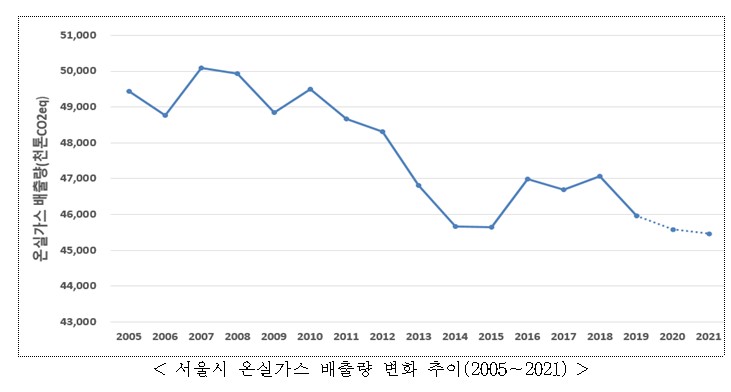
[Asia Economy Reporter Lim Cheol-young] Last year, Seoul's greenhouse gas emissions amounted to 45.46 million tons, showing a decrease of 8.1% compared to 2005, when the city declared its commitment to reducing greenhouse gases to the international community, and a 0.3% decrease compared to the previous year.
According to Seoul City on the 10th, excluding years when power demand unusually increased due to heatwaves and cold spells, greenhouse gas emissions have continuously decreased by an average of 0.5% annually since 2005. By sector, emissions decreased significantly by 2.33 million tons (22%) in transportation, 1.25 million tons (33%) in industry, and 880,000 tons (62%) in power generation. This is attributed to improvements in vehicle fuel efficiency, the spread of eco-friendly vehicles, and the relocation of high-emission factories and power plants to other regions.
However, emissions from the building sector, which accounts for the largest share (70%) of Seoul's greenhouse gas emissions, slightly increased by 1.2% (370,000 tons) in 2021 compared to 2005. This increase is due to the growth in total building floor area and lifestyle changes driven by advances in information and communication technology, resulting in higher energy consumption in buildings.
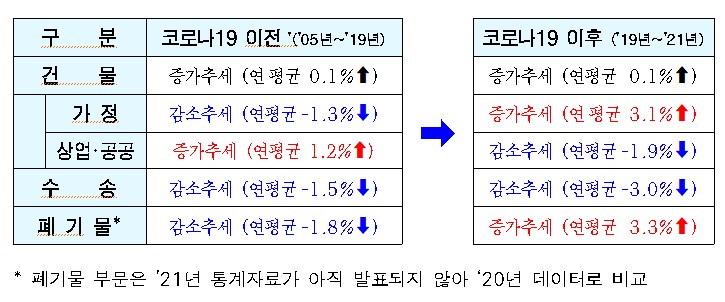
Examining changes in greenhouse gas emissions after COVID-19, emissions from the household and waste sectors, which had been decreasing, have increased, while emissions from the commercial and public sectors, which had been increasing, have decreased, showing a different pattern from before.
Meanwhile, per capita greenhouse gas emissions decreased from 4.86 tons in 2005 to 4.52 tons in 2014, then rose again to 4.78 tons in 2021. Seoul City announces its greenhouse gas inventory annually, analyzes the results, and actively develops reduction policies, aiming to reduce emissions by 30% by 2026 and achieve carbon neutrality by 2050 with full effort.
The finalized and estimated data of Seoul's greenhouse gas inventory can be found on the Seoul City website → Information by Sector (Environment) → Seoul's Environment → Greenhouse Gas Inventory*. Yoo Yeon-sik, Head of the Climate and Environment Headquarters, stated, “The greenhouse gas inventory is an important basic data source to identify greenhouse gas emissions and emission sources,” and added, “Since the estimation process has accelerated the inventory identification by two years, we will devote all efforts to link reduction policies and achieve Seoul's 2050 carbon neutrality goal.”
© The Asia Business Daily(www.asiae.co.kr). All rights reserved.


















