Half of the Nation Didn't Read a Single Book in a Year
Declining Preference for Traditional Media Like Books and Newspapers
E-books Become Mainstream... Book Subscription Platform Sales Surge
Riding the 'Newtro' Trend, Some 2030 Generation Still Prefer Paper Books... '#Bookstagram' Posts Reach 4.87 Million
"Can Savor Books While Underlining... Lifetime Ownership Is Also an Advantage"
 Although the position of paper books is shrinking due to OTT platforms providing video services such as Netflix and electronic books, some young people insist on paper books.
 [Image source=Pixabay]
[Asia Economy Reporter Yoon Seul-gi] As OTT (Over the top - video content service) platforms such as Netflix, Wavve, TVING, and Coupang Play are increasingly used during leisure time, the position of books, once a representative knowledge medium, is shrinking. Even among those who read, the activation of e-book subscription services that allow reading cheaply and abundantly has raised concerns about the tragic fate of paper books.
However, there is a prospect that new opportunities can be sought as the COVID-19 pandemic has increased the demand for paper books and a young generation immersed in 'Newtro' (New + Retro) sensibility has emerged. They enjoy the inconvenient old-fashioned feelings while moving between analog and digital, and stimulate reading motivation by sharing book quotes on social networking services (SNS).
According to a recent survey by the Ministry of Culture, Sports and Tourism targeting 6,000 adults aged 19 and over on the '2021 National Reading Status,' the annual comprehensive reading rate of Korean adults was 47.5%, and the annual comprehensive reading volume was 4.5 books. This means that less than half of the population read at least one book in the past year, and those who read averaged 4.5 books. Compared to 2019, the reading rate of Korean adults decreased by 8.2 percentage points, and the reading volume decreased by 3 books. However, the reading rate of people in their 20s increased by 0.3 percentage points to 78.1% compared to 2019.
Adults cited 'no time due to work' (26.5%) and 'use of other media and content' (26.2%) as the main reasons for difficulty in reading. Students most frequently responded that they use other media such as 'smartphones, television, and internet games' (23.7%). The development of media that can fill leisure time instead of reading seems to have influenced the decline in reading rates.
The '2021 Social Survey Results' released by Statistics Korea in November last year also clearly showed the departure from traditional media such as books and paper newspapers. Among about 36,000 household members aged 13 and over surveyed about reading and newspapers, 45.6% had read a book in the past year, showing a continuous decline since 2013 (62.4%), and only about 2 out of 10 people (20.8%) read paper newspapers.
Instead, it was found that people fill their leisure time by watching video content. In the same survey, video content viewing rates were overwhelmingly high at 88.9% on weekdays and 83.0% on weekends. This was followed by rest activities (69.0% weekdays, 70.7% weekends), computer games and internet searches (38.7%, 33.7%), hobbies and self-development activities (25.2%, 22.6%), sports activities (13.7%, 15.0%), and cultural and artistic viewing (5.9%, 7.8%).
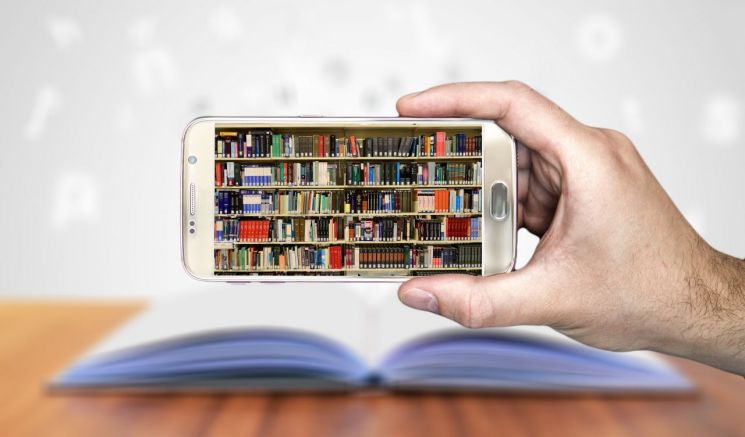 Although the position of paper books is shrinking due to OTT platforms providing video services such as Netflix and electronic books, some young people prefer paper books.
 [Image source=Pixabay]
The increasing proportion of e-books, emphasizing economic efficiency, also narrows the position of paper books. Yoon Su-hyun (32), who enjoys reading regularly, said, "I first stepped into e-books when I used e-books provided online. Since smartphones are an essential item that people cannot separate from these days, being able to read books anytime and anywhere using them is comfortable, so at some point, I stopped looking for paper books." She added, "Even when the book I want to read hasn't been published as an e-book yet, I set up notifications and wait."
The 'e-book trend' phenomenon is also reflected in statistics. According to the Korea Publishers Association, the sales of e-book subscription platforms 'Millie's Library' and 'Ridibooks' increased by 75.3% and 34%, respectively, compared to the previous year in 2020. Considering that the average monthly book purchase cost per person was 11,144 KRW in 2020, the paper book market is expected to shrink further. Moreover, if the proportion of digital publishing continues to expand, the population using e-books instead of paper books is expected to increase.
As a result, concerns about the 'end of paper books' have been repeated for years, but a new atmosphere is emerging as young people who insist on paper books appear riding the 'Newtro' trend after COVID-19. The unique certification culture of the 2030 generation stimulates 'reading motivation.' Additionally, the gap of up to about one year between the publishing times of paper books and e-books is another reason for seeking paper books.
A university student A (21), who insists on only paper books, explained, "I studied with an iPad when I was in high school. I scanned textbooks and made PDF files to create electronic textbooks myself, or took notes on the pad during class, which was neat and could be modified anytime, so it was convenient. But I felt that learning knowledge with digital devices was not efficient. I often only remembered reading and taking notes but not the actual content. Now I only read paper books, and maybe because of the feeling of turning pages one by one, it stays in my memory longer."
 Although the position of paper books is shrinking due to OTT platforms providing video services such as Netflix and electronic books, some young people prefer paper books. [Image source=Pixabay]
Jang Mo (27), an avid reader who occasionally shares 'Bookstagram' (book + Instagram, certifying reading scenes) on SNS, said, "I am the type to carefully compare and decide even when buying a single pair of socks, and I also go to bookstores to check the content before buying books. I can savor the book by underlining or touching the paper, and the fact that I can keep it for life is a big attraction." She added, "I get stimulated by Bookstagram, and I post reading certification photos hoping others will also get intellectual stimulation."
The popularity of paper books can also be confirmed by the number of posts tagged 'Bookstagram.' As of the 9th, there are a total of 4.87 million posts searchable under 'Bookstagram.' Among young people, paper books are also used for emotional purposes, and a new term 'collection school' has emerged, meaning people who collect books without reading them. This seems to be thanks to the unique 'realistic' charm of paper books that e-books cannot replace.
Reading management expert Jo Seok-jung said, "Because of the unique charm of paper books, I believe demand will remain steady in the future. In fact, people read books to satisfy their desire for content, and whether they approach it in the form of e-books or paper books is related to the purpose of reading." He explained, "For self-development books where you want to quickly see conclusions and solutions or access various content, e-books are preferred, while for novels where the overall context, description, and reflection are important, paper books tend to be chosen. The reason young generations seek paper books seems to be that they have come to appreciate the pleasure of turning pages."
He continued, "While paper books have their role, digitization is necessary to gather vast amounts of data in one place, and the National Library of Korea is already working on digitizing old documents. Because of this, the talk that paper books will disappear continues. Being able to read paper books at this time is a blessing," he said.
© The Asia Business Daily(www.asiae.co.kr). All rights reserved.



















