Demand Deposits + MMDA of 4 Major Banks Decrease by 8 Trillion Won in One Month
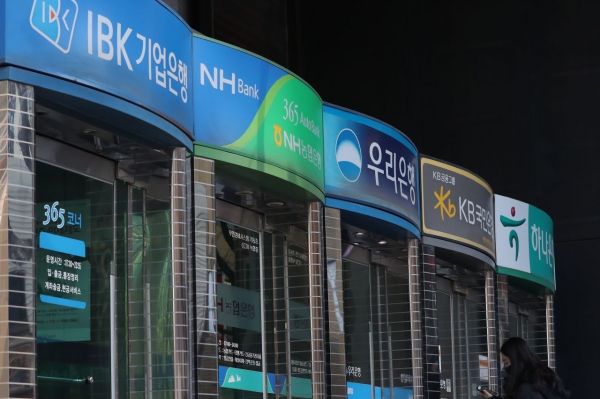
[Asia Economy Reporter Yu Je-hoon] As interest rate hikes become full-scale, competition for deposits in the financial sector is intensifying. While low-cost deposits, which have been the foundation of the strong performance of commercial banks, have turned to a declining trend and banks are struggling to find countermeasures, internet-only banks and mutual financial institutions are rapidly absorbing idle funds in the market by offering relatively high interest rates.
According to the financial sector on the 9th, the low-cost deposits, which combine demand deposits and money market deposit accounts (MMDA) of the four major domestic commercial banks (KB Kookmin, Shinhan, Hana, Woori) as of the end of last month, amounted to 584.1213 trillion won, down 8.3259 trillion won from the previous month.
Low-cost deposits, commonly encountered as salary accounts, have interest rates of only about 0.1~0.3%, and are called ‘core deposits’ by commercial banks. Because funds can be raised at a low cost, they contribute to expanding the net interest margin (NIM). The impact of such low-cost deposits was not insignificant in commercial banks achieving record-high earnings in the first quarter of this year following last year. Since interest rate hikes began in earnest last year and asset markets continued to slump, idle funds in the market flowed into low-cost deposits.
Recently, despite the sluggish asset market and rising deposit interest rates, the scale of low-cost deposits at commercial banks has turned to a declining trend due to seasonal demand for funds. Household demand for funds is increasing as the moving season intensifies, and companies are also expanding their demand for funds for new investments.
In particular, intensified competition for deposit attraction with internet-only banks and mutual financial institutions is also a main cause. Toss Bank’s parking account, which offers an annual interest rate in the 2% range launched last year, attracted 17 trillion won of market funds within six months of its release. In the case of KakaoBank, the proportion of low-cost deposits reached 59.7% as of the first quarter, surpassing commercial banks (about 42~52%).
Recently, idle funds in the market have also been flowing into mutual financial institutions such as Saemaeul Geumgo and credit cooperatives. As the interest rate hike period has begun, each institution is competitively launching high-interest special products. According to the Bank of Korea’s Economic Statistics System, the deposit balance of the mutual financial sector at the end of February was 430.9834 trillion won, an increase of 3.6734 trillion won compared to the end of the previous year.
Commercial banks are also devising countermeasures. Lee Sung-wook, Vice Chairman of Woori Financial Group, said at the first-quarter earnings conference call last month, "If interest rates rise in the future, I am concerned that the growth of core low-cost deposits may slow down a bit."
The financial sector expects the competition for such low-cost deposits to accelerate further. Since the U.S. Federal Open Market Committee (FOMC) last week implemented a so-called ‘big step’ by raising the base rate by 0.5 percentage points and hinted at the possibility of additional hikes within the year, there is a high possibility of continued asset market sluggishness and further interest rate hikes domestically.
Internet-only banks are also actively raising deposit interest rates to shake off the chase from commercial banks. As commercial banks preemptively raised deposit interest rates by up to 0.40 percentage points, these banks are also joining the rate hike trend. KakaoBank raised interest rates on free savings and fixed deposits by 0.10~0.40 percentage points last week. The basic interest rate of the parking account Safe Box was also raised by 0.10 percentage points to an annual rate of 1.20%.
© The Asia Business Daily(www.asiae.co.kr). All rights reserved.

















