The Biggest Crisis of the COVID-19 Pandemic... Plunged to 1400 in 2020
Retail Investors Counter Departing Institutions and Foreigners... First Time Driving Beyond 3000 Points
[Asia Economy Reporter Myunghwan Lee] 2200→2600→1400→3300→2600.
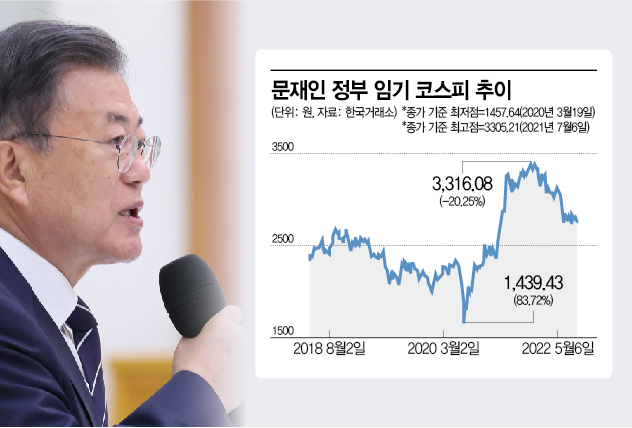
During the five-year term that ended on the 10th, President Moon Jae-in's tenure saw the KOSPI surpass the 3000-point mark for the first time in history. This was achieved despite the global stock markets plunging repeatedly due to the COVID-19 pandemic. Behind this was the stock investment boom led by individual investors, known as the "Donghak Ant Movement." However, with the index retreating daily this year due to the Ukraine war and the U.S. Federal Reserve's tightening policies, the capital market policies of the next administration are expected to be crucial.
The KOSPI, which closed at 2270.12 on May 10, 2017, the day President Moon took office, steadily rose and surpassed the 2500-point mark in early 2018. The first crisis to hit the domestic stock market was the U.S.-China trade dispute. In March 2018, then U.S. President Donald Trump announced high tariffs on Chinese products, opening the trade war, and the KOSPI retreated to the low 2000s and remained in a trading range. As tensions between the two countries intensified, the KOSPI hovered below 2000 around August 2019.
The biggest crisis the domestic stock market faced during his term was the COVID-19 pandemic. In February 2020, as COVID-19 spread worldwide including South Korea, global stock markets fluctuated wildly. The index, which had been moving in the low 2000s in early 2020, began to fall sharply from late February due to the impact of COVID-19. In March of the same year, the 2000-point level collapsed again, and on March 19, it retreated to an intraday low of 1439.43.
The turning point for the declining domestic stock market was individual investors, called "ants." A stock investment craze swept among individual investors, significantly increasing their investment scale. In the domestic stock market, where foreigners and institutions had left due to the pandemic, the ants became major players and helped overcome the market crisis. In the first half of 2020, individuals net bought 32 trillion won in the KOSPI, countering institutions and foreigners who sold 10 trillion won and 25 trillion won respectively. Kim Dae-jun, a researcher at Korea Investment & Securities, stated in a report released in July 2020 that "individual investors are effectively driving stock prices in a market abandoned by foreigners and institutions."
Fueled by this, the KOSPI showed explosive growth from the low point on March 23. On January 6, 2021, it surpassed the 3000-point mark intraday for the first time ever. The KOSPI continued to rise steadily and reached an intraday record high of 3316.08 on June 25 of the same year. The closing price hit a historic peak of 3305.21 on July 6.
As the new government prepares to take office, the domestic stock market is facing another crisis. Due to the emergence of COVID-19 variants such as Omicron and the global economic downturn, the KOSPI fell below the 2700-point level early this year. With adverse factors such as the Ukraine war and the U.S. Fed's big step (a 0.5 percentage point hike in the benchmark interest rate) accumulating, analyses suggest that the next government's capital market policies will be important.
President-elect Yoon Suk-yeol pledged during his campaign to abolish capital gains tax on stocks, restrict corporate physical division, and improve the short-selling system. Han Ji-young, a researcher at Kiwoom Securities, said about the next government's policies, "The direction of the domestic stock market is more influenced by external variables," but added, "Since the capital market development pledges are given considerable emphasis, there are factors that could re-rate the stock market in the mid to long term."
Meanwhile, comparing the index on May 10, 2017, the day President Moon took office, and the recent trading day on the 6th, the KOSPI rose by 15.34%. This is higher than the 3.89% increase during the previous administration under President Park Geun-hye. Considering the COVID-19 pandemic situation, this performance is regarded as commendable.
© The Asia Business Daily(www.asiae.co.kr). All rights reserved.
![From Hostess to Organ Seller to High Society... The Grotesque Scam of a "Human Counterfeit" Shaking the Korean Psyche [Slate]](https://cwcontent.asiae.co.kr/asiaresize/183/2026021902243444107_1771435474.jpg)
















