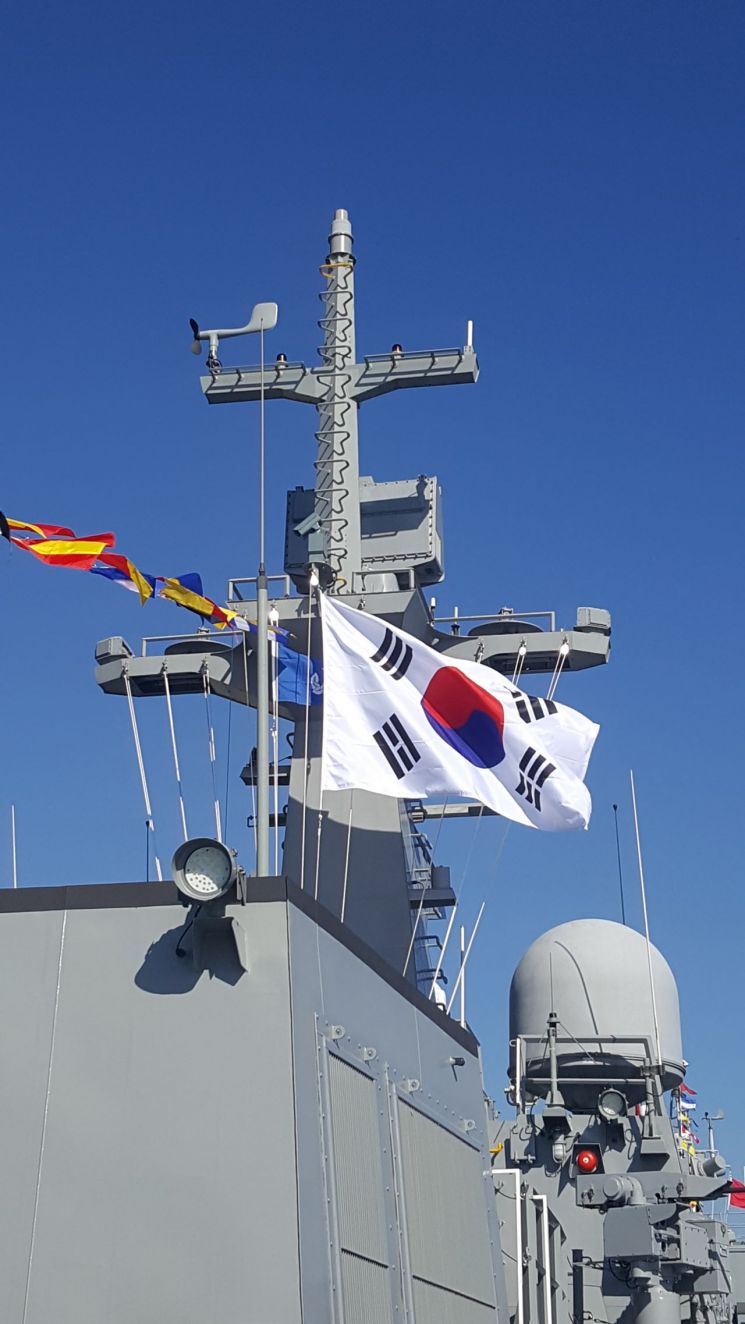
 ES equips two units at the center of the trap called the Master. ES can detect missile signals, similar to a person's fingerprint, and analyze the type of missile within one second.
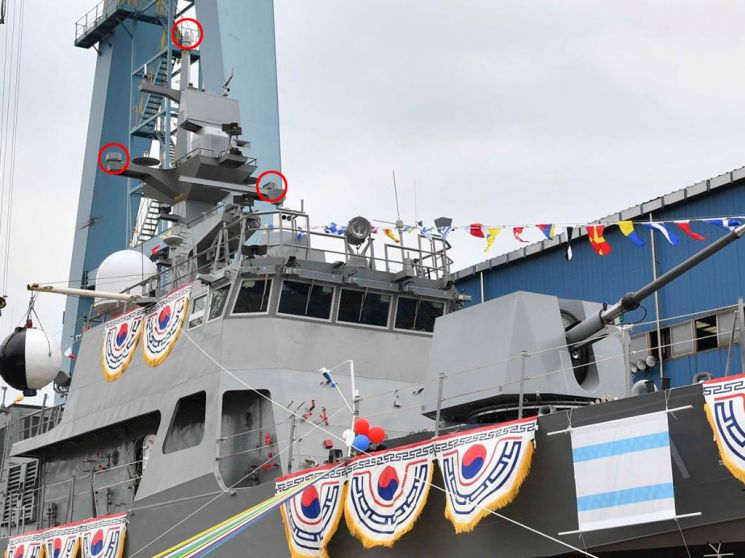 ES equips two units on the master at the center of the trap. ES can detect the missile's radio waves, which are unique like a person's fingerprint, and analyze the type of missile within one second.
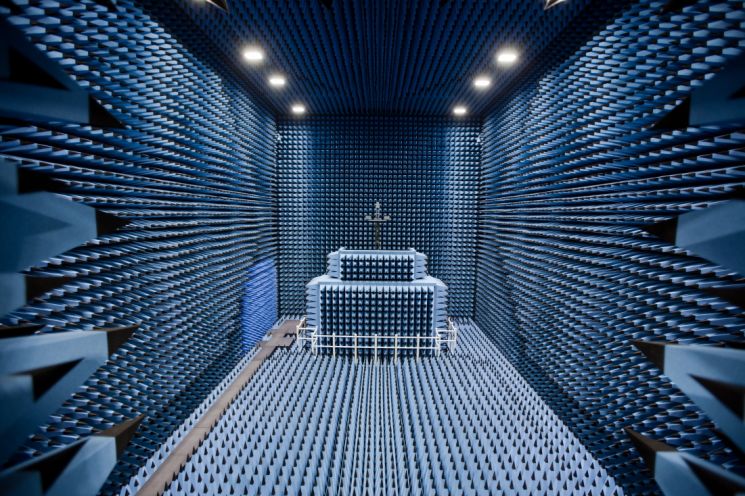 The electronic warfare test chamber, commonly called the chamber, measures 23 meters in width, 14 meters in length, and 14 meters in height.
[Asia Economy Yang Nak-gyu, Military Specialist Reporter] Our military recognized the importance of electronic warfare after the 1990 Gulf War. Electronic warfare refers to military actions that disrupt enemy radio waves to disable weapon systems or analyze radio waves emitted by the enemy. The first electronic warfare systems introduced by our military were the French Thomson company's TRC-613L Electronic Attack (EA) equipment and TRC-274C Electronic Support (ES) equipment. The EA equipment emits high-frequency waves toward North Korean forces to disrupt wireless communication networks, while the ES equipment sets a frequency range within a certain area to analyze intercepted radio waves. Currently, domestic small and medium defense companies have succeeded in localization and are leading the electronic warfare systems. To observe domestic technological capabilities, we visited VICTEK located in Icheon, Gyeonggi Province on the 2nd.
Exiting the Deokpyeong Interchange (IC) in Gyeonggi Province, a vast fertile plain typical of a premium rice production area came into view. As we ventured into the plain, the VICTEK signboard caught our eye. Upon entering the main building of VICTEK, we could see physical mockups of electronic warfare equipment, but these devices were difficult for the general public to understand.
When the enemy activates radar or launches various missiles, radio waves are emitted. Equipment that quickly detects and alerts these radio waves is electronic warfare equipment. Research Director Jo Won-sang explained, “The equipment produced by VICTEK is an electronic warfare direction-finding device (ES, electronic support) that detects the distance, speed, and direction when the enemy launches a missile, enabling a response.”
The actual size of the ES mounted on small vessels is about 1 meter in width and length. Two ES units are installed at the master station in the center of the vessel. The ES captures missile radio waves, which are like fingerprints, and can analyze the missile type within one second. This is possible due to an artificial intelligence (AI)-based algorithm.
Following vessels, VICTEK also developed the country's first ES for submarines. Before a submarine surfaces, it can check whether enemy radar is operating, ensuring the survival of soldiers. Until now, the Navy's submarine ES was imported from overseas, which meant repairs took at least over a year. The company expects that equipping domestically produced ES on the 209-class submarines will reduce repair times to within a month.
VICTEK also developed Lidar, a radar using light. Soldiers can identify objects ahead through radar, cameras, and lidar. However, radar has difficulty distinguishing object shapes, and cameras struggle to measure distance. Lidar was developed to address these issues. The Hi-Pass system used by civilians on highways to pay tolls also recognizes vehicles using lidar. VICTEK developed a military-grade lidar with 32 channels to enhance precision. Their product, operable even at minus 40 degrees Celsius, is the world's first. Currently, in partnership with a large defense company, they plan to showcase military autonomous vehicles equipped with lidar.
Namgung Hoon, Head of New Business, said, “If the detection range of lidar is extended by about 1 km, it can detect drones that radar cannot capture, making it usable as an anti-drone system,” adding, “We also plan to produce lidar for perimeter surveillance.”
We then moved to the electronic warfare test site located 10 minutes away by car. Known as the chamber, it measures 23 meters wide, 14 meters long, and 14 meters high. Thousands of carbon fiber electromagnetic wave absorbers, resembling thorns on tree branches, were attached to the interior walls. This is to prevent interference from external electromagnetic waves when the door is closed. VICTEK invested 12 billion won to build the test site in 2015, and among small and medium enterprises, VICTEK is the only one to own an electronic warfare test site. This explains why, through technological prowess and bold investment, they are on the verge of reaching cumulative sales of 1 trillion won.
© The Asia Business Daily(www.asiae.co.kr). All rights reserved.
![Clutching a Stolen Dior Bag, Saying "I Hate Being Poor but Real"... The Grotesque Con of a "Human Knockoff" [Slate]](https://cwcontent.asiae.co.kr/asiaresize/183/2026021902243444107_1771435474.jpg)


















