[Seoul District News] Seongdong-gu Completes Safety Verification of Precise Safety Inspection by Korea Institute of Architectural Structure Technology, Concludes Safety Secured in All Evaluation Items "No Building Safety Issues" Korean Architectural Institute States "Microvibrations Caused by Resonance Phenomenon Pose No Safety Risk"... Seodaemun-gu Operates 'Mobile Palm Citizen University'... Nowon-gu Completes Survey on Living Conditions of North Korean Defectors... Gwanak-gu Seoul Startup Cafe Nakseongdae Branch Recruiting Companies for 'BM Diagnosis and Advancement Program'... Yongsan-gu 2022 Second Half Safe Job Project Participants 11
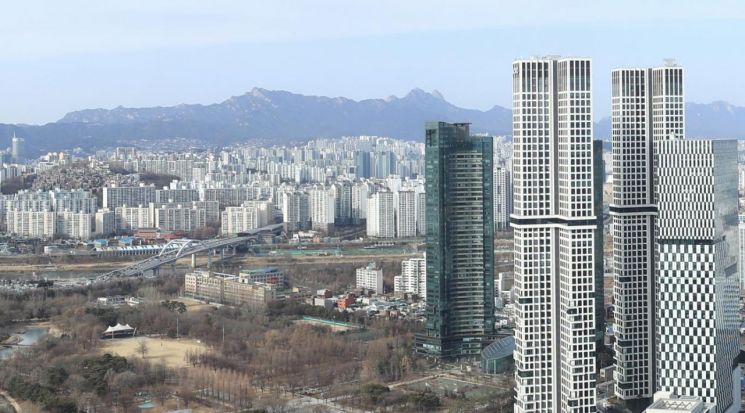 A view of D-Tower Seoul Forest office facilities and surrounding areas from above Seongsu-dong. A detailed safety inspection conducted following the vibration incident in January revealed no safety issues.
[Asia Economy Reporter Park Jong-il] Seongdong-gu announced on the 29th of last month at the ‘Acro Seoul Forest D Tower Detailed Safety Inspection Stakeholders Briefing’ that there were no accident-inducing factors found in the office facility where vibration disturbances occurred earlier this year.
Regarding the Seoul Forest office facility building where abnormal vibration phenomena occurred on some floors in January, a detailed safety inspection was conducted under public management. As a result, the Korea Society of Architectural Structure Engineers, which performed the detailed safety inspection, confirmed that D Tower Seoul Forest has no structural issues. In fact, the detailed safety inspection found no significant defects in the building’s exterior, columns, beams, or other major structural members, nor were any special defects found due to increased usage or load.
In particular, displacement measurements to verify the actual impact of vibrations showed that inclinations, settlements, and deflections of steel beam members were all within allowable displacement limits. The structural safety review for building usage loads also confirmed that all members met the standards.
Professor Lee Cheol-ho of Seoul National University’s Department of Architecture, who was responsible for the detailed safety inspection service, explained, “The detailed safety inspection results showed no abnormalities in building safety, and especially in the vibration-related inspection areas, no factors that could cause safety accidents were found.”
Meanwhile, on the same day, Seongdong-gu also announced that through the Korea Society of Architectural Structure Engineers, a third-party verification was conducted on the ‘D Tower Seoul Forest Vibration Cause Investigation and Countermeasure Establishment Report’ previously conducted by the Architectural Institute of Korea, but no issues were found. The on-site experiments, measurements, analyses, and result evaluations for the report were all deemed valid.
Earlier, on the 22nd of last month, the Architectural Institute of Korea announced that the vibration at D Tower Seoul Forest was due to a resonance phenomenon caused by rhythmic behavior on specific floors within the building. After identifying the vibration cause through multiple group rhythmic simulation load tests and measurements, it concluded that there was no abnormality in building safety due to the vibrations. The report was concluded by proposing vibration reduction measures for the floors where vibrations occurred.
A Seongdong-gu official said, “Although an emergency on-site inspection in January confirmed no safety issues, a detailed safety inspection was conducted for precise safety confirmation, leading to this final conclusion. We will continue to make active efforts to ensure a safe Seongdong-gu.”
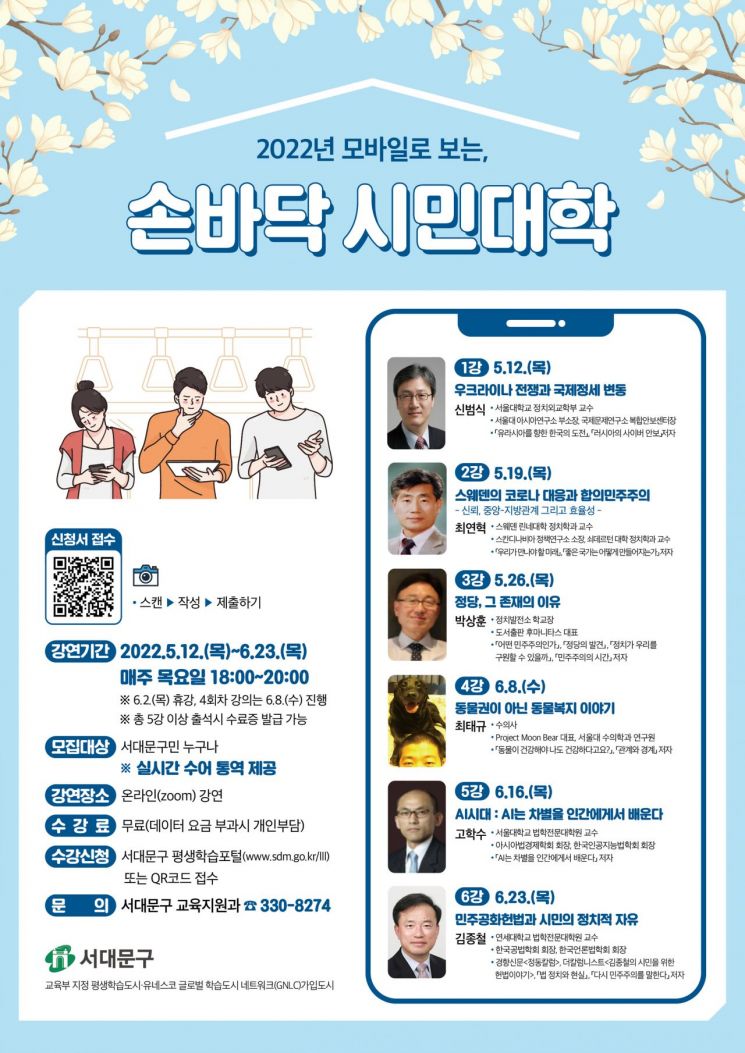
Seodaemun-gu (Mayor Moon Seok-jin) will hold the ‘Palm-sized Citizen University Viewed via Mobile’ to raise residents’ awareness of democracy and enhance understanding and response capabilities to social phenomena.
The term ‘Palm-sized’ is used to indicate that the courses can be conveniently taken via smartphone.
The program will be held online (via Zoom) every Thursday from 6 to 8 p.m. from the 12th of this month to the 23rd of next month, with sign language interpretation provided. However, the fourth lecture will be held on Wednesday, the 8th of next month, at the same time, and there will be no lecture on the 9th.
The six-session course will cover ▲The Ukraine War and Changes in International Affairs (Shin Beom-sik) ▲Sweden’s COVID-19 Response and Consensus Democracy (Choi Yeon-hyeok) ▲Political Parties, Their Reason for Existence (Park Sang-hoon) ▲Animal Welfare, Not Animal Rights (Choi Tae-gyu) ▲The AI Era: AI Learns Discrimination from Humans (Go Hak-su) ▲Democratic Republican Constitution and Citizens’ Political Freedom (Kim Jong-chul).
Any Seodaemun-gu resident who applies in advance can attend for free (however, personal data charges apply if incurred), and those who attend five or more lectures will receive a certificate of completion.
Applications can be made through the Seodaemun-gu Lifelong Learning Portal (Program → Program List), and for more details, contact the Seodaemun-gu Office Education Support Division.
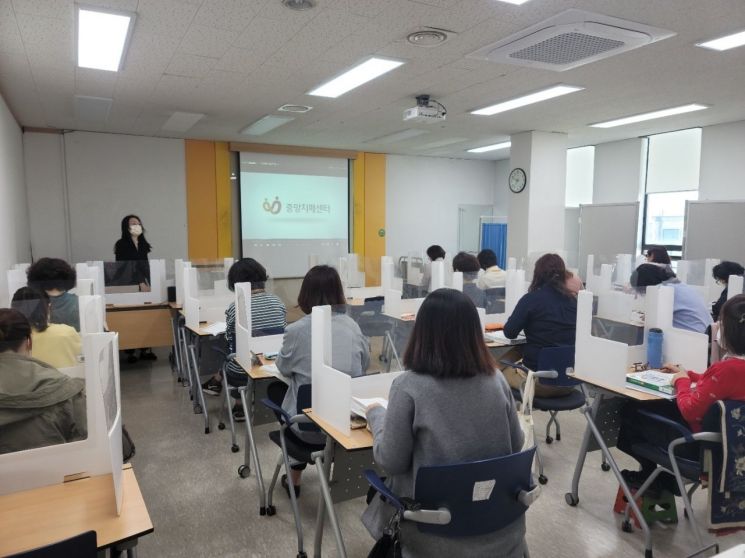
Nowon-gu announced that it has completed a survey to improve the settlement satisfaction of North Korean defectors and support their stable independence within the local community.
Earlier this year, a 30-year-old North Korean defector who returned to North Korea about a year after defecting became a major social issue. In response, the district planned this survey to check the safety of defectors residing in the area and to accurately understand their status to prepare comprehensive and systematic support measures.
In February, the district conducted a full survey targeting 1,002 North Korean defectors residing in the area. The survey achieved a high response rate of 80% (797 people) as social welfare officers at each community service center contacted respondents by phone or direct visits, enhancing the reliability of the results.
The survey focused on examining the living conditions, social participation desires, major problems experienced in South Korean life, and crisis levels of North Korean defectors. It was conducted in two stages: a ‘Living Environment Survey’ to understand basic information and social relationships, and a ‘Major Problems and Needs Survey’ to assess satisfaction with South Korean life and crisis levels.
Among respondents, 441 people (55%) belonged to socially vulnerable groups such as basic livelihood security recipients (434 people) or those with reduced self-pay under the second-lowest income bracket (2 people). Despite this, 86% (686 people) expressed satisfaction with their life in South Korea. This is analyzed as a result of the effectiveness of social security policies and support measures for vulnerable groups continuously promoted by the district.
The district has been implementing various support projects to help North Korean defectors settle safely in the community. A 2020 survey of defectors showed the highest demand for employment and technical qualification acquisition, leading to the launch of a vocational training tuition support project for certification acquisition last year. Through this project, 8 out of 10 participants obtained caregiver certification.
This year, a Barista Level 2 certification course was newly added. The district fully supports tuition and exam fees for 12 weeks of theory and practical training. Residents who obtain certification will be connected with related organizations for employment placement.
There is also an education support project for defectors’ children. For preschool and elementary school children who face learning difficulties due to language and cultural differences, one-on-one customized home tutoring is provided once a week in one subject chosen from Korean, English, or Math upon application for child learning support.
The survey also found that the biggest recent problems and difficulties faced by defectors were ‘health deterioration (143 cases/18%)’ and ‘economic problems (129 cases/16%)’, with strong demands for medical, employment, and emergency living expense support.
The district analyzed the survey results and classified living environment crisis levels as ‘high/medium/low’ and major problems and needs crisis levels as ‘high-risk/medium-risk/low-risk’. The classification identified 9 people in the ‘high’ crisis level and 3 people in the ‘high-risk’ group.
The district plans to provide tailored welfare support through professional counseling and integrated case management for these individuals. In cases of complex or special situations, follow-up management plans will be developed in cooperation with related institutions such as the Seoul Northern Hana Center and Nowon Police Station. Other households needing support will be linked to public benefits and emergency support services.
A district official said, “Rather than being complacent with the 86% satisfaction rate among defectors, we will strive to resolve the difficulties of the remaining 14%. We will spare no effort to help North Korean defectors accept our society as their new home and settle successfully.”
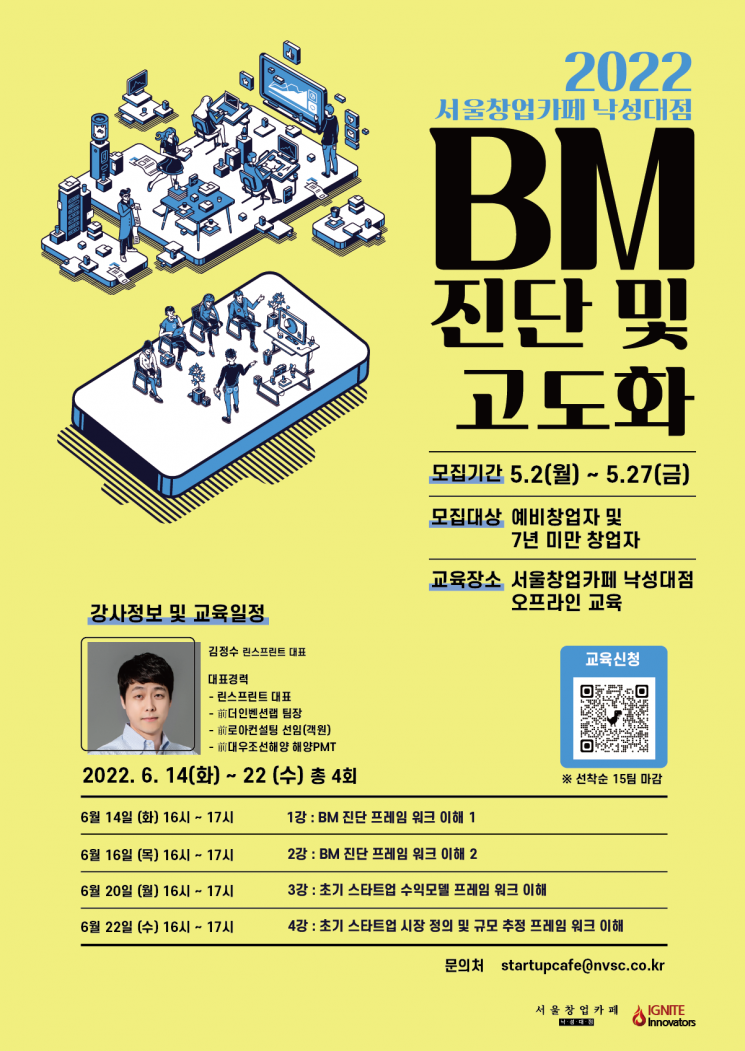
The Seoul Startup Cafe Nakseongdae Branch (1928 Nambusunhwan-ro, Gwanak-gu) located in Gwanak-gu is conducting a ‘BM Diagnosis and Advancement Program’ for prospective and new entrepreneurs.
The ‘BM Diagnosis and Advancement Program’ is an educational course that guides how to build a BM (Business Model) that fits a company’s products and services, helping to establish a clearer business plan.
In particular, the program focuses on prospective or early-stage entrepreneurs whose BMs are unstable and not systematized.
The training will be held offline at the Seoul Startup Cafe Nakseongdae Branch over four sessions from June 14 to 22, led by instructor Kim Jung-soo (CEO of Lean Sprint), who is currently active as an accelerator and specializes in BM advancement.
The program consists of basic skills on BM diagnosis frameworks, understanding early startup revenue model frameworks, and understanding early startup market definition and size estimation frameworks.
The recruitment target and scale are 15 startups within seven years of establishment residing in Seoul, and prospective entrepreneurs can also apply.
The application period is until May 27, and applicants will be accepted on a first-come, first-served basis via a Google form.
A district official said, “We hope this training will provide (prospective) entrepreneurs with an opportunity to establish a business model that fits their products and services. We will continue to strive to drive innovative growth of venture and startup companies through various incubation programs.”
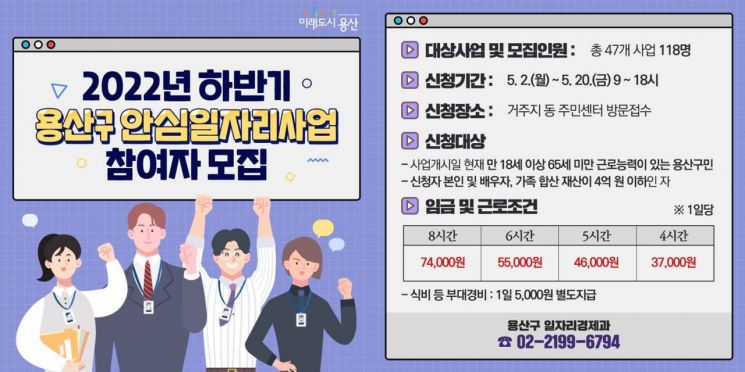
Yongsan-gu (Mayor Seong Jang-hyun) is recruiting participants for the second half of 2022 Safe Jobs Project (formerly Public Work Project) until the 20th of this month.
The project period is from July 1 to December 20. The district will select 118 workers across 47 fields.
Main projects include ▲COVID-19 quarantine management support within the partially opened Yongsan Park site ▲quarantine and environmental maintenance of traditional markets ▲operation of on-site application centers for small business loss compensation ▲inspection of transparent PET bottle separation and disposal, among others.
Residents wishing to participate should visit their local community service center with an application form, consent form for personal information collection, job registration certificate, and ID.
Related forms are available at community service centers and can also be downloaded from the district website’s announcements/notices section.
Eligibility requires Yongsan-gu residents aged 18 to under 65 with work ability as of the project start date. Those with assets exceeding 400 million KRW, income exceeding 70% of the median income, or two participants from the same household are excluded.
A district official stated, “From the second half of the year, the wage payment date has been changed from the 5th to the 10th, and paid leave for congratulatory and condolence events has been formalized, similar to public officials.”
The district will select candidates considering project-specific qualifications (preferences), applicants’ assets, household income, and participation period in public job projects. Results will be individually notified on the 21st of next month.
Work conditions are five days a week, up to six hours per day. Wages are 55,000 KRW per day (based on six hours), with some specialized personnel receiving 57,000 KRW. An additional 5,000 KRW for incidental expenses is provided. Weekly and annual leave allowances are also paid.
Additionally, the district designates and operates workplace safety managers and establishes detailed plans for preventing major industrial accidents tailored to workplace conditions to create a safe working environment.
Yongsan-gu Mayor Seong Jang-hyun said, “Public jobs are expected to help revitalize the local economy, which has begun to recover following the lifting of social distancing measures.”
© The Asia Business Daily(www.asiae.co.kr). All rights reserved.



















