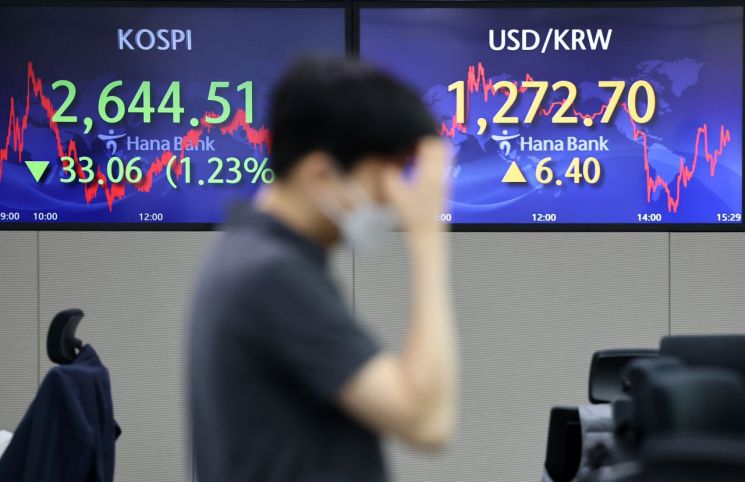
[Asia Economy Reporter Seo So-jeong] The won-dollar exchange rate surged to the 1,270-won level, and the interest rate inversion between South Korea and the U.S. has become a reality, placing a heavy burden on the new government. With exchange rate volatility expected to increase for the time being, calming financial market instability has emerged as a critical task.
According to the Seoul foreign exchange market on the 8th, the won-dollar exchange rate closed at 1,272.7 won per dollar on the 6th, up 6.4 won from the previous trading day. This is the highest level in 2 years and 1 month since March 19, 2020 (1,285.7 won, closing price), when the financial market was shocked at the early stage of the COVID-19 outbreak.
On the same day, the KOSPI closed at 2,644.51, down 33.06 points (1.23%) from the previous trading day, continuing its decline for the fourth consecutive day amid selling pressure from foreigners and institutions.
Concerns over U.S. monetary tightening are spreading, increasing financial market instability. The U.S. Federal Reserve (Fed) raised the benchmark interest rate by 0.5 percentage points at once on the 4th (local time) and announced plans to continue additional big steps.
If the Bank of Korea’s Monetary Policy Committee freezes the interest rate at its meeting on the 26th, and the U.S. Fed raises the rate by 0.5 percentage points at the Federal Open Market Committee (FOMC) meeting on June 14-15, the interest rates of South Korea and the U.S. will be equalized at 1.50%. The interest rate inversion between the two countries could become an imminent crisis starting in July.
If the U.S. Fed raises the benchmark interest rate by 0.5 percentage points each in June and July, the upper limit of the U.S. benchmark rate will rise to 2.00%. The Bank of Korea would need to consecutively raise its current 1.50% benchmark rate by 0.25 percentage points in May and July to barely match this level. However, since the Bank of Korea has never consecutively raised the benchmark rate three times, the likelihood of this happening is considered low.
What is particularly problematic is the unusual atmosphere in the foreign exchange market. With the won weakening and the prospect of interest rate inversion added, concerns over capital outflows are growing. Cho Young-moo, a research fellow at LG Economic Research Institute, said, "The unusually rapid pace of U.S. rate hikes and the sharp depreciation of the won, even before the interest rate inversion has materialized, are among the factors increasing the possibility of capital flight." He added, "If the won-dollar exchange rate continues to rise, foreign capital outflows could expand further, exacerbating stock price declines, rising market interest rates, and additional depreciation of the won."
Kim Jung-sik, Professor Emeritus at Yonsei University, emphasized, "If South Korea’s trade deficit continues and the exchange rate rises above 1,300 won, the country will be exposed to the risk of a foreign exchange crisis," adding, "Stabilizing the foreign exchange market will be an important task for the new government."
© The Asia Business Daily(www.asiae.co.kr). All rights reserved.

















