From January 3 to May 6 this year,
Samsung Electronics fell 14.94%
while Hanshin Machinery rose 270%
[Asia Economy Reporter Kwon Jae-hee] Since the beginning of this year, large-cap and mid-cap stocks in the KOSPI market have declined, while small-cap stocks alone have risen. With the new government launching on the 10th, investment sentiment is expected to focus on policy beneficiary stocks, indicating that a stock-specific market trend will continue for the time being.
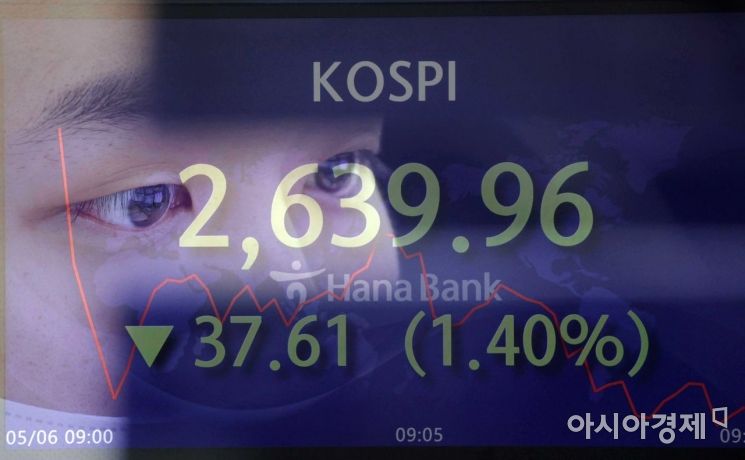
According to the Korea Exchange on the 8th, the KOSPI index fell by 11.19% from the first trading day of the year on January 3rd to the 6th of this month.
The larger the market capitalization, the greater the decline. During the same period, large-cap stocks ranked 1st to 100th by market capitalization in the KOSPI fell by 11.14%, and mid-cap stocks ranked 101st to 300th dropped by 4.76%. In contrast, small-cap stocks, composed of the remaining companies, rose by 4.47%.
Among the top large-cap stocks by market capitalization, Samsung Electronics fell by 14.94%, and SK Hynix also dropped by 18.32%. Additionally, investment sentiment toward growth stocks froze, causing internet and gaming stocks such as Krafton (-44.57%), Kakao Pay (-42.87%), NCSoft (-35.54%), Kakao Bank (-31.95%), Naver (-28.53%), and Kakao (-24.36%) to plunge sharply.
On the other hand, stocks that recorded gains of over 100%, including Hanshin Machinery (270.88%), Ildong Holdings (198.65%), Hanil Steel (128.79%), HiSteel (127.49%), Korea Industries (107.22%), and Shinsong Holdings (105.20%), were all small-cap stocks.

The KOSDAQ market also saw large-cap stocks take the brunt of the market downturn.
The KOSDAQ index fell by 14.48% since the beginning of the year. The decline was largest among large-cap stocks (-21.80%), followed by mid-cap (-11.93%) and small-cap stocks (-4.53%).
The sluggish performance of large-cap stocks is attributed to foreign investors selling about 11 trillion won in the KOSPI this year, leading to capital outflows mainly from large-cap stocks. Mid- and small-cap stocks, which have lower foreign ownership and greater volatility by stock and theme, were relatively less affected.
Kim Dae-jun, a researcher at Korea Investment & Securities, said, "The U.S. is raising interest rates at a very rapid pace, and currently, there seems to be no factor that can stop the dollar's strength for the time being. Until inflation stabilizes and the tightening intensity weakens, large-cap stocks are expected to continue underperforming compared to mid- and small-cap stocks."
He added, "With the new government launching next week, expectations for industry and stock price support related to newly implemented policies will arise, and a stock-specific market may continue."
Some argue that the mid- and small-cap stock-led market trend will soon weaken, suggesting it is time to restructure portfolios focusing on large-cap stocks.
IBK Investment & Securities explained in a recent report, "The strength of mid- and small-cap stocks cannot continue. For mid- and small-cap earnings momentum stocks to keep rising, continuous capital inflow is necessary, but current buying funds for mid- and small-caps are not new investment funds but funds from selling large-cap stocks, so sustainability is low."
They added, "With large-cap earnings upgrades, capital inflows to mid- and small-caps may shrink, so expanding the proportion of large-cap or passive investments is necessary," citing the automobile and secondary battery sectors as top preferred sectors with earnings momentum, and semiconductors as the next preferred sector with potential bottoming.
© The Asia Business Daily(www.asiae.co.kr). All rights reserved.

















