Focused Investment in Quantum Technology, a Next-Generation Innovation
Leap to Become a Global Hub in 'Nano and Materials Technology Development' Field
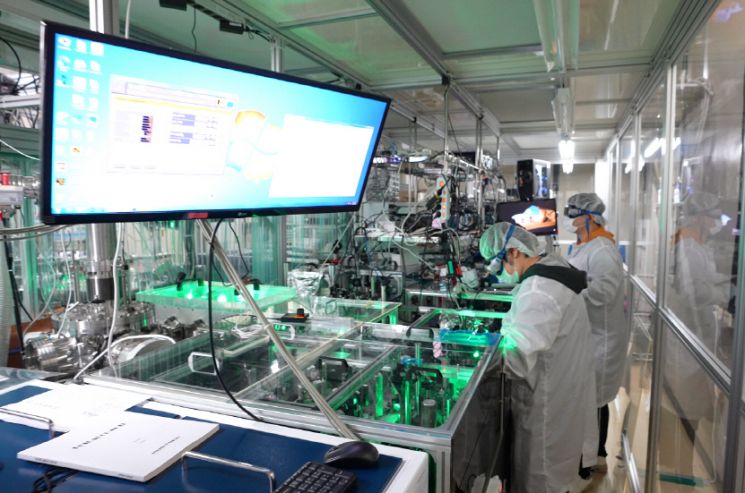 An experiment on attoseconds, which are one-tenth of a femtosecond, is underway. Pohang City and others have been finally selected for the national top 10 strategic technology quantum-based public project, securing a research budget of 30.1 billion KRW over six years.
[Asia Economy Yeongnam Reporting Headquarters Reporter Kim Yong-woo] Pohang City has been finally selected for the national quantum-based public project, one of the country's top 10 strategic technology projects.
Pohang City and the Max Planck Korea-Pohang University of Science and Technology Center for Quantum Materials (MPK) secured a total project budget of 30.15 billion KRW, including 17.25 billion KRW in national funding over six years, for the "Quantum-based Nanomaterial Technology Development to Overcome the Limits of New Materials" public project promoted by the Ministry of Science and ICT on the 4th.
The core of this research project is to replace current quantum technology limitations with topological qubits based on topological quantum materials and to develop new quantum materials and devices.
To this end, research will be conducted utilizing international large-scale facilities by linking the Pohang 4th Generation Accelerator (PAL-XFEL) and the German European XFEL.
Current quantum technology is vulnerable to external environmental factors such as vibration, heat, electrical, and magnetic noise, which limits stability and scalability. Accordingly, while 200 error-free qubits require 100,000 existing superconducting qubits, implementing qubits with topological superconductors can achieve this with as few as 1,000 qubits.
Pohang City plans to establish a world-class research hub by additionally attracting the Helmholtz Institute alongside the already hosted MPK, POSTECH, and Fraunhofer IISB Practical Research Center.
Based on this, through a research platform involving three major German institutions, they plan to promote world-leading research for developing core materials of new-concept quantum matter.
From basic research covering spatiotemporal characteristic studies of quantum matter materials, new-concept quantum device implementation, and device standardization, to integrated research in the pre-industrialization stage, this is expected to create new markets by securing leading basic source technologies.
Since its establishment in 2011, the Max Planck Korea-POSTECH Research Center has involved over 80 researchers and secured world-class basic source technologies and fostered experts in fields such as "Development of Rare Earth Substitute Advanced Composite Material-Based Permanent Magnet Source Technology" and "Korea-Germany Global Talent Development Platform Project," focusing on ultrafast dynamics and advanced composite material research.
Park Jae-hoon, Director of MPK, said, "We plan to conduct research utilizing a world-class research platform and cutting-edge global research facilities," adding, "We will focus on securing basic source technologies in quantum materials and devices, nano-processing, and nano-imaging."
Lee Jang-sik, Acting Mayor of Pohang, said, "As global competition for technological supremacy intensifies, the quantum field is one of the nation's top 10 strategic technologies, and we plan to actively support nano and material technology development and talent cultivation to respond to future technology trends."
© The Asia Business Daily(www.asiae.co.kr). All rights reserved.