[Asia Economy Reporter Lee Gwan-joo] In May, the "month of family," a health checkup is an indispensable filial gift for parents. However, when faced with various health checkup programs and items, it is easy to become confused about what to do and what not to do. Basic tests alone may not seem very meaningful, and undergoing all tests involves many considerations such as cost and examination time.
The first point to consider is to look at the diseases that mainly occur in people aged 60 and over. According to the Statistics Korea's major causes of death statistics, for those aged 60 and above, the main causes are cancer, heart disease, cerebrovascular disease, liver disease, pneumonia, and Alzheimer's disease. Generally, gastroscopy (from age 40) and colonoscopy (from age 50) are included as basic health checkups, and it is helpful to combine these with abdominal ultrasound.
It is also advisable to consider managing chronic diseases such as hypertension and diabetes, which are common with aging, during health checkups. Dr. Jeong Hwi-soo, a family medicine specialist at H Plus Yangji Hospital, recommended, "If there are risk factors for hyperlipidemia, diabetes, or hypertension, it is good to consult a doctor and receive carotid artery ultrasound examinations at appropriate intervals to check for cholesterol deposits inside blood vessels."
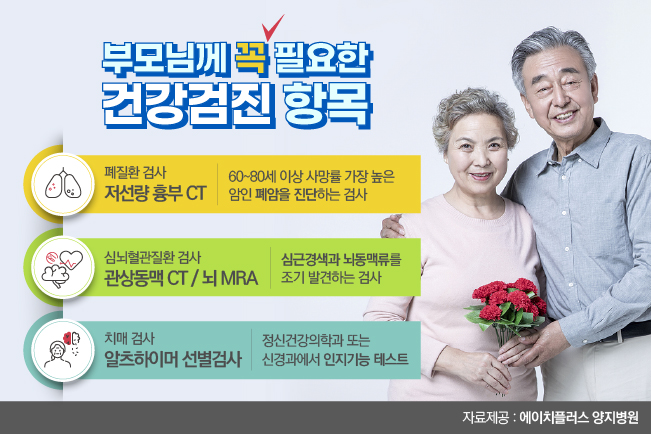
One additional test to consider beyond the basic items is the low-dose chest CT scan for lung disease screening. In the case of lung cancer, it is often difficult to detect early with a basic X-ray. For long-term smokers, those exposed to secondhand smoke, or those with a family history of lung cancer among direct relatives, it is recommended to undergo a low-dose chest CT scan every two years, which has less radiation exposure and is relatively affordable. Currently, the national cancer screening program offers low-dose chest CT scans for high-risk groups aged 54 to 74.
Additionally, for those aged 60 and above who have at least one of the five risk factors?hypertension, diabetes, hyperlipidemia, smoking, or obesity?it is advisable to undergo coronary artery CT and brain MRA scans to check cardiovascular and cerebrovascular conditions. The coronary arteries supplying blood to the heart consist of three main branches, and blockage in any one of them increases the risk of myocardial infarction. The brain MRA scan, which can detect cerebrovascular diseases, allows early detection of cerebral artery stenosis and brain aneurysms, which have a high risk of cerebral hemorrhage, enabling prevention and easy implementation of related treatments based on the test results.
Dementia, one of the most feared diseases among the elderly, is classified into Alzheimer's dementia, vascular dementia, and other dementias (due to alcohol, drugs, endocrine diseases, etc.), with Alzheimer's accounting for more than 70%. Early symptoms include memory impairment, disorientation (decline in the ability to recognize time, place, and people), language and cognitive dysfunction, aggressive behavior, depression, sleep disorders, and other mental and behavioral abnormalities. As Alzheimer's progresses significantly, daily life becomes difficult due to urinary and fecal incontinence, gait disturbances, and physical rigidity, and complications such as pneumonia and pressure ulcers may occur. If any such symptoms are suspected in those aged 60 and above, cognitive function tests and Alzheimer's screening should be conducted at neurology or psychiatry departments.
For men, it is recommended to undergo prostate cancer screening. The incidence rate is high in men aged 65 and older, and there are many cases where cancer spreads to the pelvis and spine. When blood test (PSA) levels rise, it can be determined through a biopsy whether it is due to benign prostatic hyperplasia or cancer, allowing for appropriate follow-up measures.
For women, there are uterine ultrasound and mammography tests. Mammography is included in the national basic screening, but breast ultrasound is not, so it is advisable to have it every two years if there is a family history or dense breast tissue. Thyroid ultrasound, musculoskeletal examination, bone density test, and immunity tests are also recommended at least once. Dr. Jeong Hwi-soo emphasized, “In an era where proactive treatment of chronic diseases is essential due to the aftermath of COVID-19, active health checkups tailored to parents’ health conditions for appropriate prevention and early treatment are the top priority for preventing diseases and managing health.”
© The Asia Business Daily(www.asiae.co.kr). All rights reserved.

















