Foreigners' SelKorea Moves Focused on Value Stocks Yield Profit
Retail Investors Concentrated on Overseas Growth Stocks Suffer Average Return of -35% 'Wiped Out'
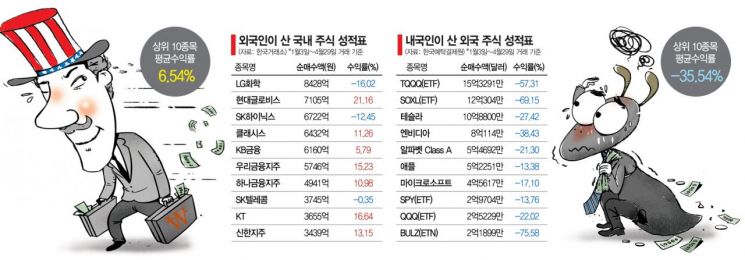
[Asia Economy reporters Lee Seon-ae and Lee Myung-hwan] Foreigners made profits from domestic stocks they purchased, but domestic investors incurred losses on foreign stocks they bought. This means that despite foreigners' persistent selling and thorough neglect of the Korean market this year, they made money by selectively buying stocks during their 'Sell Korea' trend. However, individual investors who turned their attention to overseas markets, leaving behind the sluggish KOSPI and KOSDAQ, faced the harsh reality of a complete loss in returns.
Foreigners who ignored KOSPI profited
On the 4th, Asia Economy analyzed the returns of the top 10 domestic stocks by net purchases from foreigners this year (January 3 to April 29), finding an average return of 6.54%. Except for three stocks (LG Chem, SK Hynix, SK Telecom), all yielded profits. This indicates that despite the downward pressure on the domestic stock market and the continuation of the 'Sell Korea' trend, foreigners picked only the stocks that would rise like a pinpoint selector and made profits.
During this period, foreigners' net selling amount in the domestic stock market reached 13.762 trillion KRW, a result of continuous daily selling. Consequently, foreigners' holding ratio in KOSPI dropped to the lowest level since the financial crisis. Before the full-scale 'Sell Korea' by foreigners, their holding ratio in the KOSPI market (by value) was 32.41% (as of February 28), but it has fallen to 31.09% (as of April 29). This is the lowest in 12 years and 7 months since September 10, 2009 (31.12%) during the financial crisis. The foreigners' holding ratio, which exceeded 34% earlier this year, has steadily declined, now raising alarms about breaking below 30%.
While reducing their holdings of Korean stocks, foreigners built a portfolio strategy focused on value stocks, which paid off. Notably, they included four financial companies in their basket, generating profits: KB Financial (5.79%), Woori Financial Group (15.23%), Hana Financial Group (10.98%), and Shinhan Financial Group (13.15%). Returns on KT (16.64%) and Hyundai Glovis (21.16%) were also high. SK Telecom (-0.35%) was in the loss territory but relatively stable, while LG Chem (-16.02%) and SK Hynix (-12.45%) dragged down the average returns.
The securities industry advises that since foreigners' 'Buy Korea' is unlikely in the near term, investors should carefully examine the sectors and stocks of foreigners' net selling and net buying to formulate investment strategies. Kim Dae-jun, a researcher at Korea Investment & Securities, said, "The elevated won-dollar exchange rate level may stimulate foreigners' net selling," and advised, "It is necessary to focus on sectors and stocks that can avoid foreigners' net selling in market responses."
Individuals betting on overseas stocks face total losses
Individual investors who focused on overseas markets, leaving behind the declining domestic stock market, suffered devastating returns. Analyzing the average returns of the top 10 foreign stocks by net purchases from domestic investors through April 29 this year, the average return was -35.54%. All 10 stocks recorded losses, effectively a 'total wipeout.' The maximum decline of individual stocks reached 76%, indicating significant losses. Although the domestic market, which is subject to the 'Korea discount' (undervaluation of the Korean stock market), was also in a downturn, it was expected to be better than the U.S. market, but the U.S. downturn was severe as well. Particularly, buying growth-oriented big tech companies became a burden.
The top net purchase, 'Proshares Ultrapro QQQ ETF (TQQQ),' had a return of -57.31%. TQQQ is an exchange-traded fund (ETF) that tracks the Nasdaq 100 index, composed of growth and tech stocks, with 3x volatility leverage. The second-ranked 'Direxion Daily Semiconductors BULL 3X SHS ETF (SOXL)' experienced an even larger drop of 69.15% during the same period. It tracks the Philadelphia Semiconductor Index, consisting of 16 companies in the U.S. semiconductor value chain, with 3x leverage. Sharp declines in 'Invesco QQQ Trust SRS 1 ETF (QQQ)' (-22.02%) and 'Bmo Microsectors FANG Innovation 3X Leveraged ETN (BULZ)' (-75.58%) maximized investment losses. Tesla, Nvidia, Alphabet, Apple, and Microsoft also recorded poor returns ranging from -13% to -38%.
Moon Nam-jung, a researcher at Daishin Securities, advised a cautious investment approach, stating, "U.S. tech stocks (growth stocks) are undergoing a selection process for big tech companies that will grow in the post-COVID era, returning to pre-COVID performance standards."
© The Asia Business Daily(www.asiae.co.kr). All rights reserved.

















