[Asia Economy Reporter Lee Seon-ae] This year, the price-to-earnings ratio (PER) and price-to-book ratio (PBR) of companies listed on the KOSPI have dropped to about half compared to last year.
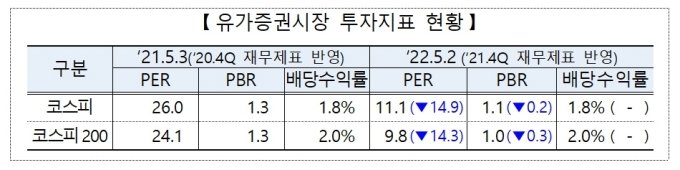
According to the Korea Exchange on the 3rd, as of the previous day, the KOSPI PER was 11.1, significantly down from the PER of 26.0 at the same time last year. The exchange explained, "This is due to earnings last year increasing to 2.3 times that of the previous year, while market capitalization slightly decreased."
The KOSPI PBR, which compares the net assets of KOSPI-listed companies at the end of last year with the current stock price level, also fell from 1.3 the previous year to 1.1. The exchange stated, "Despite the increase in total equity of KOSPI-listed companies due to favorable performance, stock prices showed weakness."
According to the exchange, the total equity of KOSPI-listed companies increased by 14.2%, from 1,651 trillion won at the end of 2020 to 1,885 trillion won at the end of last year.
This year, the KOSPI's PER and PBR are low even compared to overseas markets. The KOSPI 200's PER and PBR are 9.8 and 1.0 respectively, which are lower than those of developed countries (PER 18.4, PBR 2.8) as well as emerging countries (PER 12.3, PBR 1.6).
This indicates undervaluation of Korean stocks. PER is calculated by dividing market capitalization by net income attributable to controlling ordinary shareholders, and PBR is calculated by dividing market capitalization by total equity attributable to controlling shareholders. The decrease in PER and PBR means that stock prices have fallen relative to net income and net asset value respectively. This is due to the significant decline in KOSPI stock prices since the end of last year.
By industry, PER was relatively low in securities (3.4), banking (5.0), steel (5.1), and insurance (6.4), and PBR was relatively low in banking (0.5), insurance (0.5), securities (0.6), and utilities (0.6).
Meanwhile, the KOSPI dividend yield, calculated by dividing last year's dividends of KOSPI-listed companies by the current stock price, remained at 1.8%, the same level as the previous year. The exchange explained, "The total dividends of KOSPI-listed companies in 2021 amounted to 37.5 trillion won, slightly down from 38.2 trillion won in 2020, but due to the recent stock price weakness, the dividend yield maintained the previous year's level."
They added, "The slight decrease in total dividends in 2021 is mainly due to the 2020 figure being significantly increased by Samsung Electronics' special dividend of 10.7 trillion won. Excluding Samsung Electronics, the total dividends of KOSPI-listed companies increased by 41.9%, from 20.3 trillion won in 2020 to 28.9 trillion won in 2021." They also noted, "The dividend yield of the KOSPI 200 is 2.0%, similar to developed countries (2.0%) but lower than emerging countries (2.7%)."
© The Asia Business Daily(www.asiae.co.kr). All rights reserved.
!["The Woman Who Threw Herself into the Water Clutching a Stolen Dior Bag"...A Grotesque Success Story That Shakes the Korean Psyche [Slate]](https://cwcontent.asiae.co.kr/asiaresize/183/2026021902243444107_1771435474.jpg)
















