Rising Prices and Family Month Combine to Increase Spending
Consumer Price Inflation Up 4.8% Year-on-Year
Following Russia-Ukraine Conflict, Indonesia Halts Palm Oil Exports
Agricultural, Livestock, and Seafood Prices Continue to Rise
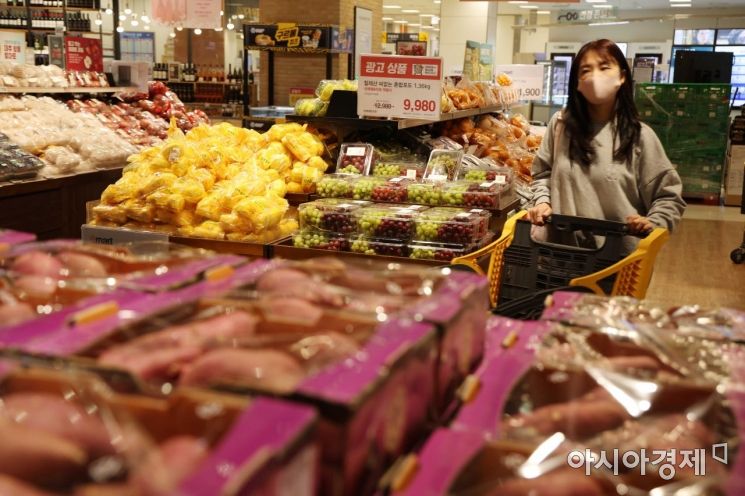 The consumer price inflation rate in March soared to the 4% range for the first time in about 10 years. On the 5th, a citizen shopping at a large supermarket in downtown Seoul is seen doing their grocery shopping. Photo by Mun Ho-nam munonam@
[Asia Economy Reporter Song Seung-yoon] "This month, it looks like I’ll just have to sit at home and breathe."
Housewife Park Seoryeong (33, pseudonym) has been sighing more these days due to worries about the rising cost of living. Nowadays, she feels anxious even before putting items in her shopping cart. Salmon, which her children usually eat well and she always puts in the cart, has gone up by 3,000 to 4,000 won per pack compared to last year, making it hard to reach for it easily. Until last year, she only heard about rising prices but didn’t feel it firsthand, but this year, with the prices of all food items soaring, she is feeling the impact of inflation more than anyone else. In May, when various anniversaries pile up, she has to spend extra on congratulatory and condolence money, making it impossible to manage with the fixed household budget.
This year’s Family Month has many people sighing more than usual. The prices of food and dining out have risen one after another, and combined with Family Month expenses, household spending has increased significantly. Last month, the consumer price inflation rate continued its upward trend, reaching the highest level since 2008 at the high 4% range.
According to the consumer price trends announced by Statistics Korea on the 3rd, last month’s consumer price index was 106.85 (2020=100), up 4.8% compared to the same month last year. In particular, prices of essential agricultural, livestock, and fishery products on the dining table continue to rise. Imported beef rose 28.8%, pork 5.5%, domestic beef 3.4%, and grapes increased by 23%. Following logistics disruptions caused by COVID-19, the Russian invasion of Ukraine has led to a sharp rise in international grain prices such as wheat and corn, and Indonesia’s palm oil export ban has further contributed to overall price increases. Most domestic food companies, including those producing ramen, instant rice, coffee, and hamburgers, have raised prices one after another, citing increases in raw material costs and logistics expenses.
According to the Korea Consumer Agency’s Cham Price information, last month the average price of Baeksul somyeon (900g) was 3,239 won, more than 9% higher than 2,966 won during the same period last year. Daehan Flour’s multipurpose Gompyo wheat flour (1kg) was 1,503 won, up 12% from 1,334 won a year ago. Ottogi’s pancake mix (1kg) rose 16% from 2,456 won a year ago to 2,866 won, and 100% soybean oil (900ml) jumped 34% from 3,648 won to 4,916 won.
Dining out prices are also rising one after another. Last month, the price of dining-out services rose 6.6% compared to the same month last year, marking another record high since 1998. As of February this year, the price of kimchi stew set meals in Seoul was 7,154 won, up 5.6% from 6,769 won a year ago, and jajangmyeon increased 9.3% from 5,346 won to 5,846 won. Naengmyeon, a representative summer dish, also rose 9.7% from 9,077 won to 9,962 won.
© The Asia Business Daily(www.asiae.co.kr). All rights reserved.
![Clutching a Stolen Dior Bag, Saying "I Hate Being Poor but Real"... The Grotesque Con of a "Human Knockoff" [Slate]](https://cwcontent.asiae.co.kr/asiaresize/183/2026021902243444107_1771435474.jpg)
















