Sending Non-Local Leaders to Local Leadership Positions to Focus on 'Ideological Alignment'
Tenures of Officials Gradually Shortening
"China's Focus Is Shifting from Economy to Politics"
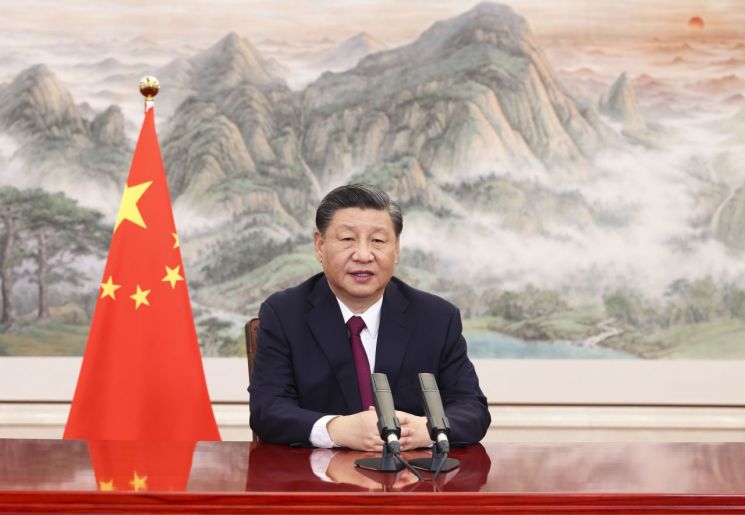
[Asia Economy Reporter Kim Hyunjung] As China prepares for the 20th National Congress of the Communist Party, which will determine President Xi Jinping's third term, it is focusing on nationwide 'ideological alignment' by replacing local leadership, the Hong Kong South China Morning Post (SCMP) reported on the 2nd. It has also been observed that non-local officials are increasingly being appointed to key positions such as Party Secretary, and the tenures of officials are gradually becoming shorter.
A representative example is the appointment of Meng Fanli, former Party Secretary of Baotou City in Inner Mongolia and a native of Linyi City, Shandong Province, as the new Party Secretary of Shenzhen City in Guangdong Province, known as China's Silicon Valley. He began his first public activity last month at Lianhua Mountain Park, where a statue of Deng Xiaoping stands, an act interpreted as following in the footsteps of President Xi Jinping, who visited the site two years ago to commemorate the 40th anniversary of the Shenzhen Special Economic Zone. According to local Guangdong media reports, Party Secretary Meng recently emphasized, "We must consistently align our thoughts, politics, and actions with the Party Central Committee, with President Xi Jinping at its core."
SCMP explained, "Promoting non-local officials to senior local government positions is not limited to Guangdong Province," adding, "Various studies related to the rotation of local leadership confirm that this trend is strengthening as part of the centralization of power."
Examples of non-local appointments include Ma Xingrui, a native of Guangdong Province who became Secretary of the Xinjiang Uygur Autonomous Region, and Wang Weizhong, former Party Secretary of Shenzhen City, who was appointed Governor of Guangdong Province. SCMP cited observers saying, "As China tightens control ahead of the 20th Party Congress scheduled for autumn, traditional political elites are being sidelined." Professor Victor Shih of the University of California, San Diego, noted that appointing outsiders is an effective method to dismantle traditional local power structures and strengthen the central government's ideology, describing it as a method used since the late 1990s.
Until 2014, Guangdong Province had appointed only locals or officials who had served extensively in related regions as Party Secretaries for 30 years. However, the situation began to change with the appointment of Ren Xuefeng, a native of Hebei Province, as Party Secretary of Guangzhou City. Subsequently, officials such as Zhang Shuofu from Hunan Province and Lin Keqing from Hubei Province were appointed as key officials in Guangzhou.
According to Associate Professor Li Tao of the Department of Public Administration at the University of Macau, research including local committees and standing committees shows that the proportion of outsiders appointed rose from single digits in 1987 to 30% in 2017. Professor Li stated, "This suggests that China's focus is shifting from the economy to politics," and predicted, "Political regionalism will diminish across China."
John L. Thornton, Director of the China Center at the Brookings Institution, recently diagnosed, "The rapid rotation of officials and the resulting shortened tenures ahead of the 20th Party Congress are truly unprecedented." According to Thornton's research, the average tenure of governors in China's 31 provinces dropped sharply from 4.5 years in 1985 to 1.6 years in 2021. For mayors, the average tenure fell from 2.5 years to 0.8 years, less than one year.
Thornton viewed these changes as occurring after President Xi's large-scale anti-corruption campaigns in 2013 and 2016, during which political heavyweights such as Zhou Yongkang, Bo Xilai, and Ling Jihua were ousted. He explained that since the last Party Congress in 2017, most of Xi's close aides and loyalists have moved into senior positions in major cities and local governments.
Meanwhile, Xi's close aide, Star Feng, Party Secretary of Inner Mongolia, was recently appointed President of the Chinese Academy of Social Sciences (CASS), a Chinese think tank. During his tenure as Party Secretary, he was known for promoting the expansion of Mandarin education in Inner Mongolia and emphasizing 'ideological alignment.'
© The Asia Business Daily(www.asiae.co.kr). All rights reserved.
![Clutching a Stolen Dior Bag, Saying "I Hate Being Poor but Real"... The Grotesque Con of a "Human Knockoff" [Slate]](https://cwcontent.asiae.co.kr/asiaresize/183/2026021902243444107_1771435474.jpg)
















