Ministry of Science and ICT Reveals Status of 5G Frequency Deployment

[Asia Economy Reporter Cha Min-young] Last year, the 5G 28 GHz network deployment obligation fulfillment rate of the three major telecom companies was found to be only 11.3% on average. This barely meets the minimum requirement of '10% or more' to avoid frequency allocation cancellation. However, in the 5G 3.5 GHz band, all three telecom companies recorded fulfillment results amounting to 2 to 3 times the required deployment quantity.
The Ministry of Science and ICT disclosed on the 3rd the submission status of the 5G mobile communication frequency deployment performance of the three telecom companies. These figures are based on the frequency allocation condition fulfillment reports submitted by each company on the 30th of last month.
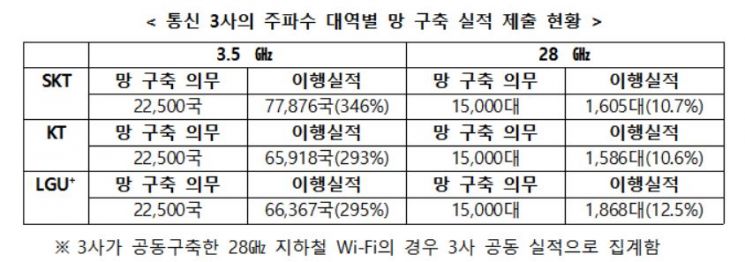
In the 5G 3.5 GHz band, SK Telecom deployed the most with 77,876 stations out of the required 22,500 stations, followed by LG Uplus (66,367 stations) and KT (65,918 stations). Compared to the mandatory deployment quantity of 22,500 stations, these represent 3.46 times, 2.95 times, and 2.93 times respectively.
In the 5G 28 GHz band, all three companies showed a passive attitude. LG Uplus had the highest number with 1,868 units, followed by SK Telecom with 1,605 units and KT with 1,586 units. Compared to the mandatory deployment quantity of 15,000 units, these correspond to 12.5%, 10.7%, and 10.6% respectively. On average, this just meets the government's minimum requirement of '10% or more' to avoid frequency allocation cancellation. Notably, the 28 GHz subway Wi-Fi jointly deployed by the three telecom companies is included as a joint achievement of all three.
The Ministry of Science and ICT will determine whether the minimum network deployment requirements have been met through written and on-site inspections of the three companies' fulfillment reports. Decisions on sanctions will be made after quantitative and qualitative evaluations by the evaluation committee.
Since this is a matter of great public interest, the Ministry plans to complete on-site inspections and announce the evaluation results as soon as possible. The process typically takes about eight months.
Choi Woo-hyuk, Director of the Radio Policy Bureau, stated, “We will strictly manage the inspection procedures to ensure rigorous evaluation based on the allocation condition fulfillment standards. If the three telecom companies are evaluated as failing to fulfill their obligations, we plan to impose sanctions in principle.”
© The Asia Business Daily(www.asiae.co.kr). All rights reserved.
![Clutching a Stolen Dior Bag, Saying "I Hate Being Poor but Real"... The Grotesque Con of a "Human Knockoff" [Slate]](https://cwcontent.asiae.co.kr/asiaresize/183/2026021902243444107_1771435474.jpg)

















