'Enforcement Decree of the National Education Committee Act' Approved at Cabinet Meeting
21 Members Including Students, Parents, Teachers, Professors
Chairperson Appointed by the President, Term of Office is 3 Years
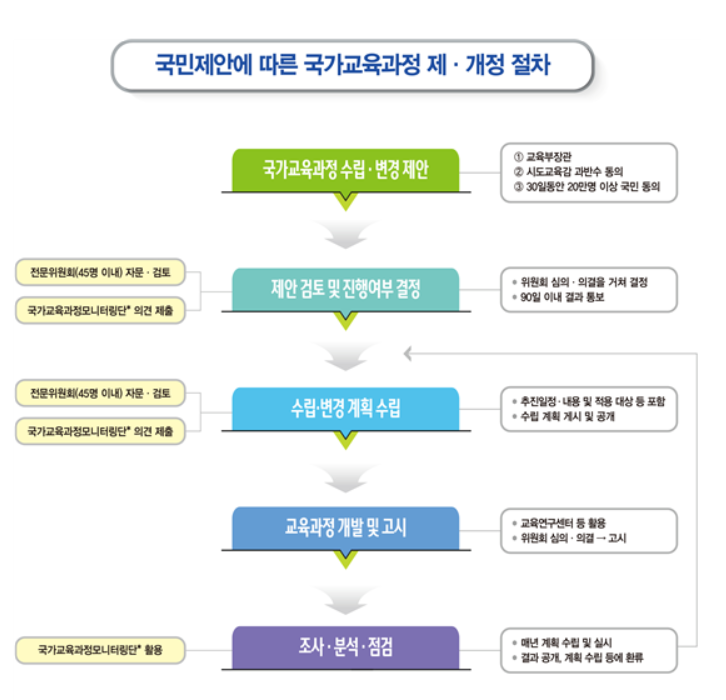
If more than 200,000 citizens agree, they will be able to request the establishment or revision of the national curriculum through the National Education Commission. The National Education Development Plan, which operates on a 10-year cycle, must be established by the end of March of the year prior to its implementation.
On the 3rd, the Ministry of Education announced that the Cabinet reviewed and approved the draft enforcement decree of the "Act on the Establishment and Operation of the National Education Commission."
The main tasks of the National Education Commission, which will be launched on July 21, include establishing the National Education Development Plan and standards and content, as well as collecting and coordinating public opinions. The National Education Development Plan includes the educational vision, mid- to long-term policy directions, school system, teacher policies, university admission policies, and appropriate number of students per class. The plan must be established by March 31 of the year prior to its implementation. Assuming the National Education Development Plan is announced in 2024 and then implemented, it must be finalized by March next year.
The National Education Commission consists of a total of 21 members, including students, youth, parents, teachers, professors, and executives of educational institutions. It includes one minister-level chairperson and two standing members (vice minister-level). There must be two members each representing students and youth, and parents.
The chairperson is appointed by the President from among the standing members. The term of office for members is three years, with the possibility of a one-year renewal. The chairperson of the National Education Commission can be nominated by the President without a confirmation hearing. To ensure diverse professional backgrounds, the number of members from any single position is limited to no more than 30%.
The President nominates five members of the National Education Commission, and the National Assembly recommends nine members. Two members are recommended by teacher-related organizations, two by the Council of University Presidents and the Council of Junior College Presidents, and one by metropolitan local governments. A Ministry of Education official explained, "When recommending members, it is specified that organizations under the Framework Act on Education and those under the Teachers' Union Act must reach an agreement."
After the commission's launch, the process of establishing or revising the standards and content of the national curriculum will guarantee public participation, including students, teachers, parents, experts, and various social figures.
If the Minister of Education and a majority of metropolitan and provincial superintendents of education or more than 200,000 citizens agree, they can request establishment or revision. The National Education Commission will decide whether to establish or revise after expert review.
Additionally, if more than 100,000 people request improvements to education policy within 90 days, the commission must decide within 45 days whether to proceed with the opinion collection and coordination process.
The Public Participation Committee will be composed of up to 500 members, with at least three-fifths recruited through open applications. The remainder can be appointed by local government heads (mayors or governors) or metropolitan and provincial superintendents of education.
Specialized and special committees will be composed of up to 21 members. Specialized members, who have abundant expertise and experience in the field of education, are appointed by the chairperson of the National Education Commission with the consent of the majority of the commission members, considering gender balance. Their term is two years, with one possible renewal.
Deputy Prime Minister and Minister of Education Yoo Eun-hye said, "Through the enactment of the enforcement decree, we expect to realize the purpose of establishing the National Education Commission, which is to formulate education policies based on social consensus, by specifying the composition of the commission members, the national curriculum, and the procedures for collecting public opinions."
© The Asia Business Daily(www.asiae.co.kr). All rights reserved.

















