Ministry of Education Publishes COVID-19 White Paper Summarizing 2 Years and 3 Months of Response
Plans to Revise Infectious Disease Prevention and Crisis Response Manual Post-Pandemic
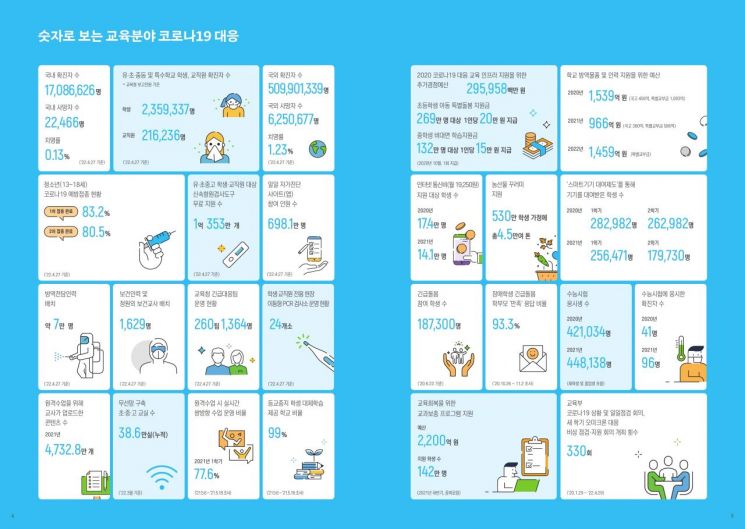
[Asia Economy Reporter Han Jinju] The Ministry of Education responded to the unprecedented online school openings, remote classes, and preemptive testing measures following the outbreak of COVID-19, but acknowledged that the educational gaps and frequent changes in quarantine guidelines placed a heavy burden on schools, which was seen as a limitation.
On the 3rd, the Ministry of Education published a white paper titled "COVID-19 Response in the Education Sector," summarizing the response process over two years and three months. It covers the education authorities' COVID-19 response from the first confirmed case in 2020 to the spread of the Omicron variant in 2022.
In April 2020, the Ministry of Education conducted the first-ever online school opening and introduced full remote classes. Although students and teachers experienced inconveniences such as system errors and connection failures while rapidly establishing a large-scale remote learning system, the system was steadily improved and stabilized. The rate of real-time interactive classes increased from 14.8% in the first semester of 2020 to 77.6% in the first semester of 2021.
From September 2021, vaccination plans for children and adolescents aged 12 to 17 were announced and implemented, followed by plans for children aged 5 to 11 starting in March 2022. In cooperation with health authorities, school-based visiting vaccination programs were also operated.
In early 2022, due to the spread of the Omicron variant, an academic operation plan was established to flexibly switch to remote classes based on the proportion of confirmed cases and students barred from attending school at each school. Under the policy of promoting normal attendance, rapid antigen test kits were distributed free of charge, and guidelines for attending school after preemptive testing were implemented.
It was regrettable that educational gaps occurred in students' learning, emotional, and social development due to over two years of combined remote and in-person classes. The frequent changes in quarantine guidelines also caused significant burdens at schools due to insufficient time to prepare lessons and other activities accordingly.
The Ministry of Education plans to revise the student infectious disease prevention and crisis response manual, including necessary improvements and field cases, after an official declaration of the end of COVID-19.
Deputy Prime Minister and Minister of Education Yoo Eun-hye said, "By recording the COVID-19 response over the past two years, we will organize a guideline system to respond to future infectious disease crises so that our education continues uninterrupted in any crisis moment, and we will do our best to achieve this."
© The Asia Business Daily(www.asiae.co.kr). All rights reserved.
![From Hostess to Organ Seller to High Society... The Grotesque Scam of a "Human Counterfeit" Shaking the Korean Psyche [Slate]](https://cwcontent.asiae.co.kr/asiaresize/183/2026021902243444107_1771435474.jpg)
















