Utilization of Public Bicycle Rental Stations, Parcel Lockers, and Rest Areas for Mobile Workers
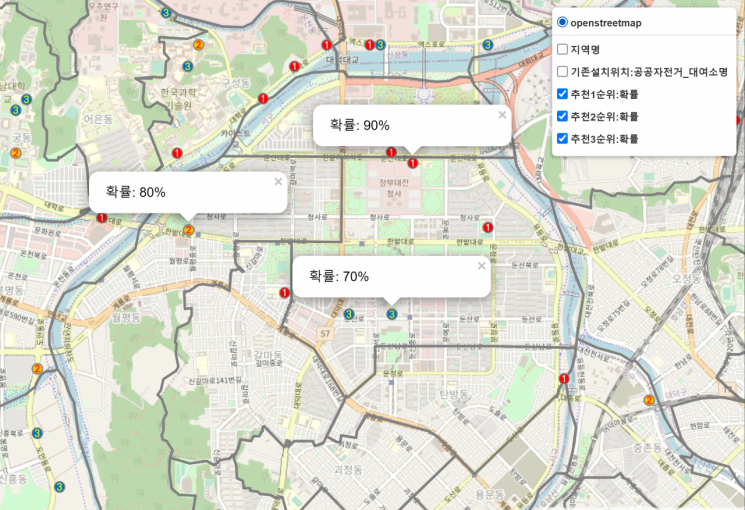
[Asia Economy Reporter Lim Cheol-young] The Ministry of the Interior and Safety announced on the 3rd that it has developed a 'standard analysis model' through data-driven scientific analysis to be used for site selection of public facilities such as public bicycle rental stations.
According to the Ministry, big data analysis for public facility site selection was conducted collaboratively with Daejeon City Hall and Yongin City Hall from October last year to March this year. Daejeon and Yongin provided location data related to facilities, including 260 existing public bicycle rental stations.
The Ministry utilized 40 types of data such as commercial districts, buildings, registered population, and transportation facilities to analyze the influence relationships among floating population, resident population, transportation, and public facility locations. The analysis showed that public bicycle rental station locations were significantly influenced by public transportation factors, with 80% of suitable installation sites having bus stops within 50 meters, indicating that locations with active public transportation are ideal for rental stations.
Areas with high suitability for parcel locker installation were residential areas mainly composed of households in their 30s to 50s, while the population in their 20s tended to decrease demand for parcel lockers, which was interpreted as related to economic activity status. Regions suitable for mobile worker rest areas were found to be old downtown areas with relatively low and dispersed resident populations and small business owners, showing a pattern of fewer than 3,000 people and fewer than 300 small business establishments within 1㎢.
Based on this analysis, Daejeon City installed an additional 739 public bicycle rental stations, including the existing 261 stations, while Yongin plans to use the site selection model for additional installation of parcel lockers and electric vehicle charging stations.
Additionally, the Ministry developed models to predict and respond to fine dust based on traffic volume and to revitalize local food (local food) markets. The fine dust prediction and response model is being used by Seocho District Office in Seoul for designing water spraying truck routes, and the local food revitalization model will be utilized in Iksan City, Jeonbuk, and Yesan County, Chungnam, for crop price prediction and recommendations.
Han Chang-seop, Director of the Government Innovation Organization Office, stated, “The standard analysis model developed this time is a general model that can be used by all administrative and public institutions to support scientific decision-making by local governments,” adding, “We will continue to develop and provide various analysis models at the government-wide level for data-driven administration.”
© The Asia Business Daily(www.asiae.co.kr). All rights reserved.
![Clutching a Stolen Dior Bag, Saying "I Hate Being Poor but Real"... The Grotesque Con of a "Human Knockoff" [Slate]](https://cwcontent.asiae.co.kr/asiaresize/183/2026021902243444107_1771435474.jpg)
















