"Qualitative Job Gap Exists Between At-Risk and Low-Risk Extinction Areas"
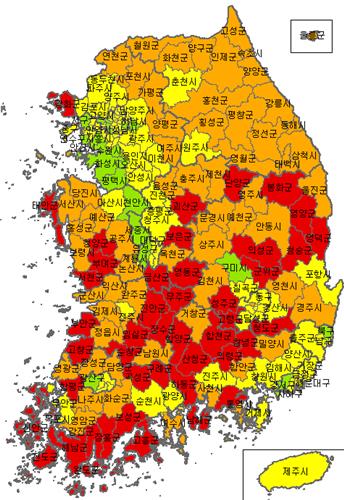 As of March, areas at high risk of extinction (red), areas entering extinction risk (orange), areas under extinction caution (yellow), and normal areas (light green). / Photo by Korea Employment Information Service
[Asia Economy Reporter Na Ye-eun] As of March, an analysis revealed that half of the basic local governments nationwide are at risk of extinction.
The Korea Employment Information Service (KEIS) analyzed extinction risk areas as of March in the spring issue of the quarterly magazine "Regional Industry and Employment," released on the 29th, which focused on local extinction. The report highlighted polarization due to industrial structure differences between regions, local extinction, and the need for alternative regional job strategies.
According to the data, out of 228 cities, counties, and districts nationwide, 113 (49.6%) were identified as "extinction risk areas." Extinction risk areas are defined as places where the extinction risk index, calculated by dividing the female population aged 20-39 by the population aged 65 and over, is below 0.5.
Researcher Lee Sang-ho of KEIS analyzed resident registration population data from Statistics Korea and monthly resident registration population statistics. The analysis showed that 11 basic local governments entered new extinction risk status as of March 2022 compared to 2020, spreading to manufacturing decline areas (Tongyeong-si, Gunsan-si, etc.) and outskirts of the metropolitan area (Pocheon-si, Dongducheon-si).
Researcher Lee explained, "Since the 2010s, regional manufacturing, which constitutes quality jobs outside the metropolitan area, has declined, worsening job conditions and causing youth population outflow."
He also emphasized the need to respond to local extinction by clarifying regional job policy goals, preventing local talent outflow, harmonizing spatial-based and human-based policies, protecting vulnerable employment groups in the region, and establishing a regionally tailored employment governance system.
KEIS stated, "There is a qualitative job gap between extinction risk areas and low-risk areas, and labor is moving from high-risk to low-risk areas."
"Regional Industry and Employment" can be viewed on the KEIS website (www.keis.or.kr).
© The Asia Business Daily(www.asiae.co.kr). All rights reserved.
![Clutching a Stolen Dior Bag, Saying "I Hate Being Poor but Real"... The Grotesque Con of a "Human Knockoff" [Slate]](https://cwcontent.asiae.co.kr/asiaresize/183/2026021902243444107_1771435474.jpg)
















