KCCI to Hold 'ESG Innovation Growth Special Forum' on 29th
Transition Committee Led by Ahn Cheol-soo and Key Economic Figures Participate
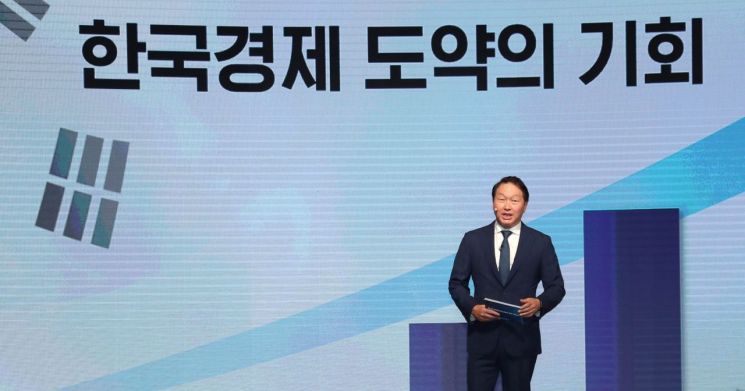 Choi Tae-won, Chairman of the Korea Chamber of Commerce and Industry, delivering the keynote speech at the 'Energy Transition and Carbon Neutrality Policy Seminar' held on the 28th at the Chamber of Commerce building in Jung-gu, Seoul. (Photo by Korea Chamber of Commerce and Industry)
[Asia Economy Reporter Moon Chae-seok]
"The government should make efforts to provide 'incentives' and 'institutional support' so that ESG (Environmental, Social, and Governance) does not become a regulation for companies. The business community will also strive for greenhouse gas reduction, future innovative technology development, and mutual growth. We hope that the 'ESG Public-Private Joint Control Tower' promoted by the Presidential Transition Committee will play a significant role as a 'communication channel."
Choi Tae-won, Chairman of the Korea Chamber of Commerce and Industry (KCCI), requested the new government to expand tax support and institutional support to further spread ESG management. To this end, they agreed on the need to establish a public-private joint control tower.
On the 29th, KCCI held a 'Special Roundtable on ESG Innovation Growth' with Ahn Cheol-soo, Chairman of the Transition Committee, at the Chamber of Commerce building in Jung-gu, Seoul. This roundtable was organized for the business community to hear the new government's ESG policy direction and to exchange opinions between the transition committee and the business sector for mutual communication.
Chairman Choi opened by saying that after taking office as KCCI chairman in March last year, gathering opinions from about 30,000 citizens through a 'communication platform,' he concluded that addressing social issues such as the environment before so-called 'business patriotism,' which refers to 'contributing to the national economy,' is the trend of the times.
Choi diagnosed that ESG management is not merely a rite of passage for raising funds in the financial market but a timely mission desired by both the public and stakeholders. He believed that good ESG management can grow both companies and the national economy. However, he emphasized that designing a sophisticated incentive system is more important than strong regulations.
Chairman Choi said, "I fully agree with Chairman Ahn's remark that ESG will lead new innovation and growth, and that environmental and social issues, which are national tasks directly linked to our future competitiveness, will act not as a 'crisis' but as an 'opportunity' to foster new industries."
Na Seok-kwon, Director of the Social Value Research Institute, who presented the current status of ESG that day, said, "ESG is becoming a 'game changer' in the great transition from shareholder capitalism to stakeholder capitalism." As ways to utilize ESG as an opportunity, he proposed three measures: ▲business model transformation ▲public-private cooperation ▲performance-based incentives. Director Na emphasized, "In particular, rather than uniformly providing subsidies once a certain standard is met, it is necessary to induce voluntary and innovative ESG behavioral changes by giving more incentives to companies with better performance through measurement and evaluation."
Meanwhile, the roundtable was attended by Transition Committee members including Chairman Ahn, Yoo Woong-hwan of the Economic 2nd Division, Go San, and Advisor Kim Dong-soo, as well as industry figures such as Chairman Choi, Samsung Electronics President Lee In-yong, Hyundai Motor President Gong Young-woon, SK Supex Council SV Chairman Lee Hyung-hee, and LG Corporation ESG Team Leader (Executive Director) Park Joon-sung. Financial sector figures such as KB Kookmin Bank President Lee Jae-geun and Shinhan Bank President Jin Ok-dong also participated, along with social venture representatives including Allicon CEO Cho Min-hee and Itmaple CEO Kim Hyun-ji, drawing attention.
© The Asia Business Daily(www.asiae.co.kr). All rights reserved.

















