Mayor Oh Se-hoon Inspects Temporary Opening Site
Large Green Plaza Three Times Seoul Plaza, Comparable to Yeontral Park... Oh Se-hoon "Expecting Synergy Between Cheong Wa Dae Opening and Gwanghwamun Plaza"
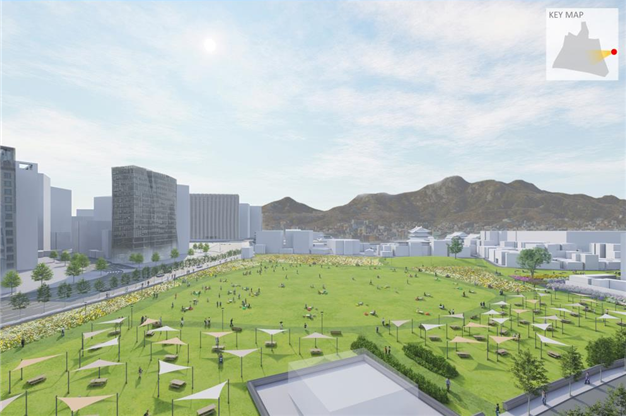
[Asia Economy Reporter Lim Cheol-young] Located right next to Gyeongbokgung Palace in the heart of downtown Seoul, the 'Songhyeon-dong site,' which has been surrounded by high walls and inaccessible for over 110 years, spanning 37,117㎡, will be transformed into a large green plaza and returned to the citizens in the second half of this year.
On the 29th, the Seoul Metropolitan Government announced that the entire Songhyeon-dong site will be developed as an open space and temporarily opened in the second half of this year in conjunction with the opening of Gwanghwamun Plaza. Mayor Oh Se-hoon visited the Songhyeon-dong site, where the wall demolition began, to check the progress and pledged to return it to the citizens as an "open plaza with rest and culture." With a severe shortage of green spaces in downtown Seoul, the new green area will be about three times the size of Seoul Plaza (13,207㎡) and comparable to Yeontral Park (34,200㎡), allowing all citizens to enjoy it.
The Songhyeon-dong site was home to royal family members and prominent noble families during the Joseon Dynasty, but in 1910, during the Japanese colonial period, the Chosen Industrial Bank’s staff housing was built there. After liberation, it was seized by the U.S. military government and used as U.S. military officers’ quarters, and later as housing for employees of the U.S. Embassy in Korea. For nearly 90 years, ownership was taken by foreign powers, preserving a painful modern history. It was returned to the Korean government in 1997 but was left abandoned and unused as its ownership changed three times.
Seoul City decided to temporarily open the Songhyeon-dong site, secured last December through a three-party sale-exchange agreement among Seoul City, Korean Air, and LH, before starting full-scale development. In February this year, various opinions were gathered through a public idea contest. Currently, Korean Air is conducting groundwork for the transfer of ownership. Starting with the opening of the main gate, which has been firmly closed for 77 years since the U.S. military officers’ residence period after liberation, the work to lower the 4-meter-high walls will begin in earnest. Once the wall lowering is completed, the vast Songhyeon-dong site will be revealed.
Seoul City has prepared a development plan aiming to create the Songhyeon-dong site as an "open space with rest and culture." Since it has been inaccessible for over 110 years, rather than installing artificial facilities, it will be developed as a wide green plaza similar to Seoul Plaza, with minimal facilities to allow for versatile use.
The green plaza will feature a shortcut (pedestrian path) connecting Gwanghwamun, Bukchon, and Cheongwadae to improve accessibility, and a green pedestrian path will be created as an alternative to the busy Yulgok-ro and Gamgodang-gil roads, offering a pleasant urban walking route. Additionally, shade structures, benches, and other resting facilities lacking in the city will be installed throughout the area to provide a place for people to take a break from their busy daily lives. A separate space will also be prepared for various events such as performances and exhibitions, providing opportunities to enjoy culture within the city.
Seoul City expects that securing a large green space in the Gwanghwamun-City Hall area, where core urban functions such as public institutions, large corporations, finance, and tourism are concentrated, as well as in the Bukchon area with dense old residential neighborhoods, will improve living conditions not only for citizens and tourists but also for local residents. In the long term, the Songhyeon-dong site will be developed as an urban green space, with part of it planned for the construction of the tentatively named 'Lee Kun-hee Donation Hall' (site area 9,787㎡, 26% of the entire site). The government will finalize the site for the 'Lee Kun-hee Donation Hall' through an international design competition and prepare an integrated spatial plan that harmonizes with the surrounding area.
Mayor Oh Se-hoon said, "The Songhyeon-dong site, returning to the citizens after 110 years, will become a representative space of the 'green ecological city center.' We also expect synergy with the opening of Cheongwadae and Gwanghwamun Plaza. We will do our best to promote the project so that downtown Seoul, which has been overshadowed by preservation and regulation, can be recreated as a space full of rest, leisure, and vitality."
© The Asia Business Daily(www.asiae.co.kr). All rights reserved.
!["The Woman Who Threw Herself into the Water Clutching a Stolen Dior Bag"...A Grotesque Success Story That Shakes the Korean Psyche [Slate]](https://cwcontent.asiae.co.kr/asiaresize/183/2026021902243444107_1771435474.jpg)
















