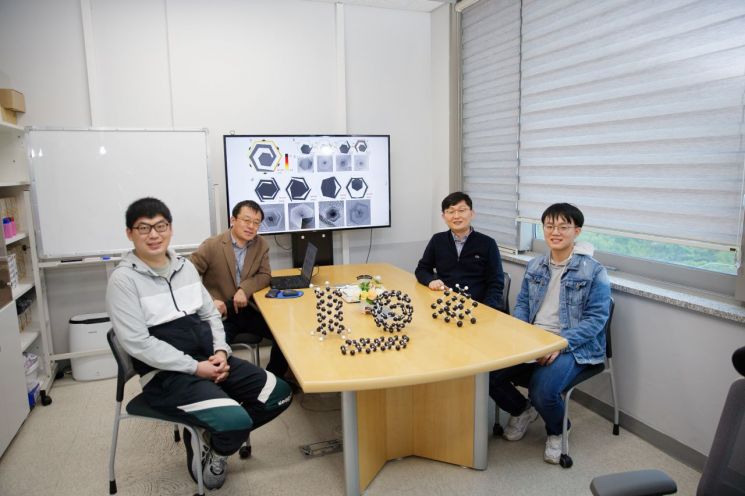
 (From the inner left clockwise) Professor Peng Ding, Professor Lee Jong-hoon, Researcher Pengning Liu, and IBS Research Fellow Xiao Kong are taking a commemorative photo.
[Asia Economy Yeongnam Reporting Headquarters Reporter Hwang Du-yeol] The research team led by Professor Feng Ding and Professor Lee Jong-hoon from the Department of New Materials Engineering at UNST has discovered for the first time a graphene adlayer synthesized in the shape of a spiral galaxy and elucidated it with a new theory.
An adlayer refers to another graphene layer formed underneath the original graphene layer.
The study is expected to provide clues for developing synthesis methods that can control the number of graphene layers according to their intended use.
Graphene is known as a two-dimensional material with a thickness of a single carbon atom. However, most synthesized graphene actually consists of multiple layers of carbon atoms stacked together.
The properties vary depending on the number of layers. While bilayer graphene can be used to create semiconductor devices that can be switched on and off, monolayer graphene cannot, but it has higher charge mobility than bilayer graphene.
This is why developing technology to synthesize graphene with a controlled number of layers according to its application is important.
Professor Ding’s research team improved existing probability-based modeling (kinetic Monte Carlo simulation) to analyze the cause of graphene being synthesized in a spiral form.
Such spiral structures have never been observed in graphene or other materials before, and existing theories had limitations in explaining this phenomenon.
According to the team’s theory, the spiral graphene grows by receiving a high concentration of carbon precursors gathered at the edges of the hexagonal graphene layer above it.
During this process, the carbon precursor concentration becomes insufficient, causing the growth to take on a spiral shape.
When carbon precursors are scarce, the lower graphene layer grows partially only along the edges where the precursors are easily supplied, while the upper graphene layer continues to grow. Following the edge of the upper graphene layer results in the lower layer forming a spiral shape.
The theory explains the peculiar phenomenon where the spiral graphene is synthesized smaller than the upper graphene layer and its ‘arms’ (spiral arms) are always in contact with the edges of the upper graphene layer.
The spiral arms refer to the web-like structures radiating from the center of the spiral.
Following the theoretical predictions, the team also succeeded in controlling the number of spiral arms by varying the concentration of graphene precursors.
Professor Feng Ding said, “The research theoretically revealed where the carbon precursors forming the adlayer come from, providing a clue for developing new synthesis methods that control the number of graphene layers by suppressing or activating precursor supply.”
Professor Lee Jong-hoon’s research team was able to analyze the complex characteristics of spiral graphene using high-resolution transmission electron microscopy (HRTEM) technology.
The study, with IBS Multidimensional Carbon Materials Research Group’s Research Fellow Xiao Kong as the first author, was published on the 24th in the international materials science journal Advanced Materials.
The research was supported by the Institute for Basic Science (IBS).
© The Asia Business Daily(www.asiae.co.kr). All rights reserved.
![Clutching a Stolen Dior Bag, Saying "I Hate Being Poor but Real"... The Grotesque Con of a "Human Knockoff" [Slate]](https://cwcontent.asiae.co.kr/asiaresize/183/2026021902243444107_1771435474.jpg)











