4 People from People Power Party, 1 from Democratic Party Resign;
Filibuster Ends with 177 Seats
Bill Processing Can Be Advanced to Avoid Emergency Cabinet Meeting
Timing of Resignation of Democratic Party Local Election Candidates Remains a Variable
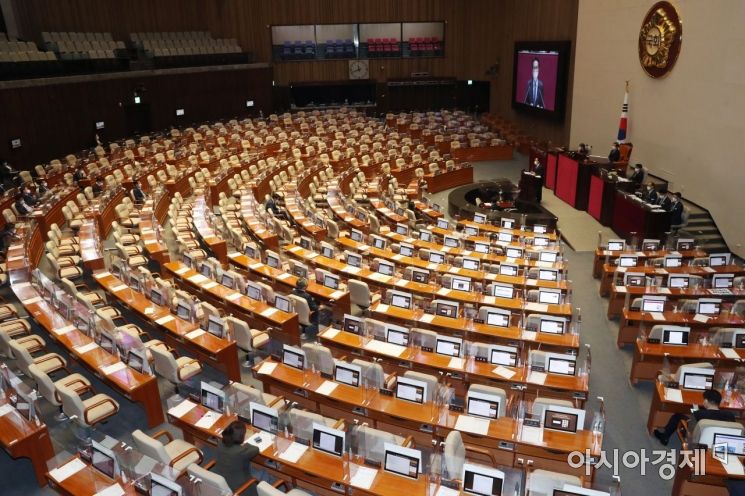 Democratic Party lawmaker An Min-seok is conducting an unlimited debate (filibuster) in support of the "Geomsu Wanbak" (separation of prosecution's investigation and indictment rights) at the National Assembly plenary session on the 27th. Photo by Yoon Dong-joo doso7@
[Asia Economy Reporter Naju-seok] There is a growing claim that the resignation of National Assembly members to run in the June 1 local elections could become a variable in the plenary session procedures for the so-called "Complete Removal of Prosecutorial Investigation Rights Act" (검수완박법). The Democratic Party of Korea appears to be countering the unlimited debate (filibuster) by splitting the session, but if members resign, the quorum for voting changes with each new session, making it easier for the Democratic Party to secure the magic number needed to end the unlimited debate. If this happens, the passage of the Prosecutors' Office Act and the Criminal Procedure Act, among other 검수완박법 bills, could be possible even before July 3.
According to political circles on the 28th, six lawmakers have confirmed their resignation to run in the upcoming local elections. Two are from the Democratic Party of Korea (Oh Young-hoon, Lee Kwang-jae) and four are from the People Power Party (Kim Eun-hye, Kim Tae-heum, Park Wan-soo, Hong Joon-pyo). Additionally, depending on the results of the Democratic Party’s primaries for the Seoul mayor and Jeonbuk governor on the 29th, two more members may resign.
Attention is focused on the resignation of lawmakers because it directly affects the quorum required to end the unlimited debate. Currently, a three-fifths majority of the 300-seat assembly, or 180 votes, is needed to forcibly end the filibuster. However, as resignations proceed, the total number of seats decreases, lowering the quorum to between 176 and 178 votes. Five members (four from the People Power Party and one from the Democratic Party), whose primaries have concluded or who have been selected early as candidates, have already submitted their resignation letters to the Speaker of the National Assembly. Oh Young-hoon, a Democratic Party member who was selected as the Jeju governor candidate on the 27th, has not yet started the resignation process.
Until now, political circles have been interested in whether the Democratic Party has secured the magic number of 180 votes needed to end the filibuster. Currently, without the consent of the Justice Party, the maximum is 179 votes (171 from the Democratic Party, 6 independents formerly from the Democratic Party, 1 from the Basic Income Party, and 1 from the People’s Party). However, depending on how the resignation letters are processed, the magic number could be secured. According to the National Assembly Act, resignations during a convened session are processed by a plenary vote, while those during recess are approved by the Speaker. If Speaker Park Byeong-seok approves the resignations of five members before the next extraordinary session on the 30th, the number of seats required to end the filibuster theoretically drops to 177, making it possible.
Democratic Party members are waiting for leadership decisions on the timing of submitting their resignation letters for these reasons. The Democratic Party hopes to end the filibuster and pass the bill early if possible. Passing the bill before the Cabinet meeting on July 3 would avoid placing political burdens on outgoing President Moon Jae-in, such as convening an extraordinary Cabinet meeting.
However, political circles largely believe it will not be easy to use the filibuster-ending card. Ending the filibuster requires a secret ballot, during which there could be defections within the party. Additionally, if resignations are not completed before the 30th, the affected constituencies could be left without a National Assembly member for nearly a year, which could also be a burden.
© The Asia Business Daily(www.asiae.co.kr). All rights reserved.

















