EU "Russian threats don't work"... Emphasizing Member State Cooperation
US LNG Export Expansion, Gas Support to Asian Allies
West-Russia Power Struggle... Concerns Over Global Energy Crisis if Prolonged
[Asia Economy Reporter Hyunwoo Lee] The European Union (EU) has declared a direct confrontation, stating that it will overcome Russia's gas supply pressure through cooperation among member states and securing alternative supply sources. The United States also announced an expansion of liquefied natural gas (LNG) exports to cooperate with Europe, and Asian allies such as South Korea have joined in gas support, intensifying the energy power struggle between the West and Russia. Although supply issues may be resolved in the short term through cooperation among countries, concerns are emerging that a prolonged conflict could escalate into a global energy crisis.
On the 27th (local time), Russia's Gazprom declared in a statement that it would unilaterally suspend gas supplies, citing that Poland and Bulgaria have not made payments. Dmitry Peskov, spokesperson for the Russian Kremlin, pressured during a press briefing that "if other European countries refuse to pay gas fees in rubles by the deadline, supply could also be cut off."
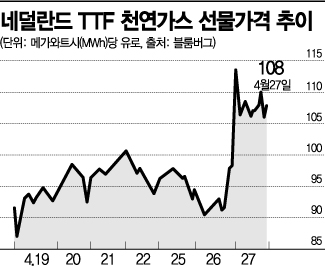
The announcement caused significant fluctuations in European natural gas prices. The Dutch TTF gas futures price, a key indicator of natural gas in Europe, surged to 115 euros (about 150,000 KRW) per megawatt-hour (MWh) during the day following Russia's supply suspension announcement, marking a 32% increase compared to the 18th.
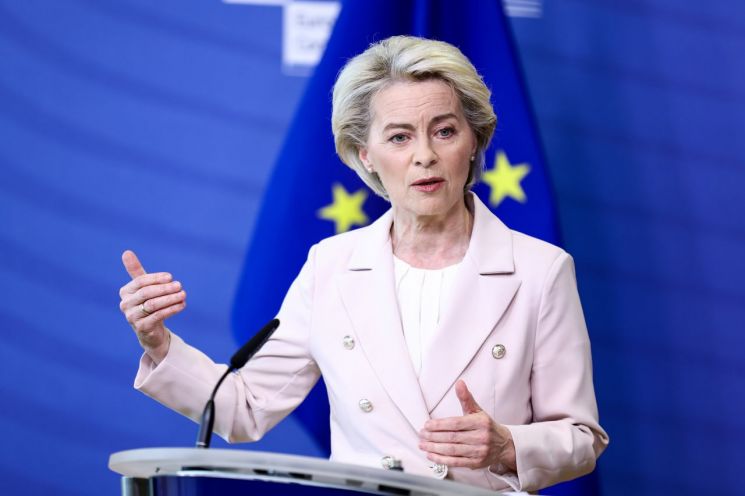
The EU immediately retaliated, warning that it would confront Russia's weaponization of gas head-on. Ursula von der Leyen, President of the European Commission, strongly criticized in a statement that "Gazprom's announcement to unilaterally suspend Europe's gas supply is an attempt by Russia to use gas as a means of intimidation."
She added, "We anticipated this scenario and are prepared. We are in close contact with all member states and have been working to secure alternative supply volumes and maintain the highest storage levels across the EU." Regarding Poland and Bulgaria, she emphasized that "they will be able to receive natural gas from neighboring EU countries."
The United States also expressed its intention to actively resolve Europe's gas supply issues by increasing liquefied natural gas (LNG) exports. According to The New York Times (NYT), the U.S. Department of Energy allowed two American companies to export an additional 14.15 million cubic meters of LNG per day. White House spokesperson Jen Psaki stated in a press briefing that "Russia's gas supply suspension was an anticipated energy weaponization measure" and emphasized that "it will reduce Europe's dependence on Russian energy."
Not only the United States but also allies in Asia such as South Korea and Japan are expected to join in LNG support. Major foreign media, citing anonymous sources, reported that South Korea will send part of its LNG volume to Europe by this summer at the request of the United States and Europe.
In the short term, the gas supply crisis in Europe is not expected to worsen due to cooperation among EU member states, the United States, and Asian allies. However, if the energy confrontation with Russia prolongs until autumn, there is a risk that it could spread into a global energy crisis.
The British magazine The Economist analyzed, "The largest LNG exporters such as the United States, Australia, and Qatar are already exporting at their maximum possible levels, and 70% of LNG export contracts are long-term contracts of over 10 years, making it difficult for Europe to find alternative supplies." The Economist also pointed out that even if the U.S. rapidly increases LNG exports, Central and Eastern European countries like Germany, which lack LNG terminal infrastructure, must first invest in infrastructure.
Some European countries are already showing signs of breaking away from the unified front in the energy confrontation with Russia. Bloomberg News reported, citing sources, that Italy's largest energy company, Eni, is considering opening a special ruble account at Gazprombank as requested by Russia. Bloomberg also reported that at least 10 companies in Europe have already opened accounts at Gazprombank, and four companies have even made payments in rubles.
© The Asia Business Daily(www.asiae.co.kr). All rights reserved.
![User Who Sold Erroneously Deposited Bitcoins to Repay Debt and Fund Entertainment... What Did the Supreme Court Decide in 2021? [Legal Issue Check]](https://cwcontent.asiae.co.kr/asiaresize/183/2026020910431234020_1770601391.png)

















