KOSPI and KOSDAQ Fall Over 1.3% and 1.8% Respectively
Samsung Electronics Hits New Low... Hyundai Motor and Kia Rise Alone
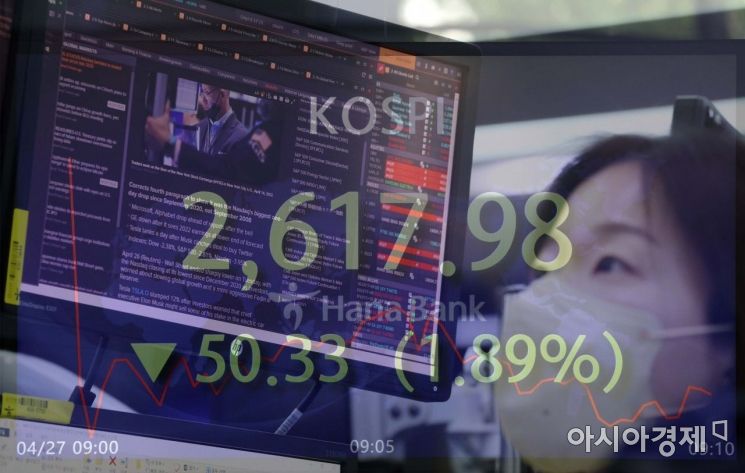 On the 27th, when the KOSPI and KOSDAQ indices plunged by over 2%, dealers were working in the dealing room of Hana Bank in Euljiro, Seoul. The U.S. stock market sharply declined due to concerns over a slowdown in the economic recession and earnings uncertainty among big tech companies, which appears to have caused a chain reaction. Photo by Moon Honam munonam@
[Asia Economy Reporter Minji Lee] While individual investors continue to be net buyers alone, the KOSPI has narrowed its losses compared to the early session. Institutions and foreigners are increasing their net selling volume.
As of 10:43 a.m. on the 27th, the KOSPI stood at 2,632.10, down 1.36% (36.21 points) from the previous trading day. The index opened the day at 2,630.58, down 1.41% (37.73 points) from the previous day, and after falling nearly 2%, it has slightly reduced its losses. At this time, individual investors bought stocks worth 418.4 billion KRW alone, while foreigners and institutions sold stocks worth 202.5 billion KRW and 207.4 billion KRW, respectively.
The domestic stock market was dragged down by concerns over economic slowdown. As major global companies forecast shrinking earnings due to prolonged lockdowns in China, worries about economic deceleration have come to the forefront.
By sector, banks (-2.13%), insurance (-2.07%), and securities (-1.98%) showed the largest declines. The U.S. 10-year Treasury yield, which had approached the 3% range, fell slightly, causing global financial stocks to decline and dampening investor sentiment. In addition, most sectors, including electrical and electronics (-1.82%) and steel and metals (-1.75%), showed downward trends.
Among the top market capitalization stocks, most showed declines. Samsung Electronics fell 1.51%, hitting a new low again. Other decliners included LG Energy Solution (-3.31%), Samsung SDI (-1.20%), SK Hynix (-2.70%), Samsung Biologics (-0.5%), NAVER (-2.09%), and Kakao (-1.77%). Hyundai Motor (0.53%) and Kia (0.24%), which posted strong earnings, showed upward trends.
At the same time, the KOSDAQ index stood at 894.28, down 1.87% (17.02 points) from the previous trading day. The KOSDAQ opened at 898.02, down 1.44% (13.14 points), and fell more than 2% during the session. Currently, individual investors bought stocks worth 97.3 billion KRW alone, while foreigners and institutions sold stocks worth 11.4 billion KRW and 84.3 billion KRW, respectively.
By sector, digital content (-7.09%), IT software (-4.55%), and food and tobacco (-4.41%) showed notable declines. The digital content sector's drop was due to the decline in gaming stocks, with Pearl Abyss (-19%) having a significant impact. The day before, this game ranked first in popularity on both the China Apple App Store and Tencent’s app market ‘TapTap’ within an hour of its release, but as of 6 a.m. that day, it had fallen to 29th place on the App Store. It is observed that panic selling continues due to weaker-than-expected sales. Other stocks such as Joycity (-6.7%), Longtu Korea (-6%), and Kakao Games (-4%) also dragged the index down.
Among the top market capitalization stocks, except for Celltrion Healthcare (0.65%) and Celltrion Pharm (1.14%), all showed sharp declines. EcoPro BM fell 1.89%, and L&F (-1.97%), Kakao Games (-3.88%), Rino Industrial (-1.59%), Chunbo (-2.31%), and CJ ENM (-2.55%) also declined.
© The Asia Business Daily(www.asiae.co.kr). All rights reserved.
![A Woman Who Jumps Holding a Stolen Dior Bag... The Mind-Shaking, Bizarre Con of a "Human Knockoff" [Slate]](https://cwcontent.asiae.co.kr/asiaresize/183/2026021902243444107_1771435474.jpg)
















