[Seoul District News] Mapo-gu Installs Ramps to Prevent Accidents from Parking Vehicle Rollbacks... Dongjak-gu Adds Unmanned Traffic Enforcement Equipment in Child Protection Zones
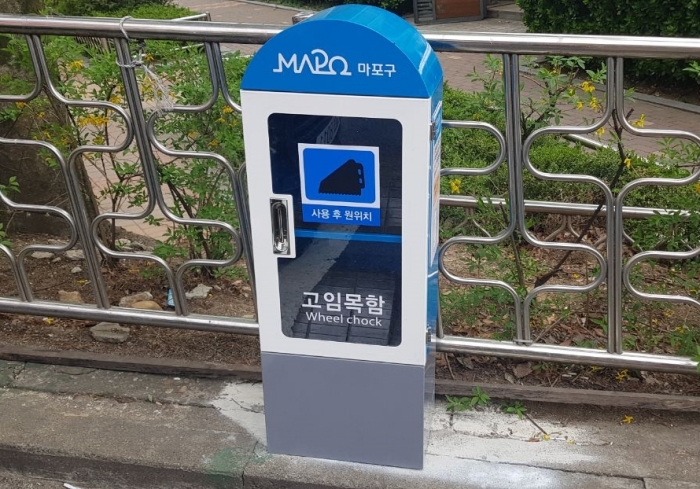
[Asia Economy Reporter Park Jong-il] Mapo-gu announced that it has installed 15 wheel chock boxes in resident-priority parking zones located on sloped terrain to secure vehicles.
This measure follows the amendment to the Parking Lot Act, which includes the installation of wheel chocks to prevent slipping in sloped parking lots, aiming to prevent casualties caused by vehicle rollbacks on slopes and to avoid various safety accidents.
Last year, the district, together with the Mapo-gu Facilities Management Corporation, produced five wheel chock boxes and installed them in four sloped resident-priority parking lots for a pilot operation.
Based on the pilot operation results showing a high usage rate of the wheel chocks and increased user awareness of parking lot safety, an additional 10 wheel chock boxes were installed in eight sloped resident-priority parking lots in April this year.
The left and right sides of the boxes display instructions on how to use the wheel chocks and guidelines to follow when parking on slopes, while the front part is made with a transparent window to allow immediate confirmation of the presence of wheel chocks.
Meanwhile, the district plans to safely manage sloped resident-priority parking lots through inspections of the wheel chock boxes in cooperation with the Mapo-gu Facilities Management Corporation and to encourage the use of wheel chocks to prevent safety accidents.
A district official stated, “The wheel chock boxes were newly produced to prevent safety accidents in sloped parking lots and to meet residents’ demands,” adding, “We hope residents parking on slopes will actively use the wheel chocks and participate in preventing safety accidents.”
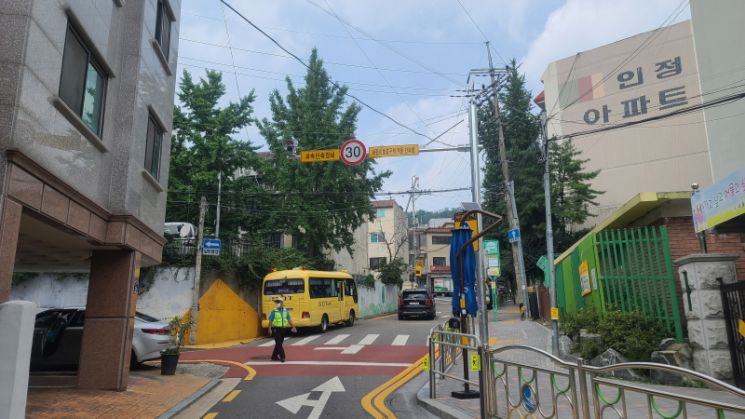
Dongjak-gu (Mayor Lee Chang-woo) announced on the 25th that it will expand the installation of unmanned traffic enforcement equipment in school zones to prevent child traffic accidents.
The district has designated 73 child and elderly protection zones and has been working on improving traffic facilities to create a safe walking environment for vulnerable road users.
Last year, unmanned traffic enforcement equipment was first installed in 19 locations with high school commuting pedestrian traffic and long downhill sections, including in front of Sinnamseong Elementary School.
The installation of unmanned traffic enforcement equipment in school zones was mandated following the enforcement of the “Min-sik Act” in March 2020. The district, together with Seoul City and the Seoul Metropolitan Police Agency, conducted field surveys and finalized additional installation sites for this year.
This year, the district will invest 270 million KRW to install additional signal and speed enforcement equipment and speed cameras in eight school zones. The main new locations are ▲Noryangjin Elementary ▲Gangnam Elementary ▲Haengnim Elementary ▲Singil Elementary ▲Boramae Elementary ▲Sinsangdo Elementary ▲Daerim Elementary ▲and in front of Isu Daycare Center.
Lee Hyun-jae, Director of the Traffic Administration Division, said, “We will do our best to create a safe walking environment aiming for zero traffic accidents in vulnerable road user zones,” and requested, “Please comply with the speed limits and signals in school zones.”
Meanwhile, the district has previously gained public approval by implementing customized traffic solutions incorporating smart technologies such as ▲solar-powered LED traffic safety signs, ▲smart intersection indicators that guide vehicle entry status with lights, and ▲LED ground traffic signals.
As a result, vehicle speeds during school start and end times around major elementary schools decreased by an average of 10%, and vehicle entry volume dropped by about 40%, securing visibility and safety for both pedestrians and drivers.
The district plans to expand the installation of unmanned traffic enforcement equipment and other facilities focusing on vulnerable traffic safety areas such as school zones and locations with frequent traffic accidents by analyzing the effects of the installed traffic safety equipment in the future.
© The Asia Business Daily(www.asiae.co.kr). All rights reserved.
![User Who Sold Erroneously Deposited Bitcoins to Repay Debt and Fund Entertainment... What Did the Supreme Court Decide in 2021? [Legal Issue Check]](https://cwcontent.asiae.co.kr/asiaresize/183/2026020910431234020_1770601391.png)

















