Solar Power Generation Expanded 10 Times Compared to Before
30 Billion Euros Invested in Future Industries Like Semiconductors
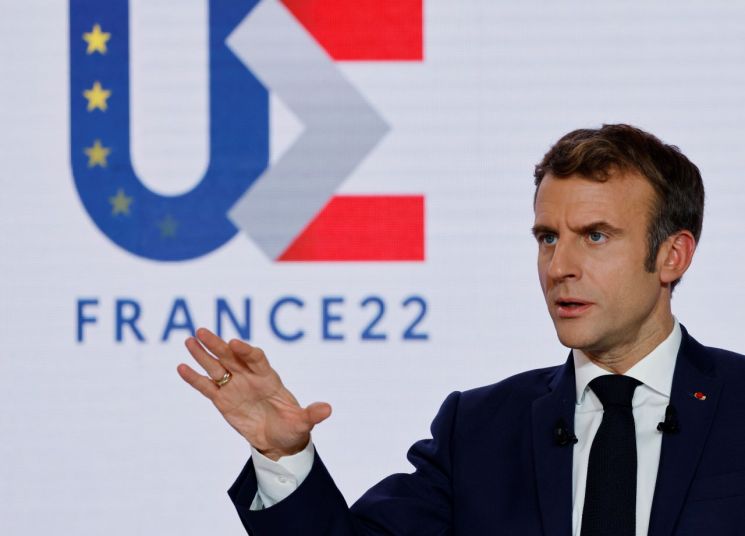
[Asia Economy Reporter Kim Jin-ho] On the 24th (local time), in the runoff of the French presidential election, President Emmanuel Macron succeeded in his re-election, raising expectations that the future French government will further strengthen eco-friendly policies and focus on fostering future strategic industries such as semiconductors and batteries.
On the 25th, KOTRA distributed related reference materials stating that during the presidential campaign, President Macron pledged to place environmental policy as the top national priority by having the Prime Minister directly responsible for mid- to long-term environmental policies and establishing a ministerial position to assist in this effort.
The Macron administration plans to increase the production of eco-friendly vehicles such as hybrid and electric cars to 2 million units by 2030 to achieve carbon neutrality by 2050, and also expand investments in renewable energy. By 2050, solar power generation capacity is expected to increase tenfold, and more than 50 offshore wind power plants are anticipated to be constructed.
The most notable aspect is the "nuclear power U-turn." President Macron, who had previously declared a phase-out of nuclear power, recently stated that an appropriate energy mix between nuclear power and renewable energy is necessary to simultaneously achieve energy independence and address climate change. The Macron administration plans to build up to 14 nuclear reactors, including six next-generation European Pressurized Reactors (EPR 2), by 2050. France currently operates 56 nuclear reactors, the second most after the United States (93 reactors).
Macron also plans to invest 30 billion euros in future industries such as semiconductors, biotechnology, energy, and aerospace to develop them as national strategic industries. A key focus for Macron in fostering future industries is reducing overseas dependence and strengthening domestic supply chains within the EU.
To this end, a roadmap for nurturing the regional semiconductor industry will be established with an investment of 6 billion dollars, and active support will be provided for the reshoring of major companies in the medical sector.
Additionally, President Macron plans to accelerate digital transformation policies such as digitizing administrative systems and expanding fiber optic cable distribution, while strengthening pro-business policies including the abolition of the Corporate Value Added Tax (CVAE), one of the taxes imposed on companies, and simplifying the tax payment system.
Kim Tae-ho, Director of KOTRA’s Economic and Trade Cooperation Headquarters, stated, “In Macron’s second term, existing policy directions such as eco-friendliness will be realized through more concrete projects, and investments in future strategic industries like semiconductors and biotechnology will be strengthened. We will actively support the entry of our companies into the French market and cooperation with local companies, focusing on promising sectors.”
© The Asia Business Daily(www.asiae.co.kr). All rights reserved.

















