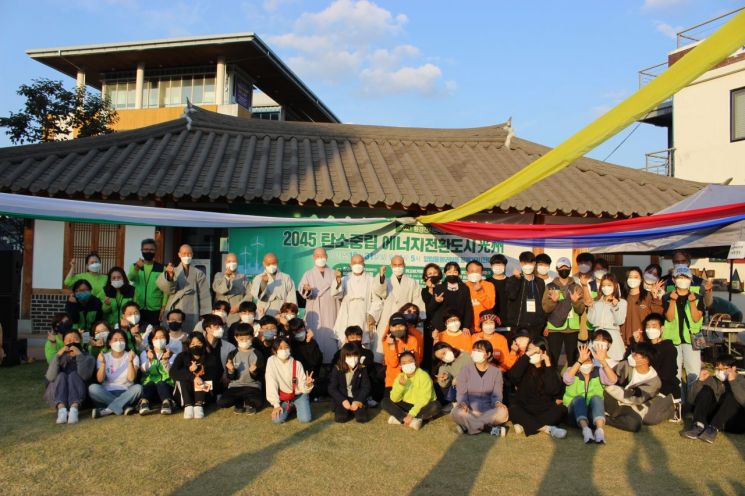
[Asia Economy Honam Reporting Headquarters Reporter Park Jin-hyung] Nam-gu, Gwangju, has been selected for the second consecutive year as the only local government in Gwangju and Jeonnam in the Korea Energy Agency’s “2022 Renewable Energy Regional Expansion Private Organization Cooperation Project” contest, and will embark on creating an energy self-sufficient city and discovering renewable energy distribution models.
On the 25th, Nam-gu announced, “In collaboration with the Gwangju Jeonnam Buddhist Environmental Solidarity, we will invest 50 million KRW in national funds this year to actively promote various projects such as training renewable energy counselors for the creation of an energy self-sufficient city and a field tour program of the Yangrim Energy Transition Village.”
The Renewable Energy Regional Expansion Private Organization Cooperation Project is a project aimed at achieving carbon neutrality goals through cooperation with local communities to improve energy efficiency, save energy, and produce new and renewable energy.
In Nam-gu’s case, it was selected for this project contest last year and established a renewable energy cafe and workshop on the third floor of the Gwangju Jeonnam Buddhist Environmental Solidarity building located in Penguin Village, Yangrim-dong. This year, based on last year’s project achievements, it plans to train 30 energy counselors to expand renewable energy in the region.
Along with this, experiential programs will be operated to improve and spread awareness of renewable energy.
First, until November, the renewable energy workshop plans to offer experiential programs such as making energy-saving kits and solar power promotional models for kindergartens, elementary school students, and residents in the district.
Also, the “Yangrim Energy Transition Village Field Tour,” which starts from the renewable energy workshop and continues to the Yangrim Energy Transition Village Hub Center, Penguin Village Energy Cafe, Zero Waste Shop, and Renewable Energy Education Center, will be actively operated.
Furthermore, from May to November, renewable energy talk concerts exploring how to expand the village’s renewable energy will be held frequently, and in October, a village energy cultural festival is also expected to be held.
In addition, with the establishment of the Namu Forest Solar Power Cooperative in March this year for developing customized renewable energy distribution models, a project to install power generation facilities by leasing idle land such as shared property, industrial complexes, and schools through resident cooperative member investments is expected to be actively promoted.
A Nam-gu official stated, “We will lay the foundation for an energy self-sufficient city and a carbon-neutral city, and in the long term, realize social value creation by supporting energy-vulnerable groups with part of the profits obtained through renewable energy.”
© The Asia Business Daily(www.asiae.co.kr). All rights reserved.

















